
Introduction
The artistic landscape of the Low Countries during the Northern Renaissance was defined by a profound shift in how humanity perceived the world. Emerging from the prosperous urban centers of what is now Belgium, these painters moved away from the stylized abstractions of the Middle Ages to embrace a revolutionary new medium: oil paint. This technical breakthrough allowed for an unprecedented level of precision, enabling artists to capture the subtle glint of light on a gemstone, the intricate texture of heavy velvet, and the microscopic details of the natural world with astonishing clarity.
During this era, the cultural heart of the region flourished through a unique blend of intense religious devotion and a burgeoning interest in secular life. The painters of this movement were masters of the ars nova, utilizing translucent layers of oil to create depth and luminosity that had never been seen before. Their works served as windows into both the divine and the mundane, blending profound spiritual symbolism with a meticulous, almost scientific observation of human emotion and landscape.
Today, these masters remain vital because they laid the foundation for Western realism. Their ability to translate the complexities of light and shadow continues to influence how we perceive visual truth, bridging the gap between the symbolic and the tangible. By examining the legacies of figures such as Pieter Bruegel the Younger and Quinten Metsys, we gain insight into a pivotal moment when art first learned to breathe with the life it sought to depict. The following selection explores ten essential painters who defined this golden age of Flemish and Belgian mastery.
Joachim Patenier
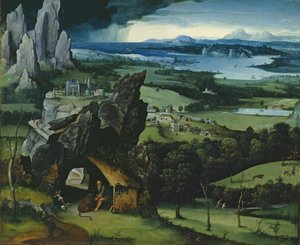 Landscape with St Jerome - Joachim Patenier
A pivotal figure in the transition of Netherlandish art, Joachim Patenier represents the shift from the meticulous, enclosed compositions of the previous generation toward the expansive vistas of the Northern Renaissance. Born around 1480 in the region of Dinant or Bouvignes, Patenier eventually established himself in Antwerp, becoming a member of the prestigious Guild of Saint Luke in 1515. While his predecessors focused on the sharp precision of textures and figures, Patenier redirected the artistic gaze toward the horizon, effectively pioneering the "world landscape" style.
His work is characterized by a profound mastery of atmospheric perspective, using soft gradations of color to simulate the way light and moisture blur distant peaks into a hazy blue. This technique allowed him to create a sense of immense scale, where the natural world is no longer a mere backdrop but the primary subject of contemplation. In his representative masterpiece, Landscape with St Jerome, the saint is rendered as a small, solitary figure dwarfed by a vast, rocky terrain. Through this approach, Patenier transformed the landscape into a space of both physical and spiritual weight, bridging the gap between the detailed realism of the Flemish tradition and the grand, panoramic visions of the Renaissance.
Pieter Bruegel The Younger
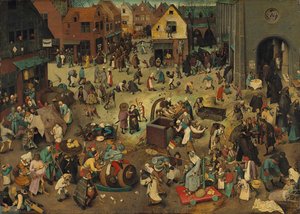 The Battle between Lent and Carnival - Pieter Bruegel The Younger
A central figure in the artistic dynasty of the Low Countries, Pieter Bruegel The Younger (1525–1569) was born in Brussels, cementing his place among the most significant Belgian Northern Renaissance painters. As the son of the legendary Pieter Bruegel the Elder and Mayken Coecke van Aelst, he inherited a profound mastery of the Northern Renaissance tradition, which emphasized astonishing detail and the use of oil to capture every minute reflection and texture. Rather than merely imitating his father, he became a strategic force in the Antwerp art market, managing a highly efficient workshop that disseminated the complex visual vocabulary of his lineage to a global audience.
His work is characterized by a meticulous attention to the human condition, often blending landscape with profound social commentary. In his representative work, The Battle between Lent and Carnival, he captures a bustling panorama of Flemish life. This piece serves as a masterful allegory, using the chaotic energy of village festivals to reflect on the tension between earthly indulgence and spiritual repentance. Through his ability to balance high-volume production with the intricate, layered glazing techniques of the era, he ensured that the stylistic hallmarks of the Northern Renaissance remained a dominant influence for generations.
Hugo van der Goes
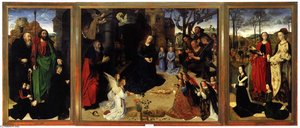
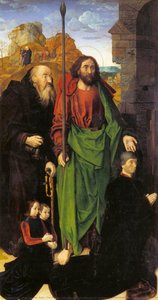 The Portinari Altarpiece, St. Thomas and St. Anthony the Hermit with Tommaso Portinari and two sons Antonio and Pigello, Left Wing - Hugo van der Goes
Born around 1440 in the vibrant artistic hub of Ghent, Hugo van der Goes stands as a pivotal figure among the Belgian Northern Renaissance painters. His work represents a transformative era where the technical mastery of oil paint was harnessed to achieve astonishing detail and profound psychological depth. Unlike the more decorative traditions that preceded him, Van der Goes introduced a startling sense of immediacy and emotional weight to his compositions, bridging the gap between the stylized forms of the past and a new, visceral realism.
His membership in the Ghent painters' guild in 1467 solidified his status as a master craftsman, yet his true legacy lies in his ability to convey complex inner states—such as awe and sorrow—through subtle gestures and the masterful manipulation of light and shadow. This innovative approach to human emotion and tangible reality allowed him to influence not only his Flemish contemporaries but also the burgeoning Italian Renaissance. His monumental style is perhaps most famously captured in the The Portinari Altarpiece, St. Thomas and St. Anthony the Hermit with Tommaso Portinari and two sons Antonio and Pigello, Left Wing, a work that exemplifies his triumph of realism and his ability to imbue religious scenes with an unprecedented, weighty presence.
Quinten Metsys
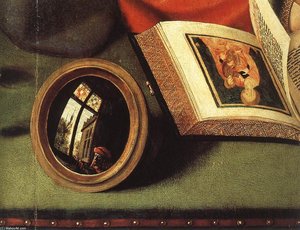 The Moneylender and his Wife (detail) - Quinten Metsys
A foundational figure of the Belgian Northern Renaissance, Quinten Metsys bridged the gap between the spiritual devotion of the Early Netherlandish tradition and the burgeoning humanism of the sixteenth century. Born in Leuven around 1466, his early training likely occurred under the guidance of Dirk Bouts, connecting him to a lineage of masters who prioritized absolute verisimilitude. Legend suggests that before mastering the brush, Metsys trained as an ironsmith—a tactile background that bestowed upon his later works a profound reverence for the physical world and the weight of material textures.
As the architect of the Antwerp School, Metsys moved beyond mere imitation of his predecessors to infuse his canvases with a new vitality and biting social commentary. This duality of technical precision and psychological depth is epitomized in The Moneylender and his Wife. In this work, his mastery of the Northern Renaissance style is evident through an almost microscopic attention to detail, from the gilt edges of an open book to the enigmatic reflections in a magnifying glass. Through such works, he transformed the meticulous observation of the Low Countries into a sophisticated exploration of the complexities of human existence.
Pieter Brueghel The Younger
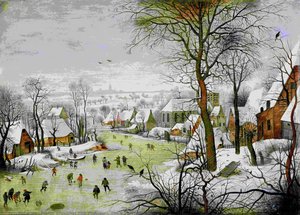 The Bird Trap - Pieter Brueghel The Younger
A central figure in the evolution of the Northern Renaissance in Belgium, Pieter Brueghel the Younger (1564–1638) carried forward a profound visual legacy. As the son of the legendary Pieter Bruegel the Elder, he was born into a lineage of immense artistic significance, nurtured by a family of skilled painters. His work is a testament to the Northern Renaissance's obsession with technical precision and the intricate details of the natural world. After relocating to the vibrant artistic hub of Antwerp, he refined his mastery of landscape and atmosphere under the guidance of Gillis van Coninxloo, eventually establishing one of the most prolific and influential workshops in European history.
His ability to blend meticulous observation with deep human empathy is vividly captured in The Bird Trap. In this evocative oil on panel, he depicts a frost-bitten, snowy landscape where the tranquility of winter village life is juxtaposed with a subtle, moralistic tension. Through his sophisticated use of light and muted wintry tones, he transforms a seasonal study into a meditative reflection on the fragility of existence, a hallmark of the Northern Renaissance tradition.
Joachim Beuckelaer
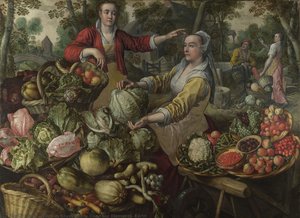 The Four Elements: Earth - Joachim Beuckelaer
A central figure in the evolution of Flemish genre painting, Joachim Beuckelaer (1533–1573) exemplifies the Northern Renaissance's obsession with technical precision and the profound symbolism hidden within the mundane. Born in Antwerp, Beuckelaer emerged from a lineage of skilled artists, training in the workshop of his uncle, Pieter Aertsen. His work represents a pivotal shift in the Northern Renaissance movement, as he moved beyond purely religious iconography to elevate the tangible realities of market life and domesticity into high art, effectively laying the groundwork for the independent still life genre.
His masterpiece, The Four Elements: Earth (1569), serves as a breathtaking testament to this stylistic transition. In this complex tableau, Beuckelaer utilizes a rich palette of phthalo greens and vibrant reds to depict a domestic interior overflowing with abundance. The composition balances a riot of fruits and vegetables with the presence of working women, transforming a simple kitchen scene into a reflective narrative. Through his meticulous attention to texture and light, Beuckelaer captures the earthy vitality of the 16th-century world, proving that even the most commonplace objects could carry deep, allegorical weight.
Petrus Christus
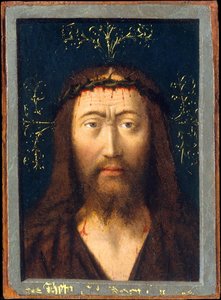 Head of Christ - Petrus Christus
A central figure in the artistic evolution of Bruges, Petrus Christus represents the sophisticated technical heights of the Belgian Northern Renaissance. Emerging as a leading master in the city following the death of Jan van Eyck, he did not merely inherit a legacy of luminous oil techniques; he transformed it through a profound mastery of linear perspective and psychological depth. His work bridges the gap between the meticulous detail of his predecessors and a new, more structured spatial awareness that defined the era.
His Head of Christ serves as a hauntingly beautiful testament to this transition. In this intimate panel, the artist moves beyond mere imitation to capture a visceral, melancholic essence of human suffering. Through the delicate application of oil, Christus renders the furrowed brow and the weight of the crown of thorns with a precision that feels almost tactile. The subtle play of light across the skin and the droplets of blood create a sense of profound devotion, marking him as a pivotal innovator among the Northern Renaissance painters from Belgium who sought to marry physical realism with deep spiritual resonance.
Frans Floris
 Venus at Vulcan's Forge - Frans Floris
Frans Floris stands as a monumental bridge in the history of Belgian Northern Renaissance painters, acting as the primary conduit between the meticulous traditions of the Low Countries and the grand, muscular language of the Italian High Renaissance. Born in Antwerp around 1519, Floris moved beyond the localized styles of his predecessors by embracing Romanism. Through the influence of mentors like Lambert Lombard, he synthesized the Flemish obsession with detail with the anatomical dynamism of masters such as Michelangelo. This unique fusion allowed him to elevate Northern art toward a more humanist, epic scale, making him a defining figure of this era.
His mastery of this synthesis is vividly realized in Venus at Vulcan's Forge (1560). In this dramatic composition, the goddess of love is immersed in the smoky, industrial atmosphere of a smithy. The work exemplifies the Romanist influence through its heavy, anatomical weight and the rhythmic, muscular movement of the figures. While the precision of the limbs and the play of light on steel reflect his Flemish heritage, the epic scale and dramatic tension are purely Renaissance, capturing a moment where the divine meets the physical strain of human labor.
Pieter Coecke van Aelst
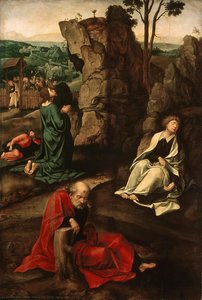 Agony in the Garden - Pieter Coecke van Aelst
In the somber, shadowed depths of the Garden of Gethsemane, a profound spiritual drama unfolds within Pieter Coecke van Aelst’s 1527 masterpiece, Agony in the Garden. This extraordinary work, rendered as a monumental tapestry, captures the heavy, breathless moment of Christ's contemplation before his betrayal. The scene is not merely a historical recount of scripture but an intimate window into the human soul facing its greatest trial, held together by a masterful command of light and shadow.
As a quintessential figure of the Northern Renaissance, Coecke van Aelst bridged the gap between the meticulous realism of the Flemish tradition and the idealized grace of the Italian High Renaissance. Born in Belgium in 1502, he was a true polymath—an architect, designer, and painter who absorbed the principles of proportion and harmony through his exposure to classical forms. His ability to infuse religious narratives with both anatomical accuracy and atmospheric tension defines the era's aesthetic. Whether through his intricate tapestries or his religious panels, his work reflects a sophisticated synthesis of Northern precision and Mediterranean elegance, making him a pivotal force in the evolution of Belgian art.
Jan Sanders van Hemessen
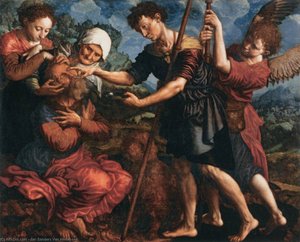 Tobias Restores his Father's Sight - Jan Sanders van Hemessen
A pivotal figure in the evolution of the Flemish Renaissance, Jan Sanders van Hemessen (c. 1500–1566) bridged the gap between the meticulous detail of the North and the monumental grace of the South. Born in Hemiksem, Belgium, his artistic identity was forged through a rigorous apprenticeship under Hendrick van Cleve I in Antwerp. This foundation allowed him to become a key representative of the Belgian Northern Renaissance, as he successfully integrated the stylistic innovations of the Italian masters with the profound moralizing traditions of his homeland.
His travels through Florence and Rome, alongside his exposure to the burgeoning Mannerist aesthetics at the Palace of Fontainebleau, fundamentally altered his visual language. This synthesis is masterfully realized in his 1555 work, Tobias Restores his Father's Sight. In this composition, van Hemessen demonstrates a virtuosic command of light and shadow to sculpt human forms, imbuing the biblical narrative with a visceral, tactile presence. By blending the sculptural weight of the Romanist school with the intricate textures of Flemish genre painting, he anticipated the complexities of Mannerism, ensuring his place as a transformative force in the history of Belgian art.
Conclusion
The legacy of these masters lies in their ability to marry profound human emotion with a technical precision that seems almost supernatural. From the intricate, microscopic details of Petrus Christus to the sprawling, allegorical landscapes of Pieter Bruegel The Younger, these artists transformed the Northern Renaissance into a celebration of both the divine and the everyday. Whether through the atmospheric depth of a mountain vista or the tactile realism of a domestic scene, each painter contributed a unique layer to a visual language that redefined how we perceive light, texture, and the human condition.
At Mus3ums.com, we invite you to bring this era of unparalleled craftsmanship into your own living space. Our dedicated artists specialize in recreating these historical masterpieces as museum-quality, hand-painted oil reproductions on 100% cotton canvas, ensuring that the soul of the original—from the delicate brushstrokes to the rich tonal range—is preserved for your enjoyment. Explore our full collection and choose a piece of history to live with forever.


