Introduction
Emerging from the refined salons of eighteenth-century France, the Rococo movement marked a departure from the heavy, formal grandeur of the Baroque era. As the rigid etiquette of the court at Versailles softened, art shifted toward the intimate, the playful, and the exquisitely decorative. These painters moved away from the monumental public halls to create works specifically designed for the private boudoirs and elegant townhouses of the aristocracy, favoring a palette of soft pastels, shimmering light, and themes of leisure, romance, and pastoral beauty.
This era was defined by a sense of joie de vivre, where the brushwork became more fluid and the compositions more asymmetrical and organic. The movement captured a world of sophisticated escapism, often depicting mythological allegories or scenes of aristocratic courtship set within lush, dreamlike landscapes. It was a period of unparalleled elegance, where the boundaries between fine art and decorative design often blurred to create a cohesive aesthetic of grace and movement.
Today, these masters remain vital to our understanding of Western art history, having perfected a visual language of light and texture that continues to influence color theory and composition. Their ability to evoke emotion through subtle tonal shifts and delicate brushwork allows their works to transcend their original era, offering a timeless sense of charm and refinement. The following selection explores ten essential figures of this movement, from the poetic dreamscapes of Watteau to the spirited, luminous compositions of Fragonard, tracing the evolution of a style that defined an age of elegance.
Jean-Antoine Watteau
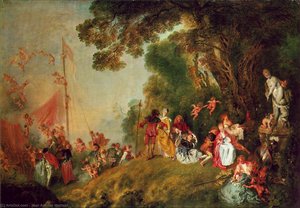
Born in Valenciennes in 1684, Jean-Antoine Watteau laid the foundation for the Rococo movement by shifting the focus of French art toward intimacy and refined emotion. His early training under Jacques-Albert Gérin and subsequent move to Paris in 1702 allowed him to absorb the nuances of Flemish and Dutch genre traditions. This period of imitation in a Pont Notre-Dame workshop was pivotal, helping him develop the loose, sketchlike brushwork that would become his signature.
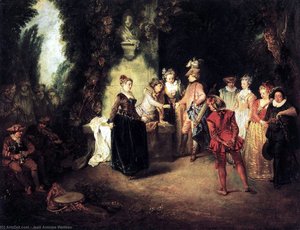
Watteau is a cornerstone of French Rococo painters primarily due to his invention of the fête galante. This genre, which depicts elegant, dreamlike outdoor gatherings, perfectly captured the era's shift toward themes of leisure and playful romance. His ability to blend reality with a sense of theatrical artifice allowed him to move away from the heavy grandeur of the previous age toward a more delicate, pastel-toned aesthetic.
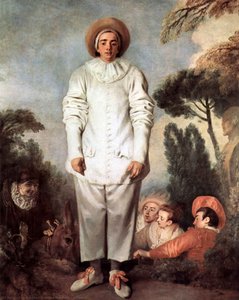
His masterpiece, Gilles (1719), exemplifies this transition. Through the figure of Pierrot, Watteau explores a sense of wistful contemplation and atmospheric depth. The work showcases his technical mastery of oil on canvas, using soft tonal gradations to create a luminous, emotive world that defines the very essence of the Rococo spirit.
Jean-Baptiste-Siméon Chardin
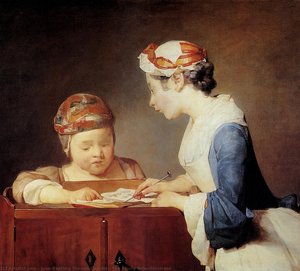 The Young Schoolmistress - Jean-Baptiste-Siméon Chardin
While many of his contemporaries embraced the flamboyant and mythological excesses of the era, Jean-Baptiste-Siméon Chardin carved a unique niche within the French Rococo movement by focusing on the quietude of the domestic sphere. Born in Paris in 1699 into a cabinetmaker’s household, his early exposure to the tactile properties of craftsmanship deeply informed his profound sensitivity to texture and form. After training under history painters Pierre-Jacques Cazes and Noël-Nicolas Coypel, Chardin moved away from grand narratives to find beauty in the tangible and the mundane, a hallmark of the Rococo interest in private, intimate life.
His mastery of still life and genre scenes allowed him to elevate everyday objects and domestic scenes to a level of serious study. In his 1740 masterpiece, The Young Schoolmistress, he demonstrates this exceptional ability through a tender, intimate moment between a girl and a caregiver. Using fine brushwork and layered glazes, Chardin achieves a luminous realism and a subdued, naturalistic color palette that emphasizes the warmth of human connection. His disciplined approach and technical rigor earned him significant recognition, including a royal pension from Louis XV, cementing his legacy as a master of serene, reflective art.
Jean-Honoré Fragonard
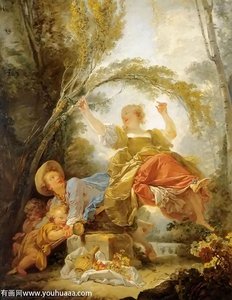 The Swing - Jean-Honoré Fragonard
Jean-Honoré Fragonard stands as a quintessential figure of the French Rococo movement, embodying the era's shift toward intimacy, playfulness, and the pursuit of pleasure. His work is instantly recognizable through a sense of exuberant movement and a soft, luminous palette that favors pastel pinks, creams, and golds. Unlike the heavy, formal compositions of the previous age, Fragonard’s brushwork is fluid and energetic, utilizing loose, expressive strokes to create an atmosphere of airy lightness and spontaneous joy.
His mastery of the Rococo aesthetic is perhaps most famously captured in his iconic work, The Swing. In this composition, he depicts a moment of aristocratic leisure, where a young woman in a shimmering, lace-trimmed dress is tossed into the air, her shoe flying upward in a gesture of carefree abandon. The scene is set within a lush, verdant garden, where light and shadow dance through the foliage to create a sense of theatricality and secret romance. This ability to blend technical precision with a sense of whimsical, sensual delight is what defines his contribution to the French Rococo tradition.
François Boucher
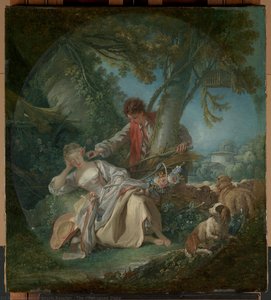 The Interrupted Sleep - François Boucher
A central figure of the French Rococo movement, François Boucher (1703–1770) epitomized the era's shift toward lightheartedness, sensuality, and pastel elegance. Born into a family of lace designers, his early exposure to intricate patterns informed a career defined by decorative grace. After training under François Lemoyne and mastering the precision of engraving with Jean-François Cars, his trajectory was forever altered by winning the prestigious Grand Prix de Rome in 1720. This triumph allowed him to study at the French Academy in Rome, where classical influences merged with his burgeoning talent for the playful, idyllic scenes that would define the Rococo aesthetic.
Boucher’s mastery of color and composition is vividly captured in The Interrupted Sleep (1750). This oil on canvas, currently housed at The Metropolitan Museum of Art, exemplifies the pastoral themes and romantic atmosphere favored by the French aristocracy, including Madame de Pompadour. Through his ability to organize complex scenes around soft, intersecting diagonals and a lush, natural palette, Boucher moved art away from the heavy grandeur of the Baroque toward a more intimate, spirited style. His influence was profound, shaping the visual language of the 18th century and inspiring successors like Jean-Honoré Fragonard.
Charles-André van Loo
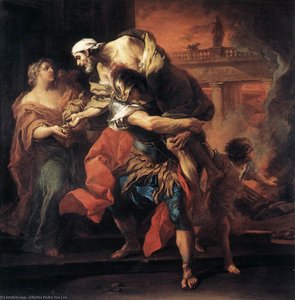 Aeneas Carrying Anchises - Charles-André van Loo
Charles-André van Loo stands as a quintessential figure of the French Rococo movement, embodying the era's transition from classical gravity to the refined elegance of the 18th-century court. Born in Nice in 1705 into a distinguished dynasty of painters, his journey through the Académie royale and his studies in Rome under masters like Benedetto Luti shaped a style defined by grace and ornate sophistication. His ascent to the position of First Painter to King Louis XV in 1762 underscores his central role in defining the visual language of the French aristocracy, a period characterized by playful leisure and mythological splendor.
In his 1729 work, Aeneas Carrying Anchises, we see the early mastery of this Rococo sensibility. While the subject matter draws from the epic weight of Virgil, Van Loo treats the scene with a rhythmic, graceful composition and an exquisite attention to texture that anticipates the movement's decorative peak. Through a sophisticated use of light and atmospheric perspective, he transforms a moment of Trojan heroism into a polished, theatrical spectacle. His ability to balance dramatic narrative with the shimmering, luxurious detail required by his royal patrons makes him a definitive voice in the history of French art.
Jean-Baptiste Greuze
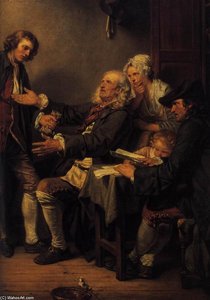 L'Accordée de Village (detail) - Jean-Baptiste Greuze
Jean-Baptiste Greuze (1725–1805) stands as a pivotal figure within the French Rococo movement, specifically through his mastery of the sentimental genre scene. While many of his contemporaries focused on the grandiosity of mythology, Greuze pivoted toward the intimate and the domestic, capturing the burgeoning emotional sensibilities of the eighteenth century. His work reflects the Rococo era's shift toward private, leisure-oriented subjects, yet he infused these scenes with a profound moral weight and a sense of bourgeois virtue that resonated deeply with the French public.
His talent was nurtured under the guidance of Grandon and later refined at the prestigious Royal Academy in Paris under Charles-Joseph Natoire. This academic foundation allowed him to elevate everyday life into high art, moving away from rigid historical narratives toward the nuanced complexities of human feeling. In his representative work, L'Accordée de Village (1761), Greuze demonstrates this exquisite ability to orchestrate subtle social interactions. The painting serves as a masterclass in capturing unspoken anxieties and nascent affection, utilizing soft, diffused light to create an atmosphere of quiet contemplation. Through such works, Greuze transformed the Rococo's playful lightness into a profound exploration of sentiment and family life.
Jean-Marc Nattier
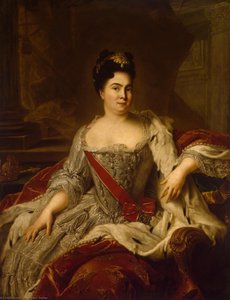 Portrait of Catherine I - Jean-Marc Nattier
Born into a lineage of artists in 1685, Jean-Marc Nattier emerged as a defining figure of the French Rococo movement through his ability to blend aristocratic reality with mythological fantasy. Eschewing the traditional path to the French Academy in Rome, Nattier remained in Paris, where he developed a highly specialized style that became the visual language of the court of Louis XV. He is celebrated for his mastery of the allegorical portrait, a technique that epitomizes the Rococo desire for playfulness and idealized beauty.
Nattier’s work often transformed his sitters into ethereal deities, draping them in classical silks and setting them within dreamlike landscapes. His Portrait of Catherine I (1717) serves as a profound example of this courtly elegance. In this work, the subject is rendered with a regal dignity, her crimson gown and intricate lace showcasing the lavish textures and shimmering light characteristic of the era. By merging the status of the sitter with the grace of mythological figures, Nattier captured the very essence of Rococo refinement, making him the preeminent painter of aristocratic dreams.
Nicolas Lancret
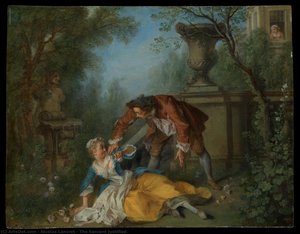 The Servant Justified - Nicolas Lancret
A visitor can immediately recognize a work by Nicolas Lancret through his spirited and lighthearted depictions of Parisian social life. His canvases are characterized by a sense of movement and conviviality, often capturing the essence of 18th-century leisure through soft, pastel-infused palettes and a brushwork that emphasizes the grace of human gesture. As a quintessential figure of the French Rococo movement, Lancret moved away from the heavy grandeur of the previous era to embrace the playful, intimate atmosphere of the Regency and the early reign of Louis XV. His style is deeply rooted in the lineage of the fêtes galantes, having been profoundly shaped by the influence of Antoine Watteau and the teachings of Jean-Baptiste Gillot.
His mastery of genre scenes is brilliantly exemplified in The Servant Justified, a work that captures a moment of social intrigue and wit. Whether portraying the elegance of a fashionable lady or the lively energy of a village wedding, Lancret’s art serves as a window into the social mores and charming frivolity of his time. His ability to transform everyday social gatherings into scenes of rhythmic elegance ensures his place as a vital voice in the Rococo tradition.
Antoine Pesne
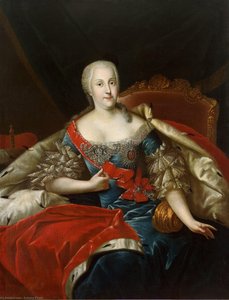 Portrait of Johanna Elisabeth, Princess of Anhalt-Zerbst - Antoine Pesne
Antoine Pesne (1683–1757) stands as a vital transitional figure in the evolution of French art, serving as a bridge between the heavy grandeur of the Baroque and the light, elegant sensibilities of the Rococo. Born into a family of artists in Paris, his early training under his father and uncle provided a rigorous foundation that he later refined through a prestigious stipend from the Académie Royale. This academic grounding, combined with his formative years in Italy, allowed him to master a refined aesthetic that would eventually define the courtly portraiture of the 18th century.
Pesne’s inclusion in the Rococo movement is evidenced by his ability to soften the formal rigidity of traditional portraiture with a newfound grace and delicate texture. His 1746 work, Portrait of Johanna Elisabeth, Princess of Anhalt-Zerbst, exemplifies this shift. In this piece, he moves beyond mere likeness to capture a sense of poised, reflective elegance. Through a masterful command of light and shadow, he renders the shimmering silks and rich velvets of aristocratic attire with a tactile sensitivity that characterizes the Rococo's focus on luxury and refined beauty. His influence extended far beyond Paris, as his appointment to the Prussian court helped disseminate this sophisticated French style across Europe.
Jean-Baptiste Pater
 The Fortune Teller - Jean-Baptiste Pater
Jean-Baptiste Pater (1695–1736) holds a singular position within the French Rococo movement as the only documented pupil of Antoine Watteau. This lineage allowed him to inherit and refine the fête galante tradition, a genre characterized by its focus on the elegant leisure and social rituals of the aristocracy. His work epitomizes the Rococo aesthetic through a preference for soft, pastel palettes and a sense of whimsical, atmospheric charm that favors grace over monumentalism.
In his representative work, The Fortune Teller, Pater’s mastery of this style is vividly apparent. The painting captures a sun-drenched, lush landscape that serves as a stage for social intimacy and refined merriment. Rather than static portraiture, the composition feels like a captured moment of courtship and intrigue, blurring the lines between reality and enchantment. Through delicate, shimmering lines and a sophisticated arrangement of figures, Pater evokes the very essence of the Rococo spirit—a celebration of sensual pleasure and the lighthearted elegance of 18th-century French life.
Conclusion
The legacy of these masters lies in their ability to transform the canvas into a realm of grace, intimacy, and sensory delight. From the poetic, melancholic gatherings of Watteau to the exuberant, swirling passions of Fragonard, these artists collectively shifted the focus of art from the grandiosity of the state to the refined pleasures of the private sphere. Whether through the delicate textures of a Chardin still life or the luminous, mythological elegance of Nattier, the French Rococo movement redefined the visual language of leisure and light.
For collectors and enthusiasts looking to bring this era of elegance into their own spaces, Mus3ums.com offers a way to experience these masterpieces firsthand. Our artisans specialize in creating museum-quality, hand-painted oil reproductions that capture the authentic brushwork and pastel luminosity of these historic works. You can explore our full collection to find the perfect piece and invite the timeless charm of the Rococo era into your home through our bespoke, handmade artistry.