
Introduction
The 1810s in the United States marked a pivotal era of visual identity, as a young nation sought to define its own aesthetic amidst the shifting tides of the post-Revolutionary period. This decade saw a fascinating convergence of European traditions and a burgeoning American spirit, where the formal elegance of Neoclassicism began to meet the intimate, character-driven nuances of early American portraiture. It was a time when the canvas became a tool for documenting the faces of a new republic and the evolving landscapes of a growing territory.
During this period, artists such as Gilbert Stuart and John Trumbull were instrumental in shaping the visual lexicon of the American elite, capturing the likenesses of statesmen and the gravity of historical moments with a sophisticated sense of light and dignity. While portraiture remained the dominant genre, the decade also laid the groundwork for more diverse explorations of light and atmosphere, as painters moved between the structured compositions of the Old World and a more distinct, localized sensibility. These works are not merely relics of a bygone era; they serve as vital windows into the social hierarchies, the psychological depth of the early American character, and the artistic maturation of a continent.
As we journey through this collection, we will encounter ten significant works that exemplify the technical mastery and the stylistic transitions of the 1810s. From the refined brushwork of celebrated portraitists to the early explorations of landscape and genre, these pieces offer a profound glimpse into the artistic soul of a nation in its formative years.
Declaration of Independence - John Trumbull
 Declaration of Independence - John Trumbull
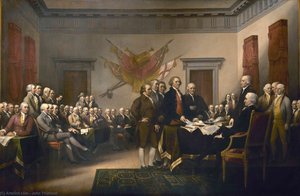
Completed in 1817, John Trumbull’s Declaration of Independence stands as a monumental testament to the birth of a nation. As a seminal work from the 1810s, this oil on canvas captures the solemnity of the Second Continental Congress, transforming a historical event into a profound study of character and conviction. Trumbull, renowned for his ability to document the American Revolution, meticulously recreates the atmosphere of Independence Hall, where the weight of responsibility is palpable among the gathered delegates.
The composition features thirteen luminaries, including Benjamin Franklin and Thomas Jefferson, positioned within a space defined by a dramatic interplay of light and shadow. Through a masterful use of chiaroscuro, Trumbull sculpts the figures and the architectural environment, bathing the scene in a warm, reflective glow. A prominent book rests upon the central mahogany table, serving as a silent symbol of the foundational principles of law and liberty. The painting does not merely record a ceremony; it captures the emotional gravity and the intellectual fervor of the men who shaped the American identity during this transformative decade.
The Court of Death - Rembrandt Peale
 The Court of Death - Rembrandt Peale
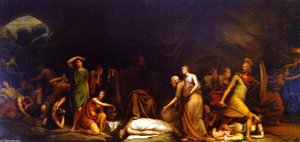
Upon encountering The Court of Death, the viewer is immediately pulled into a cavernous, dimly lit setting that feels both claustrophobic and profoundly theatrical. The eye is drawn to the center of this somber assembly, where a stern, cloaked figure presiding over a court of souls sits amidst a crowd of twenty-two figures. Rendered in a palette of deep browns, blacks, and rich reds, the scene captures a dramatic moment of judgment. Figures representing various vices and the physical decays of the body are depicted with chilling realism, creating a visual sermon on the inevitability of mortality.
This monumental work belongs to the 1810s as it represents a pivotal moment in the development of American Neoclassical art. Painted by Rembrandt Peale, a prominent American portraitist, the piece reflects the era's fascination with allegorical themes and moral instruction. Peale’s meticulous draftsmanship and his ability to translate complex poetic themes into large-scale visual narratives exemplify the high academic standards of American art during this decade, bridging the gap between classical European traditions and a burgeoning national identity.
Henry Rice - Gilbert Stuart
 Henry Rice - Gilbert Stuart
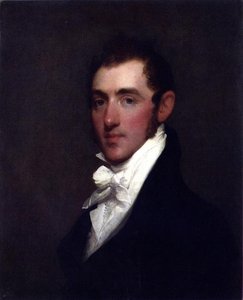
Created in 1815, Henry Rice stands as a quintessential example of American portraiture from the 1810s, a decade where the nation's visual identity was being shaped by masters of the Neoclassical style. This work by Gilbert Stuart captures Newton Henry Rice with a profound sense of formal dignity and reflective intensity. Stuart, renowned for his ability to render luminous, transparent flesh and his iconic depictions of George Washington, utilizes this portrait to showcase his mastery of chiaroscuro.
The composition is characterized by a dramatic interplay of light and shadow that sculpts the subject's features, emphasizing a steady, captivating gaze. Rice is presented with meticulous detail, from his neatly combed hair to his well-defined beard and mustache, projecting an aura of prominence. In the background, the presence of receding figures adds a layered complexity to the scene, hinting at a broader social narrative and the interconnectedness of the era's elite. Through this sophisticated use of light and depth, Stuart transforms a likeness into a powerful study of character and historical presence.
Erastus Torrey - Samuel Finley Breese Morse
 Erastus Torrey - Samuel Finley Breese Morse
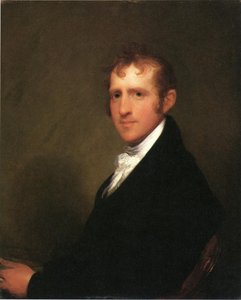
Painted in 1816, Erastus Torrey serves as a profound example of American portraiture from the 1810s, capturing the stoic essence of a man within a burgeoning republic. Samuel Finley Breese Morse, an artist celebrated for his ability to convey the spirit of early nineteenth-century life, utilizes this work to explore the intersection of individual character and social standing. The sitter is presented in a posture of quiet gravity, with hands clasped in a manner that suggests both composure and solemnity.
The composition is a masterful study in the Romantic movement's approach to light and shadow. By employing a controlled application of oil on canvas, Morse creates a sense of tangible texture in the subject's formal attire while allowing the background—comprising a hint of a richly upholstered chair and a bench—to recede into a soft, slightly blurred depth. This technique ensures the viewer's gaze remains fixed upon the sitter's countenance. Through this deliberate use of chiaroscuro and a somber, formal palette, the painting transcends mere likeness, offering a window into the dignified visual language of status and respectability prevalent in the United States during this decade.
Mother and Child - Winslow Homer
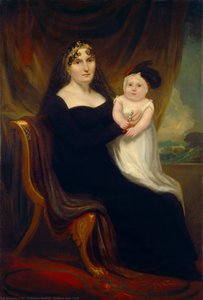 Mother and Child - Winslow Homer
Winslow Homer’s 1810 work, Mother and Child, serves as a profound testament to the domestic intimacy and emotional vulnerability that characterized much of the American artistic output during the 1810s. This piece captures a tender, quiet moment of maternal devotion, centering on a woman seated in a dark, elegant gown as she cradles her infant. The composition is deeply focused on the connection between mother and child, utilizing a soft, illuminating light that highlights the subjects against a somber, black-toned palette. This use of chiaroscuro-like lighting creates a serene and romantic atmosphere, drawing the viewer into a private, sacred space of nurturing.
The scene is not entirely solitary; the presence of figures in the periphery—one standing behind the mother and another partially visible to the side—suggests a larger domestic narrative or a communal observation of this life milestone. Through this depiction of motherhood and domesticity, Homer moves beyond mere portraiture to explore the universal themes of protection and vulnerability, grounding the 1810s American experience in the profound simplicity of human connection.
Portrait of William Young - James Peale
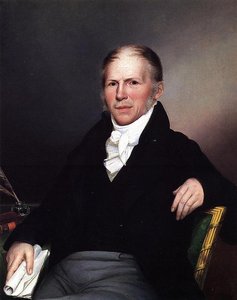 Portrait of William Young - James Peale
Upon first glance, the eye is drawn to the dignified gaze of William Young, whose presence dominates the frame with a sense of quiet prestige. Seated in a composed posture, the subject is positioned against a dark, indistinct background that pushes his figure forward, creating an intimate connection with the viewer. To his side, a table holding papers and writing implements offers a subtle glimpse into his professional life, suggesting a man of intellect and standing. This 1817 work is a quintessential example of American art from the 1810s, reflecting the era's focus on capturing realistic likenesses and the social status of the burgeoning American professional class.
James Peale employs a sophisticated, muted palette to achieve a sense of timelessness. The crisp white of the collar and shirt provides a luminous contrast against the deep black of the vest and trousers, while soft, diffused lighting bathes the face in a gentle glow. Through meticulous oil painting techniques, Peale renders a variety of textures—from the smooth, fine fabric of the shirt to the subtle, organic tones of the skin. The composition is anchored by strong geometric lines, yet the soft shading of the features lends the portrait a reflective and lifelike quality.
William II (1792–1849), King of Holland, When Prince of Orange - John Singleton Copley
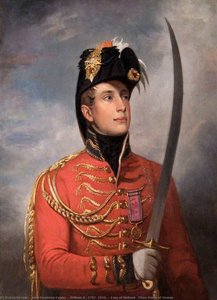 William II (1792–1849), King of Holland, When Prince of Orange - John Singleton Copley
In this 1813 portrait, the Anglo-American master John Singleton Copley captures William II at a pivotal historical juncture. As the Prince of Orange, the sitter is depicted during the Napoleonic era, a period of immense political upheaval. Copley utilizes a sophisticated layering of translucent glazes to achieve a profound sense of realism, a hallmark of his technical expertise. The subject is presented in the uniform of the Adjutant General’s Commission, holding a sword that signifies both military authority and his role as a commander-in-chief.
The work exemplifies the high standard of American-born portraiture during the 1810s through its neoclassical precision and meticulous attention to texture. Copley’s brushwork masterfully renders the tactile qualities of the red uniform and the metallic sheen of the sword, using a controlled interplay of light and shadow to create tangible volume. This portrait, currently housed in the Wellington Collection at Het Loo Palace, serves as a vital visual record of the House of Orange-Nassau, projecting an image of composure and regal stability amidst the shifting power dynamics of Europe.
Portrait of Judge Daniel Cony of Maine (1752-1842) - Gilbert Stuart
 Portrait of Judge Daniel Cony of Maine (1752-1842) - Gilbert Stuart
The viewer is immediately met by the steady, unwavering gaze of Judge Daniel Cony, a presence that commands the space through a masterful application of light and shadow. Painted in 1815, this oil portrait exemplifies the Neoclassical style prevalent in the United States during the 1810s, a period where portraiture served to solidify the dignity of the young nation's leadership. Stuart utilizes a three-quarter view to create depth, allowing directional light from the upper left to wash over the subject's silver hair and luminous skin while his black coat recedes into a somber, atmospheric darkness.
The composition is rich with the visual language of status and intellect. A crisp white cravat provides a sharp contrast to the muted, earthy tones of the background, while the presence of books in the lower corner serves as a silent testament to the subject's legal profession and scholarly life. Through smooth, deliberate brushwork, Stuart captures the fine textures of aging skin and heavy fabric, creating a lifelike representation that transcends mere likeness to capture a character of stability and wisdom. This work stands as a quintessential example of American academic portraiture from this formative decade."
Philip Van Cortlandt - Ezra Ames
 Philip Van Cortlandt - Ezra Ames
Painted in 1810, this portrait of Philip Van Cortlandt stands as a quintessential example of American Neoclassical portraiture from the 1810s. Ezra Ames, a prolific painter celebrated for his elegant characterizations of prominent figures, captures the subject in a dignified three-quarter view. The composition is defined by a somber and sophisticated palette, dominated by deep espresso tones, creamy whites, and warm flesh tones that emphasize the subject's status and stability.
The artwork utilizes directional lighting from the upper left to sculpt the contours of the face, creating a profound sense of three-dimensional depth against an indeterminate dark void. Ames demonstrates masterful control over the medium, using fine brushwork to render the tactile ruffles of a crisp white cravat and the subtle striped pattern of a waistcoat. A single folded document, marked by a small red seal, rests against the man's hand, serving as a quiet anchor that suggests a life of legal or landed responsibility. Through this interplay of organic human forms and structured geometry, Ames achieves a sense of intellectual engagement and quiet authority characteristic of the era.
Jedidiah Morse (1761-1826), B.A. 1783, M.A. 1786 - Samuel Finley Breese Morse
 Jedidiah Morse (1761-1826), B.A. 1783, M.A. 1786 - Samuel Finley Breese Morse
The viewer is immediately drawn to the quiet, scholarly stillness of the composition, where an elderly man sits in a three-quarter view, caught in a moment of profound intellectual labor. Positioned against a backdrop of rhythmic, geometric bookshelf spines and heavy, sculptural drapery, the subject leans forward with a quill in hand. The lighting, entering from the upper left, creates a masterful chiaroscuro effect, washing over his white hair and crisp cravat while casting the right side of his face into thoughtful shadow. This interplay of light and shadow emphasizes the tactile textures of his patterned silk robe and the matte surface of the paper before him.
Painted in 1810, this portrait by Samuel Finley Breese Morse serves as a quintessential example of American artworks of the 1810s. It captures the Neoclassical spirit of the era, focusing on the dignity of the individual and the intellectual traditions of the young republic. Through the depiction of Jedidiah Morse, a man of significant academic standing, Morse utilizes a warm, earthy palette of ochre, gold, and deep red to celebrate a life dedicated to literacy and the preservation of knowledge.
Conclusion
The artworks of this decade represent a pivotal era in American visual identity, capturing a nation in the midst of profound transformation. From the formal, dignified portraiture of Gilbert Stuart and Rembrandt Peale to the evolving landscapes and character studies of the period, these pieces collectively define the aesthetic foundations of a young republic. Each work contributes a unique layer to this historical tapestry, whether through the meticulous rendering of light in a private sitting or the sweeping, atmospheric documentation of the American landscape.
For those looking to expand their own gallery with these historical treasures, you can explore our full collection. At Mus3ums.com, we allow you to bring the spirit of the 1810s into your personal space through our museum-quality, hand-painted oil reproductions, meticulously crafted by master artists to preserve the texture and soul of these American masterpieces.


