Introduction
The 1930s in the United States marked a profound era of visual transformation, where the canvas became a mirror for a nation navigating the complexities of the Great Depression and the shifting landscapes of modernity. This decade saw a remarkable convergence of diverse movements, from the stark, evocative realism of urban life to the rhythmic abstractions of the burgeoning avant-garde. As the country grappled with economic hardship and social upheaval, artists sought new ways to define the American identity, often turning their gaze toward the quiet dignity of rural landscapes, the isolation of the modern city, or the raw, unbridled energy of subconscious expression.
What unites this collection is a shared sense of searching. Whether through the meticulous, almost sculptural precision of regionalism or the moody, light-drenched solitude of urban scenes, the painters of this era captured a tension between tradition and the radical unknown. It was a time when the boundaries of what constituted "art" were being aggressively redrawn, as creators moved away from European academicism to find a uniquely domestic visual language. These works remain vital today because they document the psychological pulse of a turning point in history, offering a profound meditation on solitude, resilience, and the evolving relationship between humanity and its environment.
The following selection highlights ten significant works that define this transformative decade. Through the lenses of masters such as Edward Hopper, Georgia O'Keeffe, and Grant Wood, we explore the multifaceted soul of an era that forever changed the trajectory of American art history.
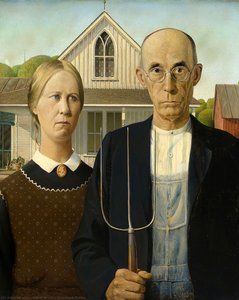
American Gothic - Grant Wood
Created in 1930, American Gothic stands as a definitive icon of the decade, capturing the stoic spirit of the American Midwest during the onset of the Great Depression. Grant Wood, a leading figure in the Regionalist movement, utilized a meticulous, luminous style reminiscent of the Flemish masters to depict a scene of profound formal restraint. The composition is anchored by a stern farmer and a woman standing before a white Carpenter Gothic farmhouse, their upright postures mirroring the verticality of the window's pointed arch and the sharp, three-pronged pitchfork held by the man.
The painting is a masterclass in geometric precision, where the rectangles of the architecture and the ovals of the faces are balanced by the rhythmic lines of the pitchfork and clothing. Wood employed a muted palette of earth tones—browns, grays, and pale blues—to ground the figures in a landscape of rolling hills. Every texture is rendered with photographic intent, from the coarse fabric of the man's suit to the delicate print of the woman's apron. This work serves as a study in resilience, offering a vision of enduring values through a lens of quiet dignity and somber stillness.
Cow's Skull Red, White, and Blue - Georgia O'Keeffe
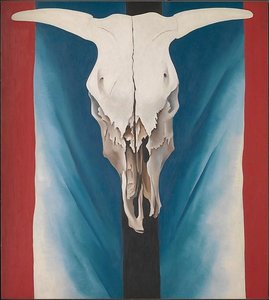 Cow's Skull Red, White, and Blue - Georgia O'Keeffe
Created in 1931, Cow's Skull Red, White, and Blue serves as a profound emblem of American modernism during the 1930s. Georgia O'Keeffe utilizes a striking composition where a meticulously detailed animal skull is centered against a backdrop of vibrant, layered vertical planes in red, white, and blue. This work exemplifies the decade's movement toward a unique synthesis of realism and abstraction, a hallmark of the era's evolving visual language.
The technique relies on a sophisticated interplay of textures and light. While the skull is rendered with a tactile, porous quality that emphasizes its organic bone structure, the background consists of smooth, almost velvety geometric shapes. This juxtaposition creates a shallow, flattened perspective that pushes the subject into the viewer's immediate space. The dramatic, directional lighting casts deep shadows, heightening the sense of three-dimensionality and contributing to a melancholic, contemplative tone. By pairing the stark, white remains of mortality with bold, symbolic colors, O'Keeffe transforms a desert relic into a powerful, surrealist statement on the cycle of life and the essence of the American Southwest.
Sketch for house in American Gothic - Grant Wood
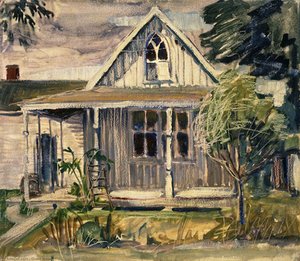 Sketch for house in American Gothic - Grant Wood
The eye is immediately drawn to the central, weathered cottage that dominates this watercolor study. Its distinctive gabled roof and the presence of a ladder leaning against the side suggest a quiet, ongoing labor within a rural landscape. This 1930 work serves as a foundational precursor to the iconic American Gothic, capturing the essence of the Midwestern spirit through a humble, domestic subject. As a piece created in 1930, it stands as a quintessential example of American art from the 1930s, a decade where the Regionalist movement sought to define a unique national identity by looking inward at the heartland.
Grant Wood employs a delicate watercolor technique, utilizing wet-on-wet washes to create a serene and reflective atmosphere. The composition is anchored by the geometric precision of the house—its rectangular windows and triangular roof—yet these forms are softened by expressive, loose brushwork. A muted palette of driftwood, cool blues, and soft grays evokes an overcast day, emphasizing the textures of the weathered wood siding and the tranquil, solitary nature of rural life. Through this sketch, Wood transforms a simple dwelling into a profound meditation on resilience and the passage of time.
Hotel Room - Edward Hopper
 Hotel Room - Edward Hopper
Edward Hopper’s 1931 oil on canvas, Hotel Room, stands as a profound exemplar of American Realism from the 1930s. This work captures a moment of profound urban isolation, featuring a solitary woman—modeled by Josephine Nivison—perched on the edge of a bed. The composition is a masterclass in geometric tension, where rigid vertical and horizontal lines create a sense of architectural enclosure, framing the subject within a transient, unnamed space. A sharp diagonal from the bed directs the viewer's gaze toward the woman as she gazes downward at a paper, her presence marked by a suitcase and discarded bags that suggest a life in transit.
The technical execution utilizes a muted, somewhat desaturated palette of pale whites, deep greens, and warm browns, which heightens the cinematic atmosphere. Light enters from an unseen source, casting sharp, electric shadows that sculpt the contours of the figure and the textures of the room. This interplay of brightness and deep shadow does more than illuminate; it defines the heavy, suspended silence characteristic of the era's introspective mood. Through smooth brushwork and simplified shapes, Hopper transforms a mundane interior into a dramatic study of quietude and reflection.
Figures in a Landscape - Jackson Pollock
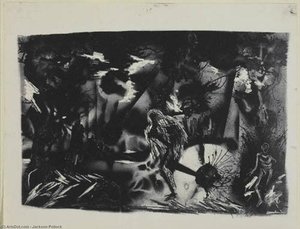 Figures in a Landscape - Jackson Pollock
Created in 1937, Figures in a Landscape serves as a profound testament to the psychological explorations defining American art during the 1930s. Long before his iconic drip technique gained global recognition, Jackson Pollock utilized a lithographic process to navigate the boundaries between reality and the subconscious. This work is a vital example of the era's movement toward Abstract Expressionism, heavily influenced by Surrealist sensibilities.
The composition is a rhythmic, monochromatic tapestry of gestural lines. Pollock employs a stark palette of grays, ranging from deep blacks to near-whites, to create a dramatic sense of light and shadow. Human forms are dispersed across an abstract, dreamlike terrain, appearing at varying scales that defy traditional perspective. These figures are not stable inhabitants but spectral presences caught within a web of dense, feathery, and assertive strokes. Through this interplay of organic and geometric shapes, the artwork evokes a palpable sense of tension and disorientation, capturing the complex, layered emotional landscape that characterized much of the avant-garde output in the United States during this decade.
Horse - Georgia O'Keeffe
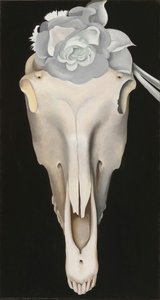 Horse - Georgia O'Keeffe
Created in 1931, this work exemplifies the profound shifts in American modernism during the 1930s, a decade where artists began exploring the tension between organic life and stark abstraction. In this composition, Georgia O'Keeffe presents a poignant dialogue between decay and bloom, juxtaposing the skeletal remains of a horse skull with the ephemeral elegance of a large, delicate gray rose. This pairing serves as a meditative memento mori, inviting a reflection on the transient nature of beauty and the inevitability of mortality.
Technically, the piece demonstrates a masterful command of oil on canvas. O'Keeffe utilizes a restrained, muted palette of grays, whites, and beige to create a sense of quiet contemplation. The artist achieves a striking tactile contrast through sophisticated layering: the bone is rendered with precise, detailed lines that emphasize its weathered, porous texture, while the rose petals are executed with soft, blurred edges that suggest a velvety smoothness. Set against an abyssal black background, the subject emerges with a haunting luminosity, capturing the essence of Contemporary Realism through its interplay of light and shadow.
Man seated by a Radiator - Norman Rockwell
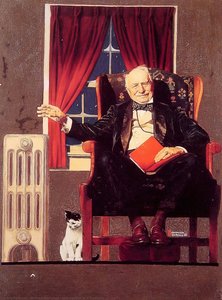 Man seated by a Radiator - Norman Rockwell
Upon first glance, the viewer is drawn into a scene of profound domestic stillness, where a man sits anchored in his chair, absorbed in the pages of a book. The composition is anchored by the soft, natural light filtering through a window, which illuminates the quiet sanctuary of the room and highlights the presence of two cats—one nestled near the man's feet and another drifting in the periphery. This interplay of light and shadow creates a palpable sense of warmth, making the simple act of reading feel like a sacred, private ritual. The textures of the chair, the iron radiator, and the feline companions are rendered with a precision that breathes life into the domestic setting.
Created in 1935, this work is a quintessential example of American art from the 1930s. During this decade, artists like Norman Rockwell became vital visual chroniclers of the American experience, focusing on the nuances of daily life and the quiet dignity of the individual. This piece exemplifies the era's shift toward narrative realism, capturing a moment of comforting solitude that resonates with the nostalgic spirit of the period.
Self-Portrait - Bill Traylor
 Self-Portrait - Bill Traylor
In this 1939 Self-Portrait, the eye is immediately drawn to the striking, simplified silhouette of an elderly man set against a muted, light brown background. The figure, depicted with a large mustache and a wide-brimmed hat, stands with a sense of quiet dignity, leaning on two walking sticks that suggest both age and physical stability. The composition is characterized by a profound flatness, eschewing traditional perspective in favor of bold, geometric shapes and a purposeful economy of color. A vibrant blue used for the trousers provides a sharp, modern contrast to the earthy tones of the torso and backdrop, anchoring the figure within the frame.
As a seminal work from the 1930s, this piece exemplifies the raw, expressive power of American outsider art during this decade. Created during his prolific years in Montgomery, Alabama, Traylor’s work captures a unique, self-taught visual language that emerged as a significant part of the American artistic landscape in the late 1930s. Through his use of crayon or colored pencil on a simple support, he transforms a personal moment of reflection into a powerful, iconic representation of presence and endurance.
Couple in Rumble Seat - Norman Rockwell
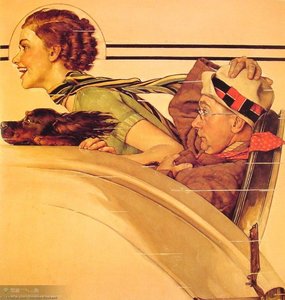 Couple in Rumble Seat - Norman Rockwell
Upon first glance, the viewer is swept into a dynamic, nostalgic scene of mid-century transit: a man, a woman, and their loyal dog are captured in a moment of joyful travel within a vintage automobile. The composition is defined by strong diagonal lines that suggest a sense of forward momentum and the breezy freedom of the open road. Rockwell’s mastery of narrative realism is evident in the tactile quality of the work, where textured brushstrokes bring life to the plush upholstery of the car and the soft fur of the canine companion. The lighting is diffused, casting gentle shadows that enhance the sentimental, optimistic atmosphere of the journey.
This piece is a quintessential example of American artworks of the 1930s, specifically embodying the Regionalist movement. By elevating a mundane, everyday moment—a family road trip—into a symbolic icon of prosperity and mobility, Rockwell captures the burgeoning optimism of the era. The work serves as a visual testament to the idealized American Dream, utilizing a warm, earthy palette to evoke a sense of security and adventure during a transformative decade in United States history."
Quoddy Head, Maine Coast - John Marin
 Quoddy Head, Maine Coast - John Marin
John Marin's 1933 watercolor, Quoddy Head, Maine Coast, stands as a profound testament to the American modernist movement during the 1930s. This work captures the rugged topography of the Maine coastline, focusing on the visceral interaction between surging waves and the geological textures of the shore. By this period, Marin had transitioned from the dense urbanity of cityscapes toward the rhythmic, natural energies of the coast, a shift characteristic of many American artists of the decade seeking essence over literalism.
The piece is defined by a sophisticated command of watercolor, utilizing a bright palette and graceful brushwork to navigate the complexities of the landscape. Marin employs a deliberate juxtaposition of color wash and sharp line, creating a sense of movement that pushes the medium's limits. Interestingly, his application of pigment emulates the tactile, structural depth of the impasto technique found in oil painting, lending a physical presence to the depiction of rocks and water. The result is a non-naturalistic, expressive vision that prioritizes the artist's subjective, energetic response to the environment, cementing its place within the vibrant landscape traditions of the 1930s.
Conclusion
The visual landscape of the 1930s in the United States was a profound dialogue between the intimate and the monumental, capturing a nation in a state of profound transformation. From the haunting, solitary urbanity of Edward Hopper to the rhythmic, abstract energies of John Marin and the iconic regionalism of Grant Wood, these works collectively defined a new American identity. Whether through the stark, expressive lines of Bill Traylor or the vibrant, organic forms of Georgia O'Keeffe, the era's output offered a diverse spectrum of emotional and structural responses to a changing world. Each artist contributed a unique lens, turning the everyday into something timeless and the landscape into a psychological map.
For those looking to bring this era of profound creativity into their own spaces, Mus3ums.com offers a way to experience these masterpieces through our museum-quality, hand-painted oil reproductions. Our artists meticulously recreate the texture, brushwork, and soul of these historic works on 100% cotton canvas, ensuring that the spirit of the 1930s lives on in your home or gallery. You can explore the breadth of this era by browsing our full collection and find the perfect piece to anchor your interior decor.