

Introduction
The 1830s in France represent a decade of profound artistic tension and dramatic transformation, a period where the rigid structures of Neoclassicism collided with the surging, emotional currents of Romanticism. As the nation navigated the political shifts following the July Revolution, the canvas became a battlefield for competing ideologies. Artists moved away from the cool, idealized clarity of the previous era, opting instead to explore the raw power of human passion, the sublime intensity of nature, and the gritty realities of contemporary life. This era was defined by a shift toward colorism and expressive brushwork, as painters sought to capture not just the form of a subject, but its psychological weight and atmospheric truth.
During this pivotal decade, the French art scene was shaped by masters who redefined the boundaries of visual storytelling. From the sweeping, turbulent compositions of Eugène Delacroix to the meticulous, almost sculptural precision of Jean-Auguste-Dominique Ingres, the period offered a spectrum of styles that challenged the viewer's perception. While some artists looked backward to classical antiquity with renewed rigor, others, like Jean-Baptiste-Camille Corot, began to lay the groundwork for landscape painting that prioritized light and mood over strict topographical accuracy. This duality—the struggle between order and emotion, between the eternal and the immediate—is what makes the works of this decade so enduringly modern.
Today, these paintings remain vital because they capture the birth of the modern individual. The movement away from idealized archetypes toward authentic, often uncomfortable, human experience resonates in our contemporary world. The works presented here offer a journey through this transformative decade, showcasing ten significant masterpieces that define the spirit of 1830s France and illustrate the diverse paths taken by the era's most influential creators.
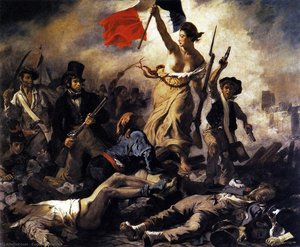
Liberty Leading the People - Eugène Delacroix
Eugène Delacroix's 1831 masterpiece, Liberty Leading the People, stands as a definitive pillar of French Romanticism from the 1830s. This monumental oil painting commemorates the July Revolution, capturing a pivotal moment of national upheaval through intense emotional energy and dramatic movement. The composition is structured in a powerful pyramidal formation, drawing the eye upward toward the central allegorical figure of Liberty. Adorned with a Phrygian cap, she strides triumphantly over a barricade of wreckage and fallen soldiers, brandishing the French tricolor flag.
Delacroix’s technique exemplifies the era's shift toward expressive, loose brushwork and impasto textures that convey immediacy and chaos. The palette is dominated by somber, earthy tones of brown and gray, which serve to heighten the visual impact of the vibrant red, white, and blue of the flag. This use of chiaroscuro—creating theatrical contrasts between light and shadow—emphasizes the struggle and sacrifice of the diverse revolutionaries, from the bourgeois to the young boy with pistols. By prioritizing atmospheric passion over rigid neoclassical precision, Delacroix defined the visual language of French revolutionary fervor during this decade.
The Execution of Lady Jane Gray - Paul Delaroche
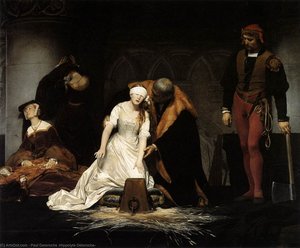 The Execution of Lady Jane Gray - Paul Delaroche
Paul Delaroche’s 1833 masterpiece, The Execution of Lady Jane Gray, stands as a definitive example of the dramatic historical narratives that characterized French art during the 1830s. This work exemplifies the transition between Romanticism and the Academic tradition, utilizing theatrical storytelling to capture a moment of profound human vulnerability. The scene depicts the young "Nine Days Queen" at the precipice of her demise, her pale hands reaching blindly for the executioner's block in a gesture of mortal terror.
Delaroche employs a sophisticated use of chiaroscuro, where piercing shafts of light illuminate the central figure against a backdrop of swallowing shadows. This lighting technique sanctifies the suffering of the protagonist, casting her in an ethereal glow that contrasts with the grim, shadowed onlookers. The technical precision of his brushwork renders the textures of heavy velvet and cold stone with meticulous realism, creating a cinematic tableau that feels both intimate and monumental. By focusing on the psychological weight of the event, Delaroche transforms a historical occurrence into a visceral study of duty and despair, a hallmark of the era's emotive power.
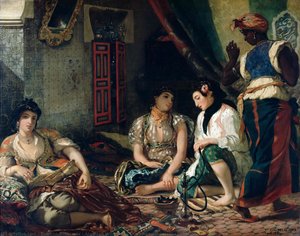
Algerian Women in Their Apartments, - (180x229) - Eugène Delacroix
Upon first glance, the viewer is drawn into an intimate, sensory-rich tableau where four women are gathered within a luxurious interior. In the foreground, two women sit upon patterned rugs, deeply engaged in conversation; one is adorned with a headscarf and holds a hookah pipe, while the other wears a white dress embellished with gold details. A third woman, distinguished by a vibrant blue headscarf and a red parasol, stands behind them, adding a sense of quiet oversight to the scene. The composition is further enriched by a mirror reflecting the room's depth, a red cabinet, and various scattered vessels that lend a lived-in authenticity to the space.
This 1834 masterpiece is a quintessential example of French art from the 1830s, embodying the height of the Romantic movement. Through his revolutionary use of loose brushwork and dramatic, sculptural lighting, Eugène Delacroix moved away from Neoclassical rigidity to embrace the emotional intensity and exoticism that defined this decade. His depiction of North African life, inspired by his travels, showcases the era's fascination with the sublime and the unknown, marking a pivotal shift in the trajectory of French painting.
Tiger Devouring a Gavial Crocodile of the Ganges - Antoine-Louis Barye
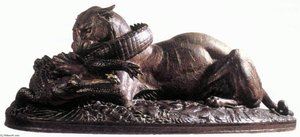 Tiger Devouring a Gavial Crocodile of the Ganges - Antoine-Louis Barye
Created in 1831, Antoine-Louis Barye’s Tiger Devouring a Gavial Crocodile of the Ganges stands as a visceral testament to the Romantic movement's fascination with the untamed forces of the natural world. As a pioneer of the animalier style, Barye moved away from idealized classical forms to embrace a raw, anatomical realism that defines the artistic spirit of France in the 1830s. This bronze masterpiece captures a moment of ferocious, primal struggle, where the boundaries between predator and prey dissolve into a dynamic symphony of movement.
The composition is defined by intense tension and organic complexity. A powerful tiger, its musculature rendered with exacting precision, dominates the scene, its body coiled in a lethal embrace with a colossal gavial crocodile. The crocodile’s scales and the tiger’s fur are articulated through a masterful play of light and shadow, achieved through the intricate lost-wax casting process. Beneath this violent encounter, a turtle emerges from the rocky base, adding a layer of ecological depth to the carnage. Through this work, Barye captures not just the anatomy of beasts, but the very essence of survival and the brutal, beautiful equilibrium of the wild.
Unknown, maybe Hippolyte Lucien-Joseph Lucas (1807-1878), a Journalist, maybe P.Mendez de Vigo (1790-1860) a Spanish General, but Most Probably the Count Pelet de la Lozere (1785-1871), a Politician - Honoré Daumier
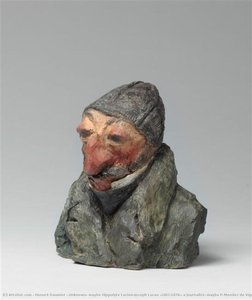 Unknown, maybe Hippolyte Lucien-Joseph Lucas (1807-1878), a Journalist, maybe P.Mendez de Vigo (1790-1860) a Spanish General, but Most Probably the Count Pelet de la Lozere (1785-1871), a Politician - Honoré Daumier
The viewer is immediately confronted by the tactile, hand-modeled surface of this expressive bust, where the physical traces of the artist's tools remain visible in the clay. The portrait focuses on the head and shoulders of an elderly man, whose features are rendered with a striking balance between unflinching realism and the subtle exaggeration characteristic of Honoré Daumier. His gaze, directed slightly off-center, suggests a state of deep, perhaps melancholic, contemplation. The composition is defined by organic, rounded shapes and a restrained palette of earthy tones—shades of grey, beige, and muted browns—interrupted only by soft, rosy hues upon the cheeks. This work belongs to the 1830s as it captures the burgeoning tension between classical portraiture and the emerging realist movement in France. Created in 1833, the piece exemplifies the era's fascination with the psychological depth of its subjects, whether they be journalists, generals, or politicians, using the sculptural medium to explore the weight of character and the passage of time.
A Sleeping Odalisque - Jean-Auguste-Dominique Ingres
 A Sleeping Odalisque - Jean-Auguste-Dominique Ingres
Created in 1835, A Sleeping Odalisque stands as a definitive masterpiece of the 1830s, embodying the peak of French Neoclassical refinement. Jean-Auguste-Dominique Ingres, a titan of the French academic tradition, utilizes this work to showcase his unparalleled mastery of the flowing, sculptural line. The composition is defined by the diagonal repose of a female figure, whose pale, luminous skin creates a striking contrast against a rich palette of deep crimsons and velvety reds.
The painting exemplifies the decade's fascination with idealized forms and exoticized intimacy. Through precise contours and a porcelain-like finish, Ingres moves beyond mere anatomical accuracy to achieve a heightened sense of aesthetic grace. Soft, directional lighting emanates from the upper left, casting gentle highlights across the organic, rounded shapes of the subject's limbs while plunging the heavy folds of the drapery into deep, atmospheric shadow. This interplay of light and shadow provides a profound sense of three-dimensionality, transforming a quiet, private moment into a timeless study of elegance and classical beauty.
View of the Forest of Fontainebleau - Jean-Baptiste-Camille Corot
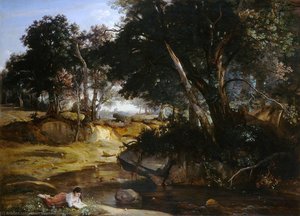 View of the Forest of Fontainebleau - Jean-Baptiste-Camille Corot
In this 1834 masterpiece, Jean-Baptiste-Camille Corot captures a profound meditation on the serenity of the natural world. The scene depicts a tranquil woodland within the Forest of Fontainebleau, where a woman rests near a gentle river, her presence harmonizing with the landscape. The composition is masterfully balanced, utilizing the soft silhouettes of trees and scattered rocks to create a sense of depth that invites the eye to wander through the glades. As the sun descends, a warm, golden light bathes the foliage, casting long, gentle shadows and bathing the entire scene in an amber glow.
Corot’s technique in this work exemplifies the shift in French art during the 1830s, acting as a bridge between the structured elegance of Neo-Classicism and the spontaneous, atmospheric innovations of the Barbizon School. Using thin washes and loosely dabbed strokes, he captures the ephemeral play of light and shadow with a burgeoning interest in plein-air observation. The palette, dominated by rich phthalo greens and warm sunset tones, breathes life into the landscape, capturing a fleeting moment of tranquility that anticipates the evolution of Impressionism.
Isaiah - Jean-Louis Ernest Meissonier
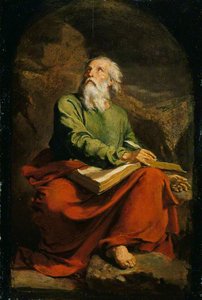 Isaiah - Jean-Louis Ernest Meissonier
In this 1838 composition, the viewer is immediately drawn to the profound concentration of an elderly, bearded man immersed in a sacred text. Seated upon a stone platform, the figure of Isaiah is draped in a heavy green robe, his posture suggesting a moment of deep prophetic contemplation. Meissonier employs a masterful use of light and shadow to sculpt the textures of the weathered skin, the delicate pages of the book, and the rugged, cave-like environment that surrounds him. The dark, somber background intensifies the dramatic and melancholic atmosphere, focusing all attention on the intellectual and spiritual weight of the scene.
As a quintessential work from the 1830s, Isaiah exemplifies the era's fascination with historical and religious narratives rendered through the lens of meticulous realism. Created during a decade when French academic art was bridging the gap between classical tradition and a new, detailed observational style, this painting showcases Meissonier's ability to transform a biblical subject into a tangible, human experience. His technical precision and the work's dramatic chiaroscuro reflect the evolving aesthetic sensibilities of France during this pivotal decade.
Lion au serpent - Antoine-Louis Barye
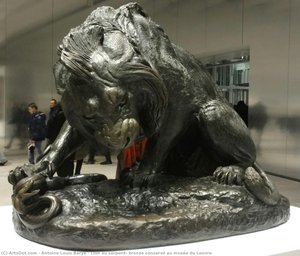 Lion au serpent - Antoine-Louis Barye
Created in 1835, this bronze sculpture epitomizes the animalier movement that flourished in France during the 1830s. Antoine-Louis Barye captures a moment of primal, violent tension, freezing the raw energy of a lion locked in a ferocious struggle with a rearing serpent. The composition is a masterclass in Romanticism, emphasizing dramatic intensity and the brutal, unyielding power of the natural world.
The technical execution reveals the artist's profound understanding of anatomy, likely honed through direct observation of wildlife. The bronze surface is rendered with meticulous precision; one can almost feel the ripple of the lion's tensed muscles and the sinuous, muscular coil of the snake. This scientific accuracy serves to amplify the emotional weight of the encounter, turning a biological struggle into a high-stakes drama. In the political landscape of 1830s France, such imagery often carried allegorical weight, with the lion potentially symbolizing the monarchy amidst the era's profound social transitions. The work stands as a testament to the decade's fascination with the intersection of naturalistic realism and intense, emotive storytelling.
March of the Volunteers of 1792 (detail) - François Rude
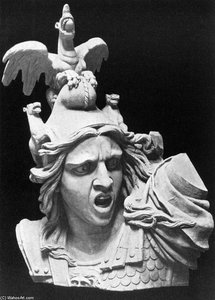 March of the Volunteers of 1792 (detail) - François Rude
The viewer is immediately struck by the visceral intensity of the facial expression, where a furrowed brow and an open mouth convey a sense of urgent, defiant determination. This detail captures a heroic male figure, part of a larger surge of movement, characterized by a dramatic interplay of light and shadow. Above the figure, an elaborate headdress featuring a winged eagle with an open beak serves as a potent symbol of liberty and national strength. The composition utilizes strong, curvilinear lines in the hair and drapery that contrast with the more angular, structured forms of the helmet, creating a sense of dynamic, rhythmic energy.
Created in 1833, this work is a quintessential example of French art from the 1830s, a decade defined by the tension between Neoclassical precision and the emotional fervor of Romanticism. François Rude masterfully bridges these two movements, using idealized forms to express the raw, passionate spirit of the era. By blending classical sculptural techniques with a heightened sense of drama, Rude’s work encapsulates the revolutionary idealism and patriotic fervor that characterized the French artistic landscape during this pivotal decade.
Conclusion
The decade of the 1830s in France served as a profound crossroads where the dramatic intensity of Romanticism met the precise discipline of Neoclassicism. From the turbulent, emotional brushwork of Eugène Delacroix to the meticulous, almost photographic clarity of Jean-Auguste-Dominique Ingres, these works capture a nation in transition. Whether through the sweeping landscapes of Corot or the biting social commentary of Daumier, this era redefined how light, shadow, and human passion could be translated onto canvas. Each piece in this collection represents a vital step in the evolution of European art, offering a window into a period of immense creative upheaval and technical mastery.
At Mus3ums.com, we invite you to bring this transformative era into your own space. Our master artists specialize in creating museum-quality, hand-painted oil reproductions that preserve the tactile soul and visible brushstrokes of these historical masterpieces. You can explore our full collection to find the perfect piece for your home and live daily with the enduring beauty of 19th-century French excellence.


