
Introduction
The decade of the 1910s in the Netherlands marked a profound period of transition, where the traditional landscapes and intimate portraits of the past collided with the radical energy of modernism. As the world moved through the turbulence of the early 20th century, Dutch artists were at the forefront of a visual revolution, moving away from mere representation toward the exploration of pure form, color, and emotion. This era saw the birth of movements that would redefine global aesthetics, shifting the focus from the naturalistic observation of light to the structured, rhythmic, and often abstract language of the avant-garde.
During this time, the Dutch art scene was a crucible of experimentation. While some artists continued to refine the nuanced, atmospheric qualities of Impressionism, others were dismantling the subject entirely. The tension between the old world and the new was palpable, manifesting in works that sought to find order in chaos or to express the psychological depth of the human experience through bold, non-naturalistic palettes. This period was not just about a change in style, but a fundamental shift in how artists perceived the relationship between the canvas and reality.
These works remain vital today because they represent the DNA of modern art. The geometric precision and color theories developed during this decade laid the groundwork for much of the 20th-century design and abstraction that followed. To look at a painting from this era is to witness the exact moment when the rules of art were being rewritten, offering a timeless dialogue between structure and spontaneity.
In the following selection, we trace this evolution through ten significant works, highlighting the diverse paths taken by the masters of the era—from the structured abstractions of the pioneers to the emotive, textured brushwork of those who sought to capture the essence of life through a modern lens.
Avond (Evening): The Red Tree - Piet Mondrian
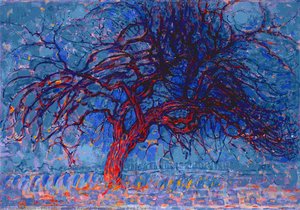 Avond (Evening): The Red Tree - Piet Mondrian
The viewer is immediately arrested by a striking, vibrant red tree that dominates a deep midnight blue field. This central element, characterized by bold black branches, creates a powerful tension against the cool expanse of the sky, which is speckled with stars. Below, the ground is rendered in warm shades of orange and yellow, providing a luminous contrast to the nocturnal atmosphere. The composition captures a tranquil evening scene through a post-impressionist lens, utilizing bold brushstrokes and a heightened color palette to interpret the natural world.
This work is a quintessential example of Dutch art from the 1910s, marking a critical evolutionary step in the career of Piet Mondrian. While it retains the atmospheric sensitivity of his earlier Dutch training, it signals a decisive departure from traditional landscape painting. By simplifying nature into intense, rhythmic forms and primary colors, Mondrian began the transition from representational art toward the radical abstraction and geometric order that would eventually define his legacy in the decade to follow.
Woman with Flowered Hat - Kees van Dongen
 Woman with Flowered Hat - Kees van Dongen
Kees van Dongen’s 1915 portrait, Woman with Flowered Hat, stands as a quintessential example of the Dutch contribution to the Fauvist movement during the 1910s. This work captures the decadent pulse of Parisian nightlife through a lens of expressive distortion and intense emotionality. The subject is presented in a stylized, head-and-shoulder composition, where her features—notably large, striking almond eyes and prominent lips—are exaggerated to prioritize psychological impact over anatomical precision. This departure from realism is a hallmark of the era's avant-garde spirit.
The artist utilizes a vibrant, high-contrast palette to frame the subject, employing a wide-brimmed hat adorned with pink floral embellishments that lend a sense of theatricality to the piece. Through thick, gestural brushstrokes and impasto techniques, van Dongen creates a textured surface that emphasizes the tactile quality of the oil paint. The interplay between the dark background and the luminous, warm tones of the figure creates a dramatic tension, blending elements of Expressionism with an emerging Art Deco sensibility. Ultimately, the painting serves as a profound exploration of modernity, capturing the intersection of fashion, femininity, and the restless energy of the early 20th century.
Portrait of Mata Hari - Isaac Israëls
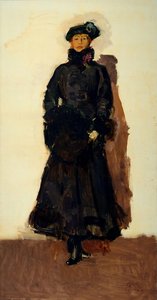 Portrait of Mata Hari - Isaac Israëls
In this 1916 portrait, Isaac Israëls captures the enigmatic dancer Mata Hari, a figure who epitomizes the exotic allure of the era. As a prominent figure in the Hague School and a master of Amsterdam Impressionism, Israëls uses this work to demonstrate the stylistic shifts occurring in urban life during the 1910s. The painting serves as a vibrant document of early twentieth-century European nightlife, moving beyond mere likeness to capture a sense of mystery and poised stillness.
Israëls employs a technique defined by loose, rapid brushstrokes and visible smears of color, eschewing photographic precision for a palpable, living energy. His palette utilizes sophisticated putty tones and deep blacks, focusing on how light interacts with the textures of her silk scarf and elegant dress. The composition, featuring subtle details like her hat and nearby handbags, emphasizes her dignified stature and monumental self-possession. Through this spontaneous application of paint, Israëls reflects the broader movement of Dutch art in the 1910s, where the focus shifted toward capturing the fleeting, atmospheric impressions of modern, sophisticated existence.
Composition no. II - Piet Mondrian
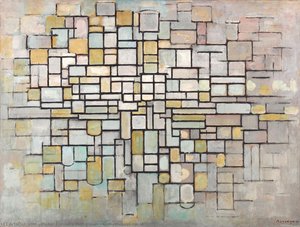 Composition no. II - Piet Mondrian
Upon first encounter, Composition no. II presents a complex, rhythmic dance of geometric forms that immediately challenges the viewer's perception of space. The eye is drawn to a dense, overlapping arrangement of rectangles and squares, where crisp black lines intersect to create a structured yet dynamic grid. Rather than using traditional perspective to suggest depth, the work utilizes a subtle layering of shapes in muted yellows, browns, grays, and pale pinks to achieve a sense of internal dimension. This deliberate flattening of the pictorial plane marks a profound departure from the naturalistic landscapes of the artist's earlier years.
This piece is a quintessential example of Dutch artworks of the 1910s, capturing the era's radical shift toward abstraction. As a pivotal work from 1913, it documents the transition of Piet Mondrian from his roots in the Hague School toward the foundational principles of Neo-Plasticism. By stripping away representational subject matter in favor of essential lines and color, the painting embodies the decade's intense search for a universal, underlying order within the modern world.
Troelstra - Theo van Doesburg
 Troelstra - Theo van Doesburg
Created in 1910, Troelstra serves as a compelling example of the stylistic experimentation occurring within Dutch art during the 1910s. This monochromatic charcoal portrait of Troelstra moves away from traditional realism, leaning instead toward the expressive tendencies of Expressionism and early Cubism. Theo van Doesburg, who would later become a central figure in the De Stijl movement, demonstrates here a profound interest in the structural deconstruction of form through a highly stylized lens.
The composition is tightly cropped, focusing on the head and shoulders to create an intimate, almost unsettling psychological encounter. Rather than seeking a literal likeness, the work utilizes bold, expressive lines and heavy hatching to define the subject. The facial features are rendered through subtle geometric shapes, and the asymmetrical arrangement of features creates a sense of fragmentation. Through the use of extensive cross-hatching on paper, van Doesburg builds a textured, tactile surface that emphasizes tonal variation despite the absence of color. The diffused lighting and minimal spatial recession contribute to a flattened perspective, prioritizing the emotional weight and the somber, ambiguous state of the subject over anatomical precision.
Study for Composition VIII (The Cow) - Theo van Doesburg
 Study for Composition VIII (The Cow) - Theo van Doesburg
In this 1918 study, Theo van Doesburg deconstructs a rural subject into a rhythmic arrangement of intersecting planes, marking a pivotal moment in the evolution of Dutch art during the 1910s. The cow is stripped of its organic curves and reduced to a geometric skeleton of vertical and horizontal lines. This work serves as a bridge between the recognizable world and the pure abstraction of Neoplasticism, seeking a universal order through the most essential elements of sight.
The palette is disciplined and austere, relying on a limited selection of green, black, and white to emphasize structure over sentiment. Thick applications of paint and visible brushstrokes provide a physical weight to the composition, creating a tension between the memory of a living form and the logic of the grid. By replacing flesh and breath with rectangular blocks of color, Van Doesburg achieves a sense of equilibrium between empty space and solid form. The result is a silent, architectural study where the chaos of nature is organized into a permanent, mathematical harmony.
The Hedgehog - Jan Mankes
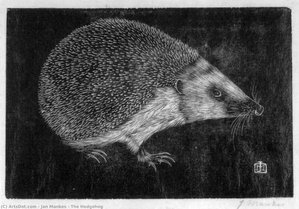 The Hedgehog - Jan Mankes
Created in 1916, The Hedgehog serves as a profound example of Jan Mankes' mastery of Symbolic Realism, a movement that defined much of the Dutch artistic output during the 1910s. This intimate wood block print captures a singular moment of stillness, presenting the subject in profile as it moves across a void of solid black. By stripping away all environmental context, Mankes focuses entirely on the essence of the creature, turning a simple observation of nature into a meditative study of form and presence.
The technical execution relies on a sophisticated system of hatching and varying line density to translate organic anatomy into a monochromatic landscape. Through meticulous engraving, the artist achieves a remarkable tactile reality:
- Fine, densely packed lines define the sharp, prickly texture of the spines.
- Sparser, softer lines suggest the delicate fur of the underbelly.
- Tonal variations simulate light and shadow, creating depth without the need for color.
Winterfun On De Loswal, Hattem - Cornelis Vreedenburgh
 Winterfun On De Loswal, Hattem - Cornelis Vreedenburgh
In this 1914 composition, Cornelis Vreedenburgh captures a poignant winter scene at De Loswal in Hattem. The viewer is immediately drawn to the frozen expanse where several boats rest upon the icy water, some appearing partially submerged or damaged by the seasonal chill. This sense of stillness is punctuated by a group of people gathered on the shore, their presence providing a human scale to the expansive, wintry environment. A dog and scattered birds add subtle movements to the landscape, creating a delicate tension between the frozen landscape and the living creatures navigating it.
The work is a quintessential example of Dutch art from the 1910s, showcasing the era's mastery of atmospheric Impressionism. Influenced by the Hague School, Vreedenburgh utilizes a muted, putty-toned palette to masterfully render the interplay of light on snow and reflective ice. His deliberate brushwork layers color to evoke the tactile texture of the cold, capturing a nostalgic and dramatic moment of life amidst the quietude of the Dutch winter. Through this careful balance of light and shadow, the painting transforms a simple landscape into a profound study of seasonal atmosphere.
Portrait of Willem Anton Engelbrecht (1874-1965) - Willem Witsen
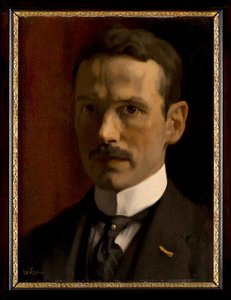 Portrait of Willem Anton Engelbrecht (1874-1965) - Willem Witsen
Willem Witsen’s 1912 Portrait of Willem Anton Engelbrecht stands as a profound example of Dutch portraiture from the 1910s, showcasing the era's mastery of psychological depth and formal precision. This bust-length oil painting captures the subject in a moment of heavy stillness, utilizing a dramatic chiaroscuro technique to carve his features out of a dark, indistinct void. A strong, directional light source from the upper left illuminates the man’s face, highlighting the meticulous texture of his skin and the sharp, bright line of his white detachable collar against the somber tones of his suit.
The composition is defined by a sophisticated palette of deep blacks, ochre, and earthy browns, which pushes the figure into the viewer's immediate space. Witsen, an Amsterdam Impressionist influenced by the tonal sensibilities of Whistler, employs a realistic and academic approach here, focusing on the subtle nuances of light and shadow to build volume. Rather than relying on grand gestures, the artist uses fine brushwork to render the silk of the tie and the grooming of the mustache, creating a sense of tangible substance. The result is a somber, dignified study of character that reflects the gravity of early 20th-century Dutch life.
Composition no. 62 - Jacoba van Heemskerck
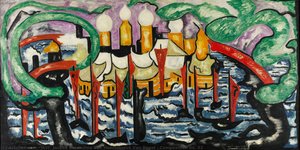 Composition no. 62 - Jacoba van Heemskerck
Upon first glance, Composition no. 62 presents a dense, rhythmic cityscape where the urban environment is distilled into a complex arrangement of architectural forms and human presence. The eye is immediately drawn to the intricate, interlocking patterns of building facades, characterized by a repetitive cadence of windows that create a sense of structural density. Amidst this rigid geometry, the fluid movement of boats navigating waterways and birds traversing open spaces introduces a vital tension between permanence and transit. The palette, dominated by a soft, rosy brown, lends a mystical and spiritual quality to the scene, transforming a bustling metropolitan view into a sophisticated, symbolic landscape.
This work is a quintessential example of Dutch art from the 1910s, reflecting the era's profound shift toward abstraction. Jacoba van Heemskerck, a pioneer of the movement, moves away from traditional perspective in favor of a flattened, rhythmic composition. By prioritizing the interconnectedness of elements over literal representation, the piece captures the essence of the modern decade, translating the chaotic energy of the city into a structured, spiritual language of form and line.
Conclusion
The Dutch art of the 1910s represents a profound era of transition, where the boundaries between traditional representation and radical abstraction were constantly being redefined. From the structured, rhythmic geometry of Mondrian and Van Doesburg to the emotive, expressive brushwork of Van Dongen, these works capture a decade of intense creative evolution. Whether through the delicate, intimate landscapes of Jan Mankes or the vibrant urban scenes of Isaac Israëls, this collection showcases a diverse movement that bridged the gap between the classical past and the modern future. Each piece serves as a testament to the ingenuity of Dutch masters who dared to reimagine the visual language of their time.
At Mus3ums.com, we invite you to bring this transformative era into your own space. Our artisans specialize in creating museum-quality, hand-painted oil reproductions that preserve the tactile depth and soul of these historical masterpieces. You can explore our full collection to find the perfect piece for your home and experience the enduring legacy of these Dutch icons through the artistry of fine oil on canvas.