




Introduction
The dawn of the twentieth century in the Netherlands marked a profound period of artistic metamorphosis, where the traditional mastery of light and landscape began to collide with the radical impulses of modernism. As the 1900s unfolded, Dutch art moved away from the quiet, observational realism of the previous century toward a more expressive, structured, and often psychological approach to the canvas. This era was defined by a tension between the established Hague School traditions and the emerging avant-garde movements that sought to deconstruct form and color.
During this decade, the cultural landscape of the Netherlands was a crucible of innovation. Artists were no longer content with merely capturing the atmosphere of the Dutch coast or the intimacy of domestic life; they began to explore the rhythmic essence of geometry, the emotional weight of vibrant color, and the bustling energy of urban modernity. This shift reflected a world in transition, as the stability of the old century gave way to the complexities of a new, industrial age, influencing how painters perceived space, light, and the human condition.
These works remain vital today because they represent the foundational DNA of modern art. The experiments conducted by Dutch masters during this decade paved the way for abstraction and expressionism, influencing global aesthetics for decades to come. To study these pieces is to witness the very moment when the boundaries of representation were pushed to their limits, offering a visual bridge between the classical past and the fragmented, dynamic future.
The following selection showcases ten significant works that embody this transformative spirit, featuring the diverse perspectives of artists who redefined the visual language of the Netherlands at the turn of the century.
Ask Me No More - Lawrence Alma-Tadema
 Ask Me No More - Lawrence Alma-Tadema
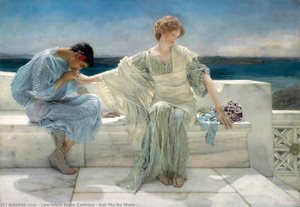
Created in 1906, Ask Me No More serves as a profound testament to the academic excellence of Dutch-born artist Lawrence Alma-Tadema. This masterpiece exemplifies the neo-Pompeian style, characterized by a meticulous obsession with archaeological detail and the luminous texture of marble. The composition captures a moment of quiet, classical romance, featuring a woman seated by a marble balustrade holding a bouquet, while a man kneels beside her in a gesture of intimacy.
The work is a study in light and atmosphere, utilizing a soft, muted palette of light blues, whites, and pale greens to evoke a dreamy, tranquil seascape. Alma-Tadema’s technical mastery is evident in the way he renders the translucent quality of fabric and the smooth, organic curves of the figures against the structured, receding lines of the balcony. By blending realistic textures with an idealized vision of antiquity, the painting reflects the early 20th-century fascination with classical beauty and the serene, decadent aesthetics of the Roman world.
Stammer Mill with Streaked Sky - Piet Mondrian
 Stammer Mill with Streaked Sky - Piet Mondrian
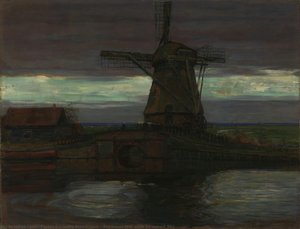
Painted in 1907, Stammer Mill with Streaked Sky serves as a profound window into the formative years of Piet Mondrian, a master who would eventually redefine modern art through Neoplasticism. This work belongs to the 1900s Dutch art movement as it captures the artist during a pivotal transition, moving away from the naturalistic traditions of the Hague School and toward the rhythmic abstraction that would later define his legacy.
The composition centers on a quintessential Dutch windmill, a symbol of national heritage, set against an expansive, dramatically streaked sky. Mondrian utilizes a palette of muted earth tones—browns, greens, and grays—interrupted by dynamic swirls of light blue and purple in the heavens. The scene is populated by small figures and a boat approaching the shore, adding a sense of human scale to the tranquil, pastoral landscape. While the subject remains representational, the visible, textured brushstrokes and the emphasis on atmospheric light hint at the emerging influence of Impressionism and early Fauvism. It is a serene yet subtly dynamic study of light and form before the artist embraced the strict geometric grids of his later career.
Dying sunflower I - Piet Mondrian
 Dying sunflower I - Piet Mondrian
The eye is immediately drawn to the top left of the composition, where a large, drooping sunflower head appears to wilt and dissolve. This 1908 work is a profound study in decay, characterized by an expressive, semi-abstract approach that moves away from traditional naturalism. The forms are amorphous, with shapes bleeding into one another through loose, gestural lines that suggest a slow, inevitable collapse. A thick, painterly impasto technique provides a heavy, tactile presence, making the physical dissolution of the plant feel tangible.
The palette is intentionally somber, utilizing muted, earthy tones such as deep ochre, burnt sienna, dark blues, and muddy purples. A final, fading pulse of brighter yellow remains in the flower's center, providing a stark contrast to the low-key, moody atmosphere. This piece belongs to the Dutch artworks of the 1900s as it captures a pivotal moment in the evolution of a master; here, Piet Mondrian begins to transition from the naturalistic traditions of the Dutch landscape toward the rhythmic, deconstructed forms that would eventually define his later, iconic style.
Maria - Kees van Dongen
 Maria - Kees van Dongen
The eye is immediately arrested by a gaze that is both unflinching and magnetic, anchored by the striking contrast between the subject's pale ivory skin and the explosive, vibrant crimson of her dress. In this 1907 portrait, Maria captures the decadent pulse of Parisian life through a lens of profound artistic rebellion. The subject, adorned with a blue headband, possesses the signature almond-shaped eyes and sensuous elegance that defined the work of Kees van Dongen, a preeminent Dutch Fauvist.
This work is a quintessential example of Dutch art from the 1900s, representing the era's radical shift toward Fauvist Expressionism. Moving away from the somber, atmospheric traditions of the Hague School, Van Dongen utilized the decade's burgeoning modernism to embrace a "wild beast" approach to pigment. His technique employs audacious, unblended splashes of color and high-contrast hues that create a graphic intensity. The large, confident brushstrokes do not merely seek a photographic likeness but instead capture a raw, romantic emotion, making the figure appear to vibrate with life against the canvas.
Cutting for the stone - Jan Steen
 Cutting for the stone - Jan Steen
This work, dated 1909, serves as a compelling representative of Dutch artistic legacy within the 1900s, bridging the gap between Golden Age traditions and the early 20th-century appreciation for historical genre scenes. The composition is a theatrical study of human impulse, utilizing a crowded, pyramidal arrangement to capture a moment of visceral tension. A sharp, dramatic light source cuts through the gloom, employing a chiaroscuro effect that pulls the central figures from an atmospheric, dark background. This lighting emphasizes the stark contrast between the patient's agony and the varied, often unsettling expressions of the onlookers, ranging from grimacing empathy to intense curiosity.
The palette is grounded in earthy tones, dominated by ochre, deep red, and muted blue. These colors, combined with visible, textured brushwork, lend a palpable weight to the heavy fabrics and the vulnerable planes of skin. Through directed gestures—a pointing finger or a tensed shoulder—the artist guides the eye through the chaotic, domestic stage, transforming a medical procedure into a profound exploration of raw, unvarnished existence.
Adam and Eve - Jozef Israëls
 Adam and Eve - Jozef Israëls
Upon first glance, the viewer is met with a profound sense of tension and intimacy within a somber, primordial woodland. The composition is anchored by two nude figures positioned on opposite sides of the center, their pale skin catching a soft, ethereal light that seems to emanate from an unseen source behind the dense foliage. Eve, holding the forbidden fruit, becomes a focal point of this dramatic encounter. The atmosphere is heavy with melancholy, achieved through a palette of deep espresso, muted greens, and ochre, where light and shadow dance across a textured, almost impressionistic surface.
This 1902 work is a quintessential example of Dutch art from the 1900s, showcasing the mastery of Jozef Israëls. As a prominent figure of the Hague School, Israëls brings his signature emotive realism to this biblical scene. Rather than focusing on sharp, clinical detail, he utilizes thick, painterly brushstrokes to evoke the raw essence of the landscape and the human form. His ability to manipulate light to create a dramatic, atmospheric mood reflects the evolving stylistic sensibilities of the Netherlands at the turn of the century.
Eenden, Willem Maris, c. 1880 - c. 1904 - Willem Maris
 Eenden, Willem Maris, c. 1880 - c. 1904 - Willem Maris
Willem Maris, a prominent figure of the Hague School, demonstrates his mastery of light and nature in this evocative work. In Eenden, created around 1904, the artist captures a serene moment near a waterfront, featuring two ducks and several chicks nestled within the lush grass. The composition is anchored by a dominant palette of Phthalo Green, which defines the vibrant, life-filled meadow surrounding the waterfowl.
The technique employed is characteristic of Maris's ability to translate the shimmering effects of the Dutch landscape. Through the use of impasto, he builds a tactile surface that mimics the organic textures of the reeds and the soft plumage of the birds. A bird perched on a nearby branch adds a sense of depth and narrative complexity to the scene, enhancing the peaceful atmosphere. This piece serves as a quintessential example of Dutch art from the 1900s, showcasing the era's profound connection to the natural world and the technical pursuit of capturing atmospheric light through visible, expressive brushwork.
MCJ (Marie) Jordan (1866-1948), The Artist's Wife - George Hendrik Breitner
 MCJ (Marie) Jordan (1866-1948), The Artist's Wife - George Hendrik Breitner
In this 1905 portrait, George Hendrik Breitner moves away from his characteristic gritty Amsterdam street scenes to capture a profound sense of domestic intimacy. MCJ (Marie) Jordan (1866-1948), The Artist's Wife serves as a poignant example of how Dutch Impressionism transitioned into the more introspective, psychological portraiture of the 1900s. The composition is tightly cropped, focusing on the subject's head and upper torso, while the remainder of the frame dissolves into an impenetrable, dark void.
Breitner utilizes a dramatic chiaroscuro effect, where a soft, directional light emerges from the left to illuminate the pale curves of Marie's face and the gentle positioning of her hand. This technique creates depth through light rather than traditional perspective, pulling the figure out of a somber, muted palette of earthy umbers, deep browns, and blacks. The surface of the work is highly tactile, characterized by visible, painterly brushstrokes and a fine network of craquelure that speaks to the passage of time. The resulting atmosphere is one of quiet melancholy, capturing a fleeting, private moment of stillness within the broader evolution of Dutch modern art."
Cigarette Smoking Girls - Isaac Israëls
 Cigarette Smoking Girls - Isaac Israëls
Isaac Israëls, a prominent figure in Amsterdam Impressionism, captures a fleeting, candid moment in Cigarette Smoking Girls. Created in 1900, this work serves as a quintessential example of Dutch art from the 1900s, marking a decisive shift toward the depiction of modern, everyday urban life. The composition focuses on two young women positioned in a dimly lit, indeterminate space, their forms emerging from a somber background of blacks, browns, and ochre.
The painting is characterized by a loose, painterly technique where layered oil paint creates a tactile, textured surface. Rather than relying on sharp outlines, Israëls uses visible brushstrokes to define the movement of light and the weight of fabric, employing a subtle chiaroscuro that lends palpable depth to the scene. One woman is captured in the act of smoking, a detail that anchors the work in a sense of gritty realism. The muted, earthy palette and soft lighting evoke a melancholic, atmospheric mood, documenting the social dynamism and ephemeral snapshots of life at the turn of the century.
Seated Female Nude - Marius Alexander Jacques Bauer
 Seated Female Nude - Marius Alexander Jacques Bauer
Marius Alexander Jacques Bauer, a prominent figure in Dutch Impressionism, demonstrates a profound shift in focus with his 1905 work, Seated Female Nude. While much of his oeuvre is celebrated for evocative Orientalist scenes of bustling bazaars, this piece reveals a more intimate, introspective side of the artist's technical mastery. It stands as a quintessential example of Dutch art from the 1900s through its rigorous study of the human form and the dramatic manipulation of light.
The composition is a somber, vertically oriented study that utilizes a classical academic approach to chiaroscuro. Seated in profile upon a low, cushioned stool, the subject is carved out of a void of deep umber and black. Directional light enters from the upper right, casting a singular glow that defines the musculature of the spine, the slope of the shoulder, and the contours of the thigh. Through a restrained palette of ochres and warm, earthy skin tones, Bauer employs a painterly technique where soft, blurred edges meet tactile, impasto highlights. The result is a quiet, three-dimensional presence that captures a moment of profound stillness and observational intimacy.
Conclusion
The Dutch artistic landscape of the 1900s represents a profound transition, bridging the gap between the traditional mastery of the previous century and the radical abstractions of the modern era. From the atmospheric landscapes and intimate urban scenes captured by Breitner and the Israëls family to the early geometric explorations of Mondrian, these works illustrate a decade of immense stylistic evolution. Each piece contributes a unique layer to this period, whether through the play of light in a maritime scene or the bold, expressive brushwork of the Fauvist-influenced portraiture that began to emerge.
For those looking to bring this era of Dutch creativity into their own living spaces, Mus3ums.com offers a way to connect with these historical milestones. You can explore our full collection to find the specific movement or mood that resonates with your aesthetic. Our artisans specialize in creating museum-quality, hand-painted oil reproductions that preserve the tactile soul and vibrant energy of these masterpieces, allowing you to live with the genius of the 1900s every day.


