


Introduction
The decade of the 1910s in Russia was a period of profound metamorphosis, where the boundaries of visual language were pushed to their absolute limits. As the old imperial order dissolved, a surge of revolutionary energy flowed through the studios of Saint Petersburg and Moscow, manifesting in a radical departure from traditional realism. This era was defined by a tension between the spiritual and the structural, as artists sought to capture the frantic, kaleidoscopic spirit of a world in transition through the lenses of abstraction, Fauvism, and Cubism.
What unites this collection is a shared obsession with the essence of form and color. Whether through the rhythmic, spiritual geometries of Wassily Kandinsky or the vibrant, emotive palettes of the avant-garde, these works represent a pivotal moment when Russian art moved from representing the external world to expressing internal, psychological, and cosmic truths. The movement was not merely a stylistic shift but a cultural upheaval, fueled by a desire to synthesize folk traditions with the most cutting-edge European modernism.
Today, these masterpieces remain vital because they capture the very moment when modern art found its voice. They serve as a testament to the power of creative rebellion, offering a visual map of how artists navigate chaos to find order and meaning. The following selection highlights ten significant works from this transformative decade, showcasing the diverse paths taken by the masters who redefined the possibilities of the canvas.
Composition VII - Wassily Kandinsky
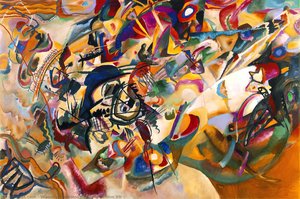 Composition VII - Wassily Kandinsky
Created in 1913, Composition VII stands as a monumental achievement in the evolution of modernism, marking a pivotal moment for Russian-born Wassily Kandinsky. This large-scale canvas represents a profound departure from representational art, serving as a primary example of the spiritual and experimental fervor that defined Russian artistic contributions during the 1910s. Moving beyond the descriptive role of color, Kandinsky utilizes a swirling vortex of intensely saturated hues—vibrant oranges, yellows, reds, and deep blues—to evoke a sense of cosmic energy and inner necessity.
The technique is characterized by a rich, impasto-like application of oil paint, where thick layering and visible, gestural brushstrokes create a tactile, turbulent surface. Rather than traditional perspective, the work achieves depth through the complex overlapping of biomorphic shapes and fragmented, organic forms. This chaotic yet meticulously balanced arrangement suggests themes of creation and transformation, mirroring the broader shift toward abstraction seen in the works of the era. By prioritizing emotional resonance and musicality over literal imagery, Kandinsky’s masterpiece captures the mystical and expressive essence of the 1910s, fundamentally altering the trajectory of 20th-century art.
Bathing of a Red Horse - Kuzma Petrov-Vodkin
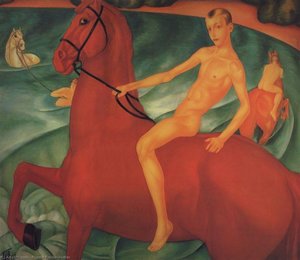 Bathing of a Red Horse - Kuzma Petrov-Vodkin
Created in 1912, Bathing of a Red Horse stands as a seminal work of the Russian 1910s, embodying the era's shift toward symbolic and visionary modernism. Kuzma Petrov-Vodkin, a master of spiritual composition, utilizes this piece to bridge the gap between traditional Russian iconography and the radical spatial experiments of the early 20th century. The painting is defined by its arresting, saturated red horse, which pulses with a rhythmic, almost cosmic energy against a landscape populated by ethereal figures and a distant dog.
A defining technical achievement of this work is Petrov-Vodkin’s signature spherical perspective. By rejecting standard linear depth, he creates a curved, encompassing sense of space that makes the scene feel monumental and immersive. The stark, white-toned figure riding the crimson beast provides a dramatic chromatic contrast, anchoring the composition amidst a swirling, symbolic atmosphere. This synthesis of intense color and unconventional geometry marks the painting as a profound expression of the spiritual and formal tensions that characterized the Russian avant-garde during this transformative decade.
Improvisation. Gorge - Wassily Kandinsky
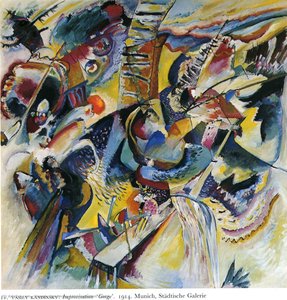 Improvisation. Gorge - Wassily Kandinsky
Wassily Kandinsky’s 1914 masterpiece, Improvisation. Gorge, stands as a seminal pillar of the Russian avant-garde during the 1910s. This work exemplifies the era's radical departure from representational traditions, moving toward a visual language of pure spiritual resonance. As a pioneer of the Der Blaue Reiter movement, Kandinsky utilized this period to explore the profound connection between color and the human soul, seeking to liberate art from the constraints of the visible world.
The composition is a dynamic, non-representational vortex of energy, characterized by a dense arrangement of geometric and organic forms. Sharp, angular lines intersect with flowing curves, creating a sense of rhythmic instability and movement. The technique is notably gestural, utilizing thick, impastoed layers of oil paint that lend a tactile, energetic quality to the canvas. Rather than depicting a physical landscape, the palette and form work in concert to evoke emotional turbulence and mystical sensations. Through this interplay of shapes and colors, Kandinsky transforms the canvas into a symphony of abstraction, marking a definitive shift in the trajectory of modern art during this transformative decade.
Mystical Head: Meditation - Alexej von Jawlensky
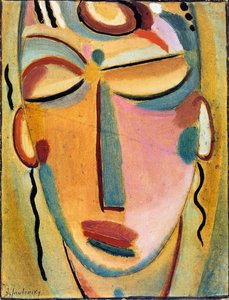 Mystical Head: Meditation - Alexej von Jawlensky
In this 1918 masterpiece, Alexej von Jawlensky captures the spiritual essence of the Russian avant-garde through a profound synthesis of Expressionism and Fauvism. The work centers on a stylized human face, where the artist abandons literal representation in favor of a rhythmic, meditative abstraction. By utilizing bold, angular lines and simplified geometric forms, Jawlensky moves beyond the physical to explore the internal landscape of the soul.
The technique is characterized by a vibrant, almost jarring color palette that creates intense visual energy. Thick, gestural brushstrokes and a heavy impasto texture lend the canvas a tactile quality, emphasizing the raw emotion inherent in the modernist movement of the 1910s. A prominent vertical division of the face suggests a duality between the material and spiritual realms, while the semi-closed eyes invite a sense of deep introspection. This focus on the psychological and the mystical exemplifies how Russian artists of this decade pushed the boundaries of portraiture, transforming the human visage into a vessel for pure, expressive energy and spiritual contemplation.
Wilhelmine with a Ball - Lovis Corinth
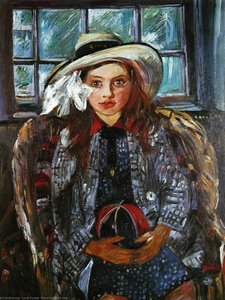 Wilhelmine with a Ball - Lovis Corinth
Lovis Corinth’s 1915 portrait, Wilhelmine with a Ball, serves as a profound example of the expressive shifts occurring across Europe during the 1910s. While much of the Russian avant-garde was exploring abstraction and color theory during this decade, Corinth—a German master bridging Impressionism and Expressionism—was turning inward toward the psychological weight of the human subject. This work captures a young girl seated in a moment of quiet contemplation, her presence defined by a sense of vulnerability and subtle melancholy.
The painting is characterized by a visceral, tactile quality. Corinth utilized a thick impasto technique, layering oil paints to create a sculptural texture that emphasizes the physicality of the medium. His palette, dominated by muted reds and deep espresso tones, avoids academic precision in favor of emotional resonance. The loose, gestural brushstrokes and shallow perspective create an atmosphere of spontaneity, mirroring the turbulent spirit of the mid-1910s. Through this expressive approach, Corinth moves beyond mere likeness, using light and organic, slightly distorted shapes to reveal the introspective state of his subject, making it a vital touchstone of the era's dramatic shift toward subjectivity.
Maslenitsa - Boris Kustodiev
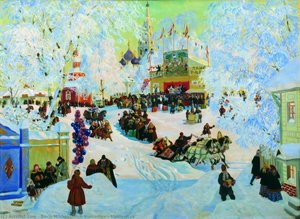 Maslenitsa - Boris Kustodiev
Boris Kustodiev’s 1916 masterpiece, Maslenitsa, serves as a quintessential example of Russian Realism during the 1910s, capturing a period of profound cultural transition. The work depicts the exuberant festival marking the end of winter, a time of communal joy and folklore. Set against a pristine, celadon-tinted snowy landscape, the scene is alive with a rhythmic crowd of figures navigating the winter chill. Kustodiev’s brushwork imbues the canvas with a sense of immediate movement, as individuals carry umbrellas and various belongings through the falling flakes.
What makes this work emblematic of the decade is its ability to blend the timeless with the contemporary. While the presence of a horse and traditional festivities evokes a deep sense of nostalgia for Russian folk traditions, the inclusion of modern accoutrements like backpacks grounds the scene in the lived reality of the early 20th century. Through a masterful interplay of stark whites and vibrant pops of color, Kustodiev transforms a bustling outdoor scene into a monumental celebration of resilience and the enduring spirit of Russian life.
Fruit Harvest in a Mountain Orchard - Marianne von Werefkin
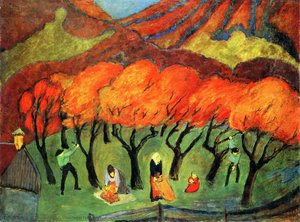 Fruit Harvest in a Mountain Orchard - Marianne von Werefkin
Created in 1912, Fruit Harvest in a Mountain Orchard serves as a quintessential example of the stylistic shifts occurring within Russian-born artists during the 1910s. Marianne von Werefkin, a pioneer of Expressionism, moves away from the strictures of her early training under Ilya Repin to embrace a more emotive, dreamlike visual language. This work exemplifies her ability to infuse landscape and human activity with profound psychological depth through a bold, non-naturalistic use of color.
The composition captures a serene moment of communal labor, featuring a group of individuals gathered amidst a lush orchard. The scene is defined by:
- Vibrant Autumnal Tones: A warm palette of reds, oranges, and yellows dominates the canvas, reflecting the intensity of the harvest season.
- Expressive Brushwork: The oil on panel technique provides a rich, textured surface that enhances the rhythmic energy of the figures.
- Atmospheric Depth: The interplay between the densely leafed trees and the distant mountain backdrop creates a tranquil yet powerful sense of space.
By prioritizing emotional resonance over mere topographical accuracy, Werefkin’s masterpiece stands as a testament to the avant-garde spirit that defined the Russian artistic landscape of this transformative decade.
Girl at the Piano - Sergey Vinogradov
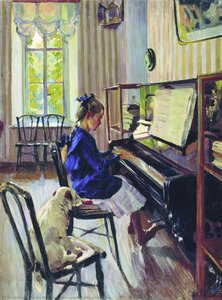 Girl at the Piano - Sergey Vinogradov
Painted in 1914, Girl at the Piano serves as a quintessential example of the lyrical genre painting that defined the Russian art scene during the 1910s. Sergey Vinogradov, a master of capturing the subtle nuances of everyday life, utilizes this composition to explore the intersection of domestic intimacy and the Impressionist fascination with light. The work belongs to this decade as it showcases the artist's mature period, where his brushwork transitioned into a looser, more expressive style, moving away from rigid academicism toward a more atmospheric, modern sensibility.
The scene is set within a cozy, lived-in interior, where a young girl is captured in a moment of quiet musical devotion. Vinogradov expertly arranges the domestic elements—the piano, chairs, and a dining table—to create a sense of depth and lived experience. The inclusion of a dog resting by the girl's side adds a layer of warmth and companionship, enhancing the nostalgic and comforting tone of the piece. Through a palette of soft, putty tones, the artist elevates a mundane household moment into a profound study of stillness and creative grace.
Landscape with Red House - Alexej von Jawlensky
 Landscape with Red House - Alexej von Jawlensky
The viewer is immediately struck by the vibrant, non-naturalistic tension between a fiery red house and the deep ultramarine shadows of the surrounding foliage. In this 1911 composition, Alexej von Jawlensky moves away from literal topography to embrace a rhythmic, Expressionist language. A central, dark tree trunk anchors the scene, acting as a structural pillar that divides the canvas and emphasizes a flattened perspective. The palette is a deliberate study in contrast, pitting electric cobalt blues against emerald greens and vivid reds, creating a psychological landscape rather than a mere wooded setting.
The work is a quintessential example of Russian art from the 1910s, a decade defined by radical experimentation and the shift toward abstraction. Jawlensky’s use of thick, gestural impasto and heavy, dark outlines reflects the era's preoccupation with capturing the spiritual essence of a subject through pure color harmony. By prioritizing the emotional resonance of pigment over realistic accuracy, the painting exemplifies the avant-garde spirit that emerged from the Russian art scene during this transformative period.
Merchants' Wives - Boris Kustodiev
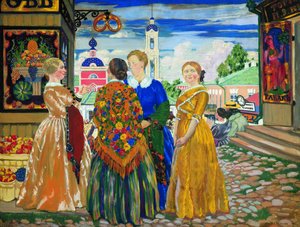 Merchants' Wives - Boris Kustodiev
Boris Kustodiev’s 1912 masterpiece, Merchants' Wives, serves as a vibrant window into the social fabric of pre-revolutionary Russia. As a prominent figure in the Academic Realism movement, Kustodiev possessed a unique ability to elevate the everyday lives of the merchant class into scenes of monumental beauty. This work captures a lively outdoor gathering, where a group of women are suspended in a moment of joyful camaraderie. The composition is rich with the textures of urban life, from the architectural depth of the background buildings to the delicate details of the subjects' attire, including the elegant sweep of an umbrella.
The painting is characterized by a lyrical handling of oil on canvas, where Kustodiev employs a palette that balances earthy architectural tones with the bright, spirited hues of the women's garments. There is a palpable sense of movement and whispered conversation, transforming a simple social interaction into a nostalgic tableau vivant. Through his masterful brushwork, Kustodiev does not merely document a specific social stratum; he captures the enduring spirit and colorful folk traditions that defined the Russian cultural landscape during the 1910s.
Conclusion
The Russian avant-garde of the 1910s represents a profound rupture in art history, where the boundaries between abstraction and representation were perpetually tested. From the spiritual geometry of Kandinsky to the vibrant, rhythmic compositions of Kustodiev and the nuanced color theories of Petrov-Vodkin, these works capture a decade of intense transformation and cultural upheaval. Each piece serves as a vital link in the evolution of modernism, bridging the gap between traditional Russian sensibilities and the radical new languages of the twentieth century.
For those looking to bring this era of intense creativity into their own space, Mus3ums.com offers a way to experience these masterpieces through our museum-quality, hand-painted oil reproductions. Whether you are drawn to the bold energy of the early abstractionists or the lush textures of the period's portraiture, our artists meticulously recreate the brushstrokes and tonal depth of these iconic works on 100% cotton canvas. You can explore the breadth of this transformative era by browsing our full collection and find a piece that resonates with your personal aesthetic.