Introduction
The 15th century in the Low Countries marked a profound revolution in the history of Western art, centered in the prosperous urban hubs of what is now Belgium. This era saw the birth of a distinct visual language characterized by an unprecedented devotion to naturalism and the mastery of oil pigments. Unlike the tempera-driven traditions of the South, these masters utilized the translucent qualities of oil to capture the subtle play of light on fabric, the intricate textures of precious stones, and the profound depth of human emotion. It was a period where the spiritual and the material converged, as artists sought to render the divine through the meticulous, almost scientific observation of the physical world.
During this golden age, the flourishing trade in Flanders provided the economic foundation for a sophisticated patronage of both religious institutions and wealthy merchants. This cultural wealth allowed for the development of highly detailed compositions that bridged the gap between the symbolic iconography of the Middle Ages and the humanistic realism of the Renaissance. The technical innovations of this period—specifically the refinement of the oil painting technique—changed the course of art history, influencing masters across Europe from Italy to Spain.
Today, these painters remain vital because they represent the very moment when art learned to breathe. Their ability to imbue a canvas with atmosphere and tactile reality continues to fascinate scholars and enthusiasts alike. By examining the works of the masters who defined this era, we gain insight into the origins of modern portraiture and landscape painting. The following selection explores the lives and legacies of the most influential figures of this movement, from the pioneers of light to the masters of complex religious narratives.
Jan van Eyck
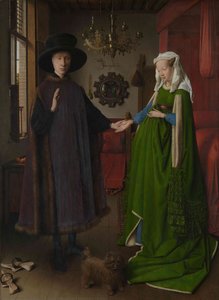 Portrait of Giovanni Arnolfini and his Wife - Jan van Eyck
As a central figure of the 15th century Flemish painters, Jan van Eyck (c. 1390–1441) fundamentally transformed the trajectory of Western art. Born into a lineage of skilled craftsmen in what is now Belgium, he was raised in a household where the secrets of pigment and preparation were shared among brothers, including Hubert and Lambert. His early training as a miniaturist and illuminator instilled in him a profound discipline for detail, a skill that would later define his monumental contributions to Early Netherlandish painting.
Van Eyck’s mastery of the oil medium allowed him to achieve a luminosity and depth previously unseen in the 15th century. By applying translucent glazes, he captured the subtle play of light on diverse textures, a technique that set him apart from his contemporaries. His Portrait of Giovanni Arnolfini and his Wife (1434) remains a definitive masterpiece of this era, serving as a complex window into Burgundian life through its unprecedented realism and intricate symbolism. Moving through the high-stakes halls of the Burgundian court, Van Eyck transitioned from a meticulous craftsman to a visionary whose ability to manipulate light and shadow would influence generations of artists across Europe."
Rogier van der Weyden
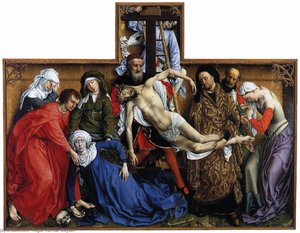 Deposition - Rogier van der Weyden
Born in Tournai around 1400, Rogier van der Weyden stands as a monumental figure among 15th century Belgian painters. His journey from a household of skilled craftsmen to the heights of the Burgundian court allowed him to redefine the emotional landscape of Early Netherlandish art. After honing a meticulous discipline in his youth, he entered the workshop of Robert Campin in 1427, a pivotal transition that transformed him from a craftsman into a master of psychological depth. Unlike the rigid iconography of previous eras, his work breathes with a visceral, human reality.
His masterpiece, Deposition (c. 1435), exemplifies this profound shift. In this work, the somber weight of grief is rendered through a sophisticated use of color and intricate detail, capturing a moment of intense religious devotion. The figures possess an idealized yet deeply expressive naturalism, where every tear and fold of fabric contributes to a sense of dramatic pathos. Through his ability to weave together technical precision and raw human emotion, van der Weyden secured his legacy as a central architect of the Northern Renaissance, leaving an indelible mark on the artistic heritage of the Low Countries."
Hugo van der Goes
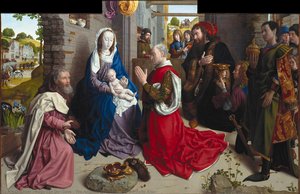 The Adoration of the Kings (Monforte Altar) - Hugo van der Goes
The Adoration of the Kings (Monforte Altar) serves as a profound testament to the dramatic realism that defined the career of Hugo van der Goes. In this 1470 masterpiece, the artist captures a sacred moment of divine homage, utilizing a sophisticated understanding of perspective to draw the viewer into the scene. The composition is characterized by a luminous quality, achieved through the meticulous application of oil paints on wood panels, where subtle gradations of color bring the textures of sumptuous garments and expressive faces to life.
As a pivotal figure born in the artistic hub of Ghent, Van der Goes stands as a cornerstone of the 15th century Belgian tradition. His work moved beyond the mere technical brilliance of his predecessors, introducing an unprecedented psychological depth and emotional weight to religious narratives. By imbuing his figures with individualized character and a sense of tangible reality, he bridged the gap between the stylized conventions of the early Northern Renaissance and the intense humanism that would later influence the Italian Renaissance. His ability to manipulate light and shadow to convey internal states—such as awe and reverence—cemented his legacy as a master of the Flemish Renaissance.
Quinten Metsys
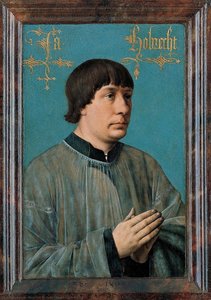 Jacob Obrecht - Quinten Metsys
A pivotal figure in the transition toward the Northern Renaissance, Quinten Metsys stands as the foundational architect of the Antwerp School. Born in Leuven, Belgium, around 1466, his artistic lineage is deeply rooted in the 15th-century traditions of the Low Countries. Having likely trained under the guidance of Dirk Bouts, Metsys inherited the meticulous devotion to verisimilitude established by predecessors like Hans Memling and Rogier van der Weyden. This connection to the masters of the previous generation ensures his place among the essential Belgian painters of the 15th-century tradition, even as his work began to signal a new era.
Metsys’s unique sensibility was shaped by a rumored early training as an ironsmith, a background that bestowed upon his canvases a profound, tactile reverence for the physical world. He possessed an uncanny ability to render the cold glint of metal and the heavy sheen of silk with startling precision. In his representative work, Jacob Obrecht, we witness this mastery of light and character. Through the careful application of thin oil glazes, he achieves a luminous depth, capturing the subject with a quiet, contemplative dignity that bridges the gap between spiritual devotion and the burgeoning humanism of a changing world.
Petrus Christus
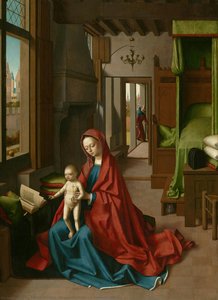 Virgin and Child in a Domestic Interior - Petrus Christus
A central figure in the artistic landscape of the 15th century, Petrus Christus emerged as a master in Bruges, a city that served as a vital hub for Flemish innovation. Following the era of Jan van Eyck, Christus became one of the most sought-after painters in the region, bridging the gap between the traditions of his predecessors and the evolving demands of the Northern Renaissance. His presence in the historical records of Bruges marks him as a quintessential representative of the 15th century painters from Belgium, as he refined the luminous oil techniques and meticulous detail that defined the era.
His technical brilliance is most profoundly captured in Virgin and Child in a Domestic Interior (1467). In this work, Christus moves beyond mere imitation of his contemporaries to become a pioneer of linear perspective. He masterfully utilizes architectural moldings and structured spaces to create a revolutionary sense of three-dimensional reality. The light, streaming softly through a window, does not merely illuminate the scene; it sculpts the figures, transforming a quiet, domestic setting into a sacred sanctuary of stillness and devotion. Through this sophisticated use of space and light, he elevated the intimacy of the divine to a tangible, human experience.
Aelbrecht Bouts
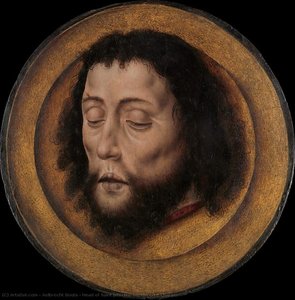 Head of Saint John the Baptist on a Charger - Aelbrecht Bouts
Born in Leuven around 1452, Aelbrecht Bouts stands as a pivotal figure among 15th century Flemish painters from Belgium. As the son of the renowned Dieric Bouts the Elder, he was raised within a prestigious artistic lineage that defined the visual language of the era. While his early training in his father's workshop provided a foundation in the meticulous rendering of drapery and rich, earthy tones, Aelbrecht eventually transcended his familial influence to develop a highly personal, expressive style. His work is characterized by an intense emotionality and a profound sensitivity to themes of spiritual contemplation and human sorrow.
This mastery of dramatic introspection is epitomized in his work, Head of Saint John the Baptist on a Charger. In this piece, Bouts moves beyond mere religious iconography to create a meditation on mortality. Through exceptional technical precision, he achieves a startling verisimilitude, capturing the subtle textures of the saint's visage against a shimmering gold background. The composition invites a quiet, melancholic dialogue, transforming a somber subject into a profound study of the human soul, a hallmark of his contribution to the Flemish Renaissance.
Juan de Flandes
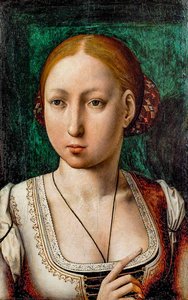 Portrait of Joan the Mad - Juan de Flandes
The identity of Juan de Flandes remains one of the most captivating mysteries of the Early Netherlandish tradition. Though his career reached its zenith in the Spanish court, his artistic soul was firmly rooted in the vibrant traditions of 15th-century Belgium. Emerging from the prestigious artistic milieu of Ghent, he was shaped by the innovations of the Ghent School, absorbing the technical precision that defined the era's masters. This Belgian foundation allowed him to bridge the gap between Northern meticulousness and the solemn grandeur of the Spanish Renaissance.
His destiny became inextricably linked with the Spanish Crown in 1496 when he secured the patronage of Queen Isabella I of Castile. This pivotal moment is epitomized in his Portrait of Joan the Mad, a work that transcends mere likeness. In this masterpiece, he captures the complex dignity of Joan I of Castile, blending the microscopic detail characteristic of his Flemish training with a profound, reflective sensibility. By translating the delicate interplay of light and texture learned in the Low Countries to the service of the Spanish monarchy, Juan de Flandes became a vital link between the Northern masters and the evolving Iberian aesthetic.
Petrus Christus
 Annunciation - Petrus Christus
A central figure in the evolution of the Early Netherlandish school, Petrus Christus represents the technical sophistication of 15th century Belgian painters. Active during the mid-to-late 1400s, his career is defined by a profound ability to translate the spiritual into the tangible through meticulous realism. He is particularly noted for his mastery of light and his capacity to organize complex theological narratives within structured, harmonious compositions.
His work is characterized by an intense attention to detail that bridges the gap between the earthly and the divine. In his Annunciation, he demonstrates a remarkable command of spatial depth and atmosphere, using light to sanctify the scene and evoke a sense of profound reverence. This ability to capture subtle human emotions and the textures of the physical world solidified his reputation as a master of his era. By integrating advanced oil painting techniques, Christus helped define the aesthetic standards of the 15th century Belgian tradition, ensuring his legacy as a pivotal artist whose influence resonated throughout the Low Countries.
Bernard Van Orley
 A Young Man - Bernard Van Orley
A pivotal figure in the transition from the Early Netherlandish tradition to the High Renaissance, Bernard Van Orley represents the evolution of the artistic legacy established by 15th-century Belgian masters. Born into a family of established painters in Brussels, his lineage connects him directly to the meticulous, detail-oriented traditions that defined the region's art during the 1400s. While his roots were firmly planted in the Flemish soil of his predecessors, Van Orley became a transformative force by synthesizing Northern precision with the classical ideals of Italy.
His transformative journeys to Rome allowed him to absorb the anatomical accuracy and graceful compositions of masters like Raphael, a skill set he brought back to the courts of Charles V and Mary of Hungary. This fusion of styles is evident in the quiet intensity of A Young Man. In this work, the artist demonstrates the profound ability to capture a singular identity through oil on oak, utilizing a dramatic, saturated red background to push the subject into the viewer's immediate presence. The portrait showcases the refined elegance and technical mastery that allowed him to bridge the gap between the late medieval Flemish style and the burgeoning Renaissance era.
Jan Provoost
 Mourning of Christ - Jan Provoost
A true polymath of the Northern Renaissance, Jan Provoost represents the sophisticated evolution of the 15th century Belgian tradition. Born around 1462, his career bridged the gap between the late Middle Ages and the burgeoning humanism of the new era. His stylistic lineage is deeply rooted in the Bruges school, where he is believed to have absorbed the luminous, atmospheric qualities and meticulous attention to detail characteristic of Hans Memling. As a master who achieved burgher status in Bruges in 1494, Provoost’s influence extended through his influential workshops in both Bruges and Antwerp, cementing his place among the premier painters of the region during this transformative century.
One can recognize a Provoost original by the profound sense of spiritual depth achieved through masterful glazing. His technique involves applying thin, translucent layers of oil paint to create a radiant, inner light that animates the surface. In his 1490 work, Mourning of Christ, this is exemplified by the sculptural weight of the drapery and the somber, dramatic interplay of light and shadow. The composition utilizes a rich palette of deep reds, blues, and heavy browns to heighten the emotional gravity of the scene, rendered with a tactile realism that defines the Early Netherlandish style.
Conclusion
The masters of the 15th century from this region redefined the visual language of Europe, moving from the symbolic rigidity of the Middle Ages toward a profound, luminous realism. From the microscopic precision of Jan van Eyck to the emotional intensity found in the compositions of Rogier van der Weyden, these artists mastered the alchemy of oil paint to capture the texture of velvet, the glint of light on metal, and the deep psychological complexity of the human soul. Whether through the intricate landscapes of Hugo van der Goes or the delicate portraiture of Petrus Christus, their collective legacy remains a testament to the power of observation and technical brilliance.
At Mus3ums.com, we invite you to bring this era of unparalleled craftsmanship into your own living space. Our dedicated team of academic artists specializes in recreating these historical masterpieces as museum-quality, hand-painted oil reproductions on 100% cotton canvas. By choosing a custom commission, you can own a piece of art history that honors the original brushstrokes and tonal depth of these Flemish legends. Explore our full collection and find the perfect masterpiece to transform your home.