Introduction
French Orientalist painters were captivated by the landscapes, architecture, and daily life of North Africa and West Asia, creating a visual bridge between Europe and the East during the 19th century. Driven by a fascination with the exoticism of the Maghreb and the Levant, these artists often blended meticulous academic realism with a romanticized, sometimes imagined, perspective of distant cultures. Their works frequently sought to capture the intense light, vibrant colors, and intricate textures of markets, harems, and desert vistas, often reflecting the complex geopolitical tensions and colonial curiosities of their era.
This movement represents a significant chapter in art history, where the precision of French academic training met a profound desire for the unknown. While their depictions were often filtered through a Western lens, the technical mastery and dramatic compositions of these painters have left an indelible mark on the evolution of color and light in modern art. Today, these works continue to resonate for their evocative storytelling and the sheer sensory power of their brushwork.
To understand the depth of this aesthetic, one must look at the masters who defined the genre. From the highly detailed narratives of Jean-Léon Gérôme to the atmospheric explorations of Eugène Fromentin, the following artists represent the pinnacle of French Orientalist expression.
Jean-Léon Gérôme
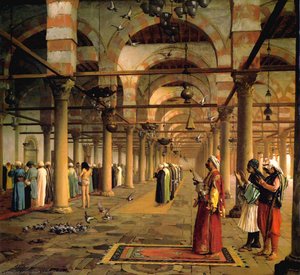
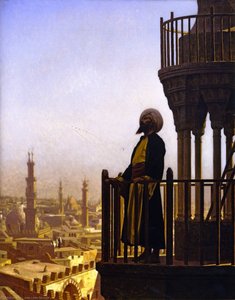
In his 1870 masterpiece, Public Prayer in the Mosque of Amr, Cairo, Jean-Léon Gérôme captures a profound moment of spiritual unity through a masterful command of perspective and light. This work exemplifies his ability to transport the viewer into the heart of Islamic devotion, using a rhythmic composition of worshippers and towering arches to create a sense of immense architectural scale. His palette, rich in warm ochres and earthy reds, is punctuated by the vibrant attire of the devotees, all bathed in a soft, natural light that filters through the sacred space.
Born in 1824, Gérôme became a titan of French Academicism, a movement he defended with militant conviction. His technical precision was forged in the studios of Paul Delaroche and Charles Gleyre, and further refined by his travels through the ancient ruins of Italy. As a leading figure among French Orientalist painters, Gérôme was celebrated for his ability to blend meticulous, almost photographic detail with dramatic historical and exotic narratives. Whether depicting the quiet reverence of a mosque or the intensity of Roman antiquity, his work remains a testament to the rigorous standards of the 19th-century French academic tradition, characterized by a seamless fusion of realism and atmospheric storytelling.
Jean-Joseph Benjamin-Constant
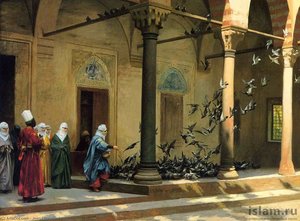
 Scene in a Harem (Un Envoi de Serbie) - Jean-Joseph Benjamin-Constant
A central figure in the French Orientalist movement, Jean-Joseph Benjamin-Constant (1845–1902) masterfully bridged the gap between rigorous academic precision and the romantic allure of the exotic. Trained at the École des Beaux-Arts under the esteemed Alexandre Cabanel, his early career was rooted in the dramatic compositions of historical painting. However, his artistic soul was truly ignited during a transformative journey to Morocco in 1872. This immersion into North African life allowed him to move beyond mere observation, enabling him to translate the vibrant colors and captivating light of the Maghreb into evocative, sensory experiences.
His place among the great French Orientalist painters is defined by this ability to blend technical mastery with a fascination for the mysterious customs of the East. In his representative work, Scene in a Harem (Un Envoi de Serbie) (1876), he explores the quiet tensions of private, shadowed interiors. Through this piece, Benjamin-Constant captures the stillness of a domestic yet provocative moment, utilizing a rich, atmospheric palette to transport the viewer into a world of profound privacy and cultural intrigue.
Eugène Fromentin
 Women of the Ouled Nayls - Eugène Fromentin
Eugène Fromentin (1820–1876) stands as a pivotal figure among French Orientalist painters, distinguished by his ability to transcend mere exoticism through a profound, firsthand engagement with North African life. Unlike many of his contemporaries who relied on studio imagination, Fromentin’s work was forged through direct experience, including a 1852 mission accompanying an archaeological expedition. This intimate knowledge of the Sahara allowed him to blend Romanticism with a striking, atmospheric realism that captured the very essence of the desert's light and heat.
His mastery of light and shadow is perhaps most poignantly captured in his 1867 work, Women of the Ouled Nayls. In this composition, Fromentin moves away from the grand, sweeping vistas of his earlier acclaim to explore a more intimate, quietude-filled moment. Through a sophisticated use of chiaroscuro, he illuminates the stark white drapery of the women against the deep ochre and umber tones of an enclosed Algerian courtyard. The painting exemplifies his unique contribution to the movement: a meticulous, tactile observation of human presence within a sun-drenched, architectural landscape, rendered with a precision that makes the heat and stillness of the moment feel palpable.
Alexandre Gabriel Decamps
 Souvenir de la Turquie d'Asie, dit aussi Enfants turcs auprès d'une fontaine - Alexandre Gabriel Decamps
A pioneer of the Orientalist movement, Alexandre Gabriel Decamps (1803–1860) broke away from rigid academic conventions to capture the essence of the East through a lens of Romanticism. His work is instantly recognizable by its bold, vigorous brushstrokes and a profound sense of narrative realism. Unlike many of his contemporaries who relied on idealized fantasies, Decamps utilized his travels to North Africa and the Middle East to ground his compositions in authentic, lived-in atmospheres, often imbuing his scenes with a dramatic, sun-drenched vitality.
In his evocative work, Souvenir de la Turquie d'Asie, dit aussi Enfants turcs auprès d'une fontaine (1846), Decamps demonstrates his mastery of light and texture. The painting captures a serene, playful moment where Turkish children gather around a slow-moving tortoise near a stone fountain. Through meticulous attention to the textures of weathered masonry and the soft movements of animals, he transforms a simple courtyard scene into a captivating window into a different world. His ability to blend meticulous observation with a vibrant, expressive palette ensures his place as a foundational figure in French Orientalist painting.
Victor Huguet
 Coats of arms of King João I and Queen Phillipa of Lancaster - Victor Huguet
Victor Pierre Huguet (1835–1902) was a distinguished figure among French Orientalist painters, a group dedicated to capturing the vibrant essence of North Africa and the Middle East. His artistic journey was deeply shaped by his studies under Émile Loubon and, most significantly, the renowned Orientalist Eugène Fromentin. It was Fromentin’s influence that steered Huguet toward a style rooted in direct observation and the authentic portrayal of local life, a hallmark of the movement. His early travels to Egypt in 1852 ignited a lifelong fascination with the region's profound history and architecture, allowing him to translate the exotic allure of distant lands into detailed, evocative canvases.
While his reputation is built upon the landscapes and cultural scenes of the Orient, his technical precision is also evident in his ability to interpret historical grandeur. In the Coats of arms of King João I and Queen Phillipa of Lancaster, one observes the masterful hand of an artist capable of breathing life into rigid, historical subjects. This work demonstrates the same meticulous attention to detail and composition that Huguet applied to his depictions of Eastern traditions, bridging the gap between the monumental weight of European history and the intimate, nuanced observations of his Orientalist masterpieces.
Georges Antoine Rochegrosse
 Portrait Of An Oriental Woman - Georges Antoine Rochegrosse
Georges Antoine Rochegrosse (1859–1938) stands as a formidable figure within the French Orientalist movement, a genre that sought to interpret the exoticism of North Africa and West Asia through a European lens. While his early training at the Académie Julian under Jules Joseph Lefebvre and Gustave Boulanger focused on the dramatic intensity of historical epics, Rochegrosse eventually transitioned his theatrical sensibility toward the allure of the Orient. His work often bridged the gap between academic rigor and the evocative, sometimes imagined, atmospheres characteristic of Orientalist art.
In his representative work, Portrait Of An Oriental Woman, Rochegrosse demonstrates the elegance and romanticism that defined his approach to the movement. The composition centers on a woman adorned with an ornate necklace and a floral headpiece, her long hair cascading down her back. Through a structured arrangement of figures and a direct, engaging gaze, the artist captures a sense of poised grace. This piece exemplifies how Rochegrosse utilized the stylistic tools of the late 19th century to transform exotic subject matter into a sophisticated visual experience, blending meticulous detail with the vibrant, emotive spirit of French Orientalism.
Nasreddine Dinet
 The snake charmer - Nasreddine Dinet
Nasreddine Dinet stands as a singular figure among French Orientalist painters due to his profound spiritual and cultural immersion in the Maghreb. Born in Paris in 1861, he received his classical training at the Académie Julian and the École nationale supérieure des Beaux-Arts. However, his artistic trajectory shifted fundamentally when he moved beyond the academic traditions of France to embrace the life and faith of Algeria. By converting to Islam and adopting his namesake, Dinet transitioned from a mere observer of North African customs to a dedicated chronicler of its authentic essence, bridging the gap between European technique and ethnographic truth.
His masterpiece, The snake charmer (1889), exemplifies this deep connection to the subject matter. In this oil on canvas, Dinet captures a vibrant, spontaneous moment of community performance. Rather than presenting a staged or imagined fantasy, the work offers a vivid slice of life, focusing on a charismatic performer amidst a circle of spectators. Through his mastery of light and detail, he portrays the textures of turbans and the energy of the gathering with a sense of immediate presence, making the ritual feel as though it is unfolding directly before the viewer.
Georges Clairin
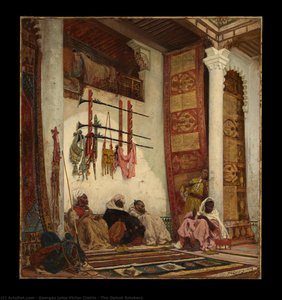 The Opium Smokers - Georges Clairin
Georges Clairin (1843–1919) stands as a luminous figure among French Orientalist painters, bridging the gap between academic precision and the romanticized allure of the East. Trained in the prestigious workshops of Isidore Pils and François-Édouard Picot, Clairin’s artistic journey was shaped by extensive travels through Spain and Italy alongside contemporaries like Jean-Léon Gérôme. His deep immersion in North African culture, particularly through frequent journeys to Morocco and Egypt, allowed him to master the depiction of Moorish architecture and the vibrant energy of Eastern life.
His inclusion in the Orientalist movement is defined by his ability to capture the exoticism of the Maghreb, often focusing on the dramatic movement of dancers and horsemen. In his representative work, The Opium Smokers (1872), Clairin demonstrates a sophisticated command of atmosphere, utilizing a rich palette to depict figures in states of repose within highly decorated, intimate settings. Beyond his North African themes, he was famously the close confidant and portraitist of the legendary actress Sarah Bernhardt, often portraying her in elaborate, theatrical costumes that echoed the dramatic intensity found in his Orientalist compositions. His style remains a masterful blend of realism and romanticism, immortalizing the ethereal beauty of his subjects.
Théodore Frère
 Funeral in the Vicinity of the Town of Constantina - Théodore Frère
Théodore Frère stands as a quintessential figure among French Orientalist painters, a master who transitioned from the academic rigor of Paris to the evocative landscapes of North Africa. After receiving foundational training at the prestigious École des Beaux-Arts under Jules Coignet and Camille Roqueplan, Frère’s artistic trajectory was irrevocably altered by his travels. His journeys to Algeria and Constantine in the late 1830s provided the essential spark for his specialization in Orientalist themes, moving him away from his early French landscapes toward the vibrant, often dramatic atmospheres of the Middle East.
His ability to synthesize meticulous technical skill with a profound sense of place is exemplified in his 1841 work, Funeral in the Vicinity of the Town of Constantina. In this piece, Frère captures a somber procession navigating a rugged, mountainous terrain, demonstrating his capacity to render both the vast scale of the natural world and the intimate human narratives of mourning. Through his use of light and color, he became renowned for documenting the daily life and shifting atmospheres of regions like Cairo and Jerusalem, securing his legacy as a painter who brought the exotic light of the Orient to the Parisian Salon.
Prosper Marilhat
 Arabes Syriens En Voyage - Prosper Marilhat
Prosper Marilhat (1811–1847) remains a captivating figure of the French Orientalist movement, known for capturing the evocative spirit of the Middle East through an emotional, romantic lens. Unlike those who sought only to document, Marilhat translated his travels to Egypt and Syria into scenes imbued with mystery and a profound sense of longing. His work is instantly recognizable by its mastery of light; he possessed a unique ability to depict the heavy, shimmering heat of the desert and the golden glow bathing ancient ruins.
A quintessential example of his talent is the oil on wood painting, Arabes syriens en voyage. In this work, Marilhat captures a quiet, rhythmic moment of life as a caravan moves through an arid landscape. The composition emphasizes the crushing weight of the midday sun, using dense pigments to convey the stillness and dust of the terrain. His brushwork effectively recreates the atmospheric haze of the horizon, where the landscape seems to dissolve into the sand. Through his focus on the light and life of the Orient, Marilhat transformed the vastness of the desert into intimate, soulful encounters with the unfamiliar.
Conclusion
The legacy of these masters lies in their ability to weave complex narratives of light, shadow, and exoticism, transforming the landscapes and social customs of North Africa and West Asia into vivid visual poetry. From the meticulous, academic precision of Jean-Léon Gérôme to the atmospheric, light-drenched compositions of Nasreddine Dinet, each artist contributed a unique lens through which the Western world viewed the East, whether through a romanticized lens or a more observational, textured approach. Together, they defined a movement that captured the imagination of an entire era, blending historical grandeur with the intimate details of daily life.
For those looking to bring this sense of historical drama and vibrant color into a modern space, Mus3ums.com offers a way to connect with these storied traditions. You can explore our full collection to find your favorite scene, available as museum-quality, hand-painted oil reproductions that preserve the soul and texture of the original masterpieces.