who was andre breton
 André Robert Breton
André Breton: Surrealist writer & poet (1896-1966). Co-founder of surrealism, known for ‘Nadja’ & ‘L'Amour Fou’. Pioneered 'pure psychic automatism'. Explore his revolutionary art.
André Robert Breton (1896–1966) was a French writer, poet, and critic who served as the principal theorist and co-founder of Surrealism. Born in Tinchebray, Normandy, he transitioned from medical studies and Dadaism to establish a transformative movement focused on the creative potential of the unconscious mind.
Breton was born to a modest family; his father, Louis-Justin Breton, was a policeman and his mother, Marguerite-Marie-Eugénie Le Gouguès, was a former seamstress. His medical training was interrupted by World War I, during which he worked in a neurological ward in Nantes. This experience provided him with early exposure to the workings of the human psyche.
His intellectual development was further shaped by his association with the Dada movement (1916) and his encounter with Jacques Vaché. Following the war, Breton moved to Paris, living at rue Fontaine No. 42 in the Pigalle district from 1 January 1922. His personal life included marriage to Simone Kahn on 15 September 1921.
Who was André Breton?
André Breton was a central figure in twentieth-century French literature and art, known for defining the Surrealist movement. He was a prolific author of works such as Nadja (1928) and L'Amour fou (Mad Love), and he was a key leader who shaped the direction of Surrealist thought and practice.
Breton's influence extended into the political sphere. He was a member of the French Communist Party from 1927 to 1933 before later embracing pure anarchism. During World War II, he was forced to leave occupied France due to a ban on his writing by the Vichy government, eventually finding refuge in the United States and Canada.
His personal collection was extensive and diverse, containing over 5,300 items. This collection included:
- Modern paintings and drawings
- Sculptures and photographs
- Books and art catalogs
- Journals and manuscripts
- Works of popular and Oceanic art
What was his role in the Surrealist movement?
Breton acted as the primary architect and leader of the Surrealist movement. Through his theoretical writings and the founding of key publications, he established the movement's formal principles, policed its boundaries, and provided the intellectual framework that allowed Surrealism to expand from a literary circle into a global phenomenon.
In 1924, he published the Manifeste du surréalisme (Surrealist Manifesto), which formally announced the movement. This was followed by the founding of the magazine La Révolution surréaliste and the Bureau of Surrealist Research. His leadership was characterized by a strong personality, which led to both the cohesion of the group and internal conflicts.
The movement's evolution was marked by several key milestones:
- 1919: Launch of the review Littérature with Louis Aragon and Philippe Soupault
- 1924: Publication of the first Manifeste du surréalisme
- 1929: Publication of the Second manifeste du surréalisme
How did his theories of psychic automatism change art?
Breton introduced the concept of "pure psychic automatism" to bypass the constraints of reason and aesthetic or moral preoccupations. This technique aimed to express the real process of thought by tapping into the subconscious, fundamentally shifting the focus of art from external reality to the internal landscape of dreams.
This method was explored through automatic writing, a technique designed to allow the subconscious to dictate content without conscious control. Breton and Philippe Soupault demonstrated this in their collaborative work, Les Champs Magnétiques (The Magnetic Fields). This approach encouraged artists to embrace the irrational and the unexpected as legitimate sources of inspiration.
By advocating for the resolution of the contradictory states of dream and reality into a "surreality," Breton changed how artists approached composition and subject matter. This shift moved art away from traditional logic and toward the exploration of the marvelous and the uncanny.
Which artists were influenced by his ideas?
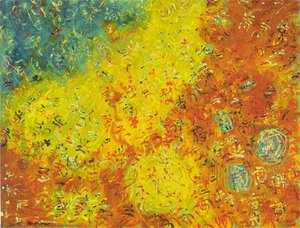
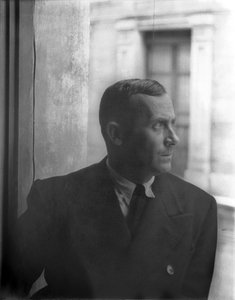 Joan Miró
Explore Joan Miró's vibrant world! Discover Surrealist & abstract masterpieces, Catalan symbolism, & playful forms. A pioneer of modern art – view works at Mus3ums!
Breton's theories influenced a wide range of prominent twentieth-century artists across various media. His emphasis on the unconscious and spontaneous expression provided the conceptual foundation for many painters, sculptors, and poets who sought to break away from conventional rationalism and academic traditions.
The following artists were closely associated with Breton or the Surrealist movement he led:
- Salvador Dalí
- Joan Miró
- Max Ernst
- Marcel Duchamp
- Toyen
- Paul Éluard
- Louis Aragon
- Robert Desnos
Breton's legacy is also visible in the work of later movements that utilized similar explorations of the subconscious. His ability to merge poetic concepts with visual art helped facilitate collaborations with many of the most significant figures in modern art history.
Frequently asked questions
Where was he born?
He was born in Tinchebray, Normandy, in 1896.
Where did he work during WWI?
He worked in a neurological ward in Nantes during WWI.
How many items were in his Paris collection?
His Paris collection included over 5,300 items.
What did he co-author?
He co-authored Les Champs Magnétiques with Philippe Soupault.
Learn more
- 1896 – 1966André Robert Breton BiographyDiscover the profound life and pivotal role of the man who defined the Surrealist movement.
- All André Robert Breton ArtworksExplore our curated collection of Breton's works, from archival giclee prints to museum-quality hand-painted oils.