



Introduction
The emergence of British baroque painters marks a transformative era in the visual history of the United Kingdom, characterized by a departure from the rigid, formal portraiture of the Tudor and Stuart periods toward a more emotive and theatrical aesthetic. During the 17th and early 18th centuries, the movement introduced a sophisticated use of chiaroscuro—the dramatic interplay of light and shadow—and dynamic, diagonal compositions designed to engage the viewer directly. This period saw the British Isles absorbing continental influences from the Low Countries and Italy, blending them with a distinct local sensibility that favored both grandiosity and a burgeoning interest in naturalistic detail.
Culturally, these artists operated within a landscape of significant political and religious shifts, providing the visual language for a rising aristocracy and a changing social order. Their works served as more than mere likenesses; they were studies in movement, texture, and psychological depth. Today, these painters remain essential to the study of Western art history, as their mastery of light and form laid the groundwork for the development of the English school of portraiture and landscape painting.
The following selection examines ten pivotal figures who defined this era, ranging from master portraitists to specialists in genre and landscape, illustrating the breadth of the Baroque spirit within the British Isles.
Cornelis Janssens van Ceulen
 Portrait of Elisabeth Vervoorn (1617-1657) - Cornelis Janssens van Ceulen
Cornelis Janssens van Ceulen (1593–1661) stands as a pivotal figure among British Baroque painters, representing the sophisticated fusion of Netherlandish precision and English courtly elegance. Born in London to Dutch or Flemish parents, his heritage allowed him to bridge the stylistic gap between the Continental traditions and the burgeoning Jacobean and Caroline art scenes. His inclusion in the Baroque movement is defined by his mastery of chiaroscuro and his ability to utilize dramatic light to define the social status and physical presence of his sitters.
A specialist in portraiture, Janssens van Ceulen gained immense prestige for his meticulous rendering of textures, particularly the fine linens and heavy fabrics favored by the English gentry. His Portrait of Elisabeth Vervoorn (1650) serves as a quintessential example of this technical prowess. In this work, he employs a somber, restricted palette of deep blacks and stark whites to create a sense of quiet dignity. The lighting, emanating from the upper left, carves the subject out of an indeterminate darkness, emphasizing the tactile quality of her gloves and the crispness of her collar. Through such works, he helped establish a standard of psychological depth and material realism that characterized the era.
William Dobson
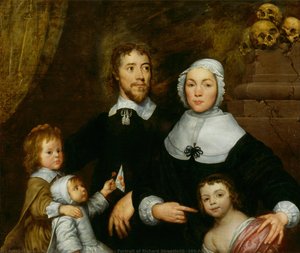 Portrait of Richard Streatfeild Family - William Dobson
William Dobson (1611–1646) stands as a pivotal figure in the development of British Baroque portraiture, bridging the gap between the elegance of the Caroline court and a more profound, dramatic realism. As a leading painter from the United Kingdom during this era, his work is characterized by a distinct Venetian influence, having absorbed the coloristic mastery and glazing techniques of Titian. This stylistic departure from the more rigid Mannerist traditions allowed him to infuse his subjects with a palpable, psychological depth that defined the movement's theatricality.
His Portrait of Richard Streatfeild Family (c. 1645) serves as a profound example of this Baroque sensibility. In this somber composition, Dobson utilizes the movement's signature use of chiaroscuro, placing the family against a receding, dark wooded backdrop. The work transcends simple documentation through its use of memento mori symbolism; the presence of a stack of skulls and a broken pedestal introduces a dramatic tension between the living subjects and the inevitability of death. Through such complex allegories and masterful tonal ranges, Dobson secured his reputation as one of the most significant English painters of the seventeenth century.
Samuel Cooper
 Portrait of Thomas Hobbes - Samuel Cooper
In the Portrait of Thomas Hobbes, the viewer encounters a profound encounter with Enlightenment intellect, captured within the intimate confines of a miniature. This work exemplifies the technical mastery of Samuel Cooper (1609–1672), a figure who stands as the preeminent miniaturist of the 17th century. His ability to render the sharp acuity of a subject's gaze and the delicate textures of hair and skin on such a small scale—often no larger than six inches—is nothing short of extraordinary.
As a central figure among British Baroque painters, Cooper utilized the period's characteristic focus on psychological depth and dramatic presence, albeit through the specialized medium of portrait miniatures. Trained under his uncle, the renowned artist John Hoskins, Cooper mastered the art of painting on ivory and gilt, a skill that allowed him to achieve a luminous, lifelike quality. His social standing was reflected in his patronage, which included luminaries such as Oliver Cromwell and Samuel Pepys. Beyond the brush, his cosmopolitan nature was evidenced by his fluency in French and his talent as a lutenist. Through his meticulous handling of tone and light, Cooper transformed small-scale portraiture into a powerful, sculptural medium of historical significance.
Alexander Cooper
 Willem II (1626-1650). Prince of Orange - Alexander Cooper
In the intimate oval format of Willem II (1626-1650), Prince of Orange, one encounters the profound ability of Alexander Cooper to command presence through miniature scale. This 1640 portrait captures the Prince in a moment of quiet nobility, utilizing a restrained palette of ochre, cream, and warm browns to define his features. The soft, directional lighting carves the contours of the face, creating a three-dimensional volume that belies the smallness of the support. Through delicate watercolor application, Cooper renders the intricate textures of a lace collar and the heavy weight of a doublet, all while maintaining a sense of psychological depth and a certain melancholic stillness.
Born in London in 1609, Alexander Cooper was a significant figure among British Baroque painters, specializing in the highly refined genre of portrait miniatures. Trained under the master Peter Oliver and sharing a creative lineage with his brother Samuel Cooper, his technical precision allowed him to navigate the sophisticated artistic circles of The Hague and Amsterdam. His membership in the Guild of Saint Luke and his eventual role as a court painter to Queen Christina of Sweden underscore his status as a premier miniaturist of the era, capable of translating the dramatic chiaroscuro and grandiosity of the Baroque movement into the most delicate of mediums.
Peter Oliver
 Portrait of Charles I Stuart (1600-1649) - Peter Oliver
Peter Oliver (1594–1648) stands as a vital figure among British Baroque painters, specifically through his mastery of the miniature portrait during a period of intense political and religious transition in the United Kingdom. Trained under his father, the celebrated Isaac Oliver, Peter inherited a sophisticated command of Flemish techniques, characterized by the meticulous layering of glazes to achieve a lifelike, breathing vitality. His work is distinguished by a commitment to Renaissance ideals of clarity and elegance, eschewing the more exaggerated flourishes of Mannerism in favor of precise, psychological depth.
A visitor can recognize an Oliver original by the exquisite, jewel-like precision of his brushwork and his ability to manipulate light and shadow on a microscopic scale. His Portrait of Charles I Stuart (1621) exemplifies this technical prowess. In this work, the sitter is rendered with a quiet dignity, where the soft, diffused light catches the pale smoothness of the skin and the intricate, tangible texture of a white lace ruff. The use of deep, contrasting tones—such as a black doublet against a vibrant cobalt blue sash—creates a dramatic, theatrical presence typical of the era's aesthetic, even within the intimate confines of a small-scale portrait.
Mary Beale
 King Charles II - Mary Beale
Born in Suffolk in 1633, Mary Beale emerged as a pioneering force within the British Baroque movement, carving out a professional legacy in an era that rarely permitted such female agency. Trained under the guidance of her father, John Cradock, she transitioned from a student of the arts to a highly sought-after portraitist. Her work is characterized by a profound ability to navigate the dramatic tension between light and shadow, a hallmark of the Baroque sensibility that defines her place among the premier painters of the United Kingdom.
Her technical mastery is most evident in her 1675 portrait, King Charles II. In this striking work, she utilizes chiaroscuro to pull the monarch from a deep, shadowy void, using directional light to illuminate the intricate textures of a white lace cravat and the soft contours of his face. The painting demonstrates a sophisticated command of oil on canvas, employing both delicate glazes and tactile impasto to render the voluminous curls of the sitter. Through this interplay of somber tones and luminous highlights, Beale captured the quiet prestige and heavy sovereignty of her subjects, securing her status as a master of 17th-century portraiture.
Johan Van Diest
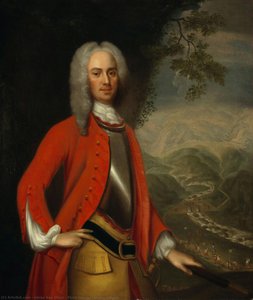 Field-Marshal George Wade - Johan Van Diest
Johan Van Diest (1695–1757) represents a sophisticated intersection of Dutch technical mastery and the British Baroque tradition. Although born in Leiden, his career and legacy are deeply intertwined with the United Kingdom, where he became a specialist in capturing the dignified presence of the era's most influential figures. His inclusion in the canon of British Baroque painters stems from his ability to adapt the dramatic chiaroscuro of the Dutch Masters to the specific demands of British portraiture, focusing on the psychological depth and social stature of the nation's nobility and military elite.
In his notable work, Field-Marshal George Wade (c. 1731), Van Diest demonstrates the quintessential Baroque tension between structured human authority and the untamed natural world. The portrait depicts the high-ranking officer in vibrant red military attire, his status reinforced by the meticulous rendering of lace and regalia. By placing the formal, composed figure against a rugged, mountainous landscape, Van Diest utilizes the dramatic diagonals and tonal contrasts characteristic of the Baroque movement to elevate the subject from a mere likeness to a symbol of indomitable command and duty.
Anthonie Palamedesz.
 Portrait of a Man, probably Pieter Anthonisz van Bronckhorst (1588-1661), Anthonie Palamedesz, 1652 - Anthonie Palamedesz.
Anthonie Palamedesz (1602–1673) represents a unique intersection of British and Dutch artistic heritage. Born in Leith, Scotland, his early life was shaped by the displacement of his family during the Eighty Years' War, a formative experience that lent a profound psychological depth to his later subjects. As a key figure in the Baroque movement, his work is characterized by a mastery of realism and the dramatic, theatrical use of light to define form and space. He was trained under the esteemed masters Hans Jordaens and Michiel Jansz. van Mierevelt, absorbing the foundational techniques of the Delft school.
A visitor can recognize a Palamedesz at a glance through his intimate genre scenes and his command of the cortegaarde, or guardroom scene, where he utilizes strong diagonals and deep shadows to pull the viewer into the narrative. His brushwork is meticulous, focusing on the understated elegance of the individual rather than idealized grandeur. In his 1652 Portrait of a Man, probably Pieter Anthonisz van Bronckhorst, we see his ability to capture the dignified presence of his sitters through a controlled, traditional composition and a sophisticated tonal range, often set against muted, atmospheric backgrounds that emphasize the character of the subject.
John Vanderbank
 George I (1660-1727) - John Vanderbank
In his 1726 portrait George I, John Vanderbank exemplifies the dramatic energy of the British Baroque through a masterful command of movement and light. The composition captures the monarch atop a rearing bay horse, utilizing a low perspective to instill a sense of royal authority. The striking contrast between the vermilion red of the King's coat and the deep blue of the sky creates a theatrical tension characteristic of the era, while the use of chiaroscuro illuminates the subject against a distant military landscape.
Vanderbank, born into a London Huguenot tapestry-weaving family, brought a unique sensitivity to texture and fabric that defined his career. Trained under Sir Godfrey Kneller at James Thornhill's Academy, he integrated classical portraiture techniques with a dynamic, characterful approach. His ability to render the sheen of a horse's coat and the intricate folds of silk demonstrates the technical sophistication required of a leading painter during the George I era. Beyond his celebrated portraits, his skill extended to intricate book illustrations, including works for Cervantes' Don Quixote. His legacy remains a testament to the expressive potential of the Baroque style in the United Kingdom, marked by both technical brilliance and a profound psychological depth.
John Michael Wright
John Michael Wright (1617–1694) stands as a pivotal figure among British Baroque painters, distinguished by his ability to synthesize the meticulousness of Northern European portraiture with the dramatic chiaroscuro of the Italian tradition. His artistic evolution was shaped by a cosmopolitan journey, beginning with his training under George Jamesone in Edinburgh and reaching a transformative peak during his residency in Rome. By enrolling at the Accademia di San Luca, Wright absorbed the sophisticated use of light and shadow that defines the Baroque aesthetic, a skill he later applied to the service of the English court under Charles II and James II.
His mastery of texture and theatrical lighting is exemplified in his 1676 work, Sir John Corbet of Adderley, 3rd Baronet. In this portrait, Wright utilizes a deep, near-black void to push the sitter into the foreground, a classic Baroque technique that emphasizes the physical presence of the subject. Through precise brushwork, he captures the tactile reality of seventeenth-century luxury, from the translucent delicacy of lace to the heavy, light-catching sheen of silk and metallic embroidery. This ability to marry realistic detail with dramatic, sculptural depth secures his legacy as a master of the Baroque style in the United Kingdom.
Conclusion
The British Baroque movement represents a pivotal era where the dramatic chiaroscuro of the continent met the distinct sensibilities of the United Kingdom. From the formal portraiture of William Dobson and Mary Beale to the sophisticated compositions of John Michael Wright, these artists collectively defined a visual language of power, emotion, and theatricality. Whether through the intimate character studies of the era or the grand, sweeping narratives of the period, these painters established a foundation for the evolution of British art, capturing the light and shadow of a transformative age.
For those seeking to integrate this historical grandeur into a modern setting, our full collection offers a gateway to these masterworks. We invite you to experience the tactile depth and emotional resonance of this era through our museum-quality, hand-painted oil reproductions, meticulously crafted to preserve the soul of the Baroque masters.


