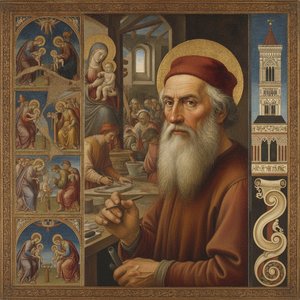
A Life Painted in Plaster and Light
In the quiet village of San Sebastiano Curone, a child was born who would eventually decorate the very walls of history. Felice Giani did not merely paint; he transformed spaces. His early years took him to Pavia, where he sat at the feet of Carlo Antonio Bianchi and the architect Antonio Galli Bibiena. This early exposure to architectural design shaped his hands, teaching him how a figure might inhabit a ceiling or how a painted drapery could follow the curve of a vault. He moved through Bologna, studying under Ubaldo Gandolfi and Domenico Pedrini, absorbing the academic rigors of the Accademia Clementina before the pull of Rome drew him toward the heart of the classical world.
His path was one of movement and patronage. Under the protection of Prince Andrea Doria Pamphili and later the marchese Luigi Botta, Giani found himself working in the grandest settings of Italy. He moved between the studios of Rome, where he learned from Pompeo Batoni and Christoph Unterberger, and the northern cities of Venice, Bologna, and Faenza. In Rome, his brush touched the Palazzo Altieri, creating scenes that breathed with the spirit of antiquity. He was a man who understood the weight of history, often choosing subjects drawn from the legends of Greece and Rome to satisfy the tastes of those who commissioned his work.
The Grandeur of the Neoclassical Vision
Giani possessed a particular talent for tempera on plaster, a medium that allowed him to create surfaces that felt as though they were part of the architecture itself. His style was defined by a certain clarity and a preference for Greco-Roman themes. He did not shy away from the massive scale required for palace decorations. In Faenza, his work reached a peak of productivity. Alongside a dedicated team of assistants including Gaetano Bertolini and Antonio Trentanove, he undertook the decoration of the Laderchi, Naldi, and Milzetti Palaces. The latter remains a significant achievement, where his frescoes display a mastery of light and form.
His hands were equally skilled in more intimate formats. He was a prodigious draughtsman, constantly sketching the Roman countryside or the lives of fellow artists. His drawings, often executed in pen, ink, and watercolor over black chalk, reveal a man deeply observant of the world around him. Whether he was working on a large-scale mural for the Palazzo Quirinale or a small sketch of a Roman view, the same dedication to classical proportion remained evident. He even traveled to France, where his influence helped shape the beginnings of the French Empire style through his work in the villa of Antonio Aldini.
A Legacy Written in Stone and Color
The later years of Giani's life were marked by continued activity and high honors. He joined the Accademia di San Luca and became a member of the Congregation of the Virtuosi of the Pantheon. Even as the political landscape of Europe shifted through revolution and war, his commissions continued to flow. He remained a proponent of the Neoclassical ideal, finding beauty in the symmetry and order of the ancient past. His work often featured:
- The marriage of mythological figures, such as Poseidon and Amphitrite.
- Historical scenes from the lives of Roman leaders like Numa Pompilius and Titus.
- Allegorical figures representing the arts, prosperity, and peace.
- Detailed architectural decorations that integrated painting with stucco work.
His life came to an abrupt end in Rome after a fall from his horse. He was laid to rest in the church of Sant'Andrea delle Fratte, leaving behind a vast corpus of work that spans walls, ceilings, and paper. His ability to blend the decorative with the narrative ensured that his name would remain linked to the era of Neoclassicism, a period when the grandeur of the past was reimagined for a new age.
الأسئلة والأجوبة
في أي مدينة ودولة وُلد Felice Giani؟
وُلد Felice Giani في San Sebastiano Curone، في Italy.
إلى أي حقبة تاريخية ينتمي Felice Giani؟
أبدع Felice Giani خلال حقبة Early Modern، وهي الفترة التي تضع نشاط الفنان في سياقه التاريخي.
بأي أسماء أخرى يُعرف Felice Giani؟
يُعرف Felice Giani أيضاً باسم Gianni Felice, Felice Gianni, Феличе Джани.