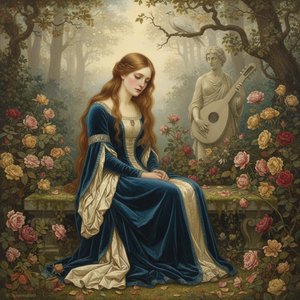
The Precision of an American Pre-Raphaelite
Robert Bolling Brandegee remains a vital figure for those who value technical rigor over mere sentiment. He was an American Pre-Raphaelite, a label that carries weight because of the specific, exacting manner in which he handled his medium. His work does not rely on vague impressions; instead, it demands attention through a brilliant palette and a disciplined approach to light and shadow. To look at a Brandegee is to see a controlled command of the brush, whether he was working in small-scale watercolors or oils on board.
His career was defined by a dual commitment to practice and pedagogy. He did not merely paint in isolation; he shaped the next generation of American artists through his teaching roles. His influence extended from the classrooms of Miss Porter's School for Girls in Farmington, Connecticut, to the prestigious Art Students League of New York. This ability to translate complex visual theories into instruction marks him as a central figure in the American academic tradition.
Technical Foundations and Stylistic Evolution
The development of his style was not accidental. It was the result of specific training and a deliberate engagement with European and American movements. His early work leaned heavily into the exacting techniques of the American Ruskinian circle, characterized by a meticulous attention to detail that many of his contemporaries ignored. As his career progressed, his brushwork shifted, absorbing the directness of the Munich School and the influence of Frank Duveneck.
Several key elements define his artistic output:
- The use of dramatic contrasts between light and dark to create depth.
- A preference for small-scale watercolors that require intense focus.
- A broad and direct painting technique in his later oil works.
- A focus on botanical, landscape, and genre subjects.
His movement through the art world was marked by a move from the precise, detailed watercolors of his youth toward a more robust, direct application of paint. This transition allowed him to master the play of light on varied surfaces, from the delicate petals of a Purple Iris to the heavy textures of a coastal harbor scene.
A Lasting Institutional Presence
The legitimacy of an artist is often measured by where their work resides after they are gone. Brandegee’s legacy is secured by his presence in major American collections. His work is held by the National Gallery of Art and the New Britain Museum of American Art. These are not mere placements; they are evidence of a career that met the highest standards of the National Academy of Design, which also holds his self-portrait.
He was a painter of substance, working from Berlin, Connecticut, until his death in Farmington. His ability to balance the delicate requirements of watercolor with the heavy demands of oil painting ensures his relevance to anyone studying the evolution of American realism. He did not follow trends; he mastered the tools of his trade.
الأسئلة والأجوبة
أين ومتى وُلد Robert Bolling Brandegee؟
وُلد Robert Bolling Brandegee في Berlin عام 1848.
في أي مدينة ودولة وُلد Robert Bolling Brandegee؟
وُلد Robert Bolling Brandegee في Berlin، في United States.
بأي أسماء أخرى يُعرف Robert Bolling Brandegee؟
يُعرف Robert Bolling Brandegee أيضاً بأسماء أخرى هي Robert Boling Brandegee, Robert Brandegee, Robert B. Brandegee, Robert Billing Brandegee.