Early Life and Artistic Beginnings
Albert Pinkham Ryder, born March 19, 1847, in New Bedford, Massachusetts, remains a somewhat enigmatic figure in American art history. Details of his childhood are scarce, shrouded in the mists that would later become so characteristic of his paintings. However, it is known that he began to explore his artistic inclinations early on, capturing the landscapes of his native New Bedford with nascent skill. This coastal upbringing, steeped in the atmosphere of a bustling whaling port, undoubtedly left an indelible mark on his imagination and would resurface throughout his career as a recurring source of inspiration.Little is documented about Ryder’s formative years. He was born into a family of Methodists who adhered to strict Quaker traditions regarding women's dress. His paternal grandparents resided in Cape Cod, where the seafaring heritage profoundly shaped his worldview.
From an early age, Ryder demonstrated an aptitude for drawing and painting—activities he pursued independently before formal artistic training began.
Formal Training and European Influences
Ryder’s formal art education commenced with studies under William Edgar Marshall in New York City. He subsequently enrolled at the National Academy of Design between 1870 and 1875, where he debuted his work in 1873 and forged a lifelong friendship with fellow artist Julian Alden Weir. These formative years provided him with a solid foundation in traditional techniques and introduced him to the established art world.However, Ryder’s artistic vision transcended conventional academic boundaries. Between 1877 and 1903, he undertook four expeditions to Europe—to Paris, London, Holland, and Belgium—immersing himself in the artistic currents of the Old World. He was particularly captivated by the French Barbizon school, which championed naturalism and plein air painting, and the Dutch Hague School, renowned for its atmospheric landscapes and muted color palettes.
These influences profoundly shaped Ryder’s aesthetic sensibilities, contributing to the development of his distinctive style—characterized by expansive brushstrokes, luminous tonal harmonies, and a preoccupation with spiritual themes.
A Unique Artistic Vision: Style and Themes
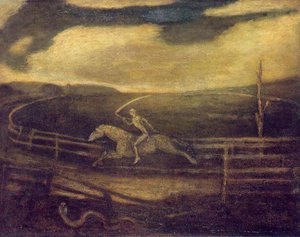
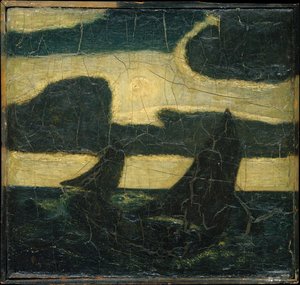
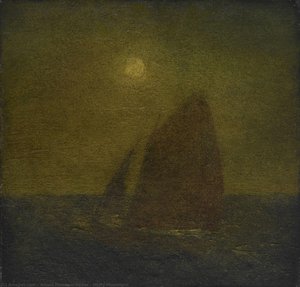
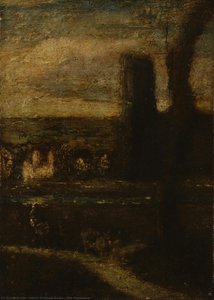
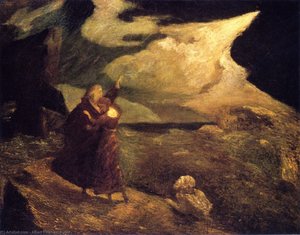
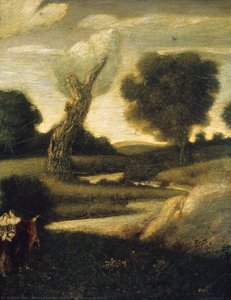
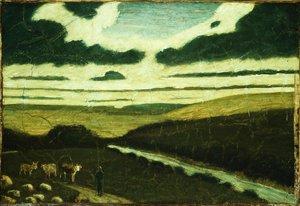
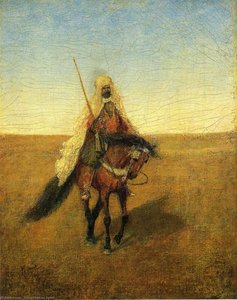
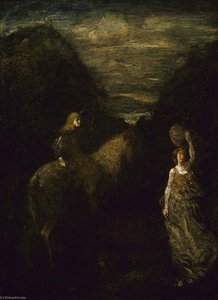
Ryder's artistic signature is instantly recognizable—a captivating blend of Symbolism, Tonalist Influences, and a deeply personal vision. His paintings are not mere representations of reality but rather evocative interpretations of nature infused with mood, mystery, and spiritual resonance.He favored broad, often ill-defined shapes and stylized figures set within dreamlike landscapes or seascapes, creating an atmosphere that is both ethereal and haunting. Light plays a crucial role in Ryder’s work—often depicted as diffuse and melancholic—illuminating his scenes with dim sunlight filtering through eerie clouds or the soft glow of moonlight.
Ryder skillfully manipulated color to create subtle variations and atmospheric effects, frequently employing a limited palette to maximize emotional impact. His paintings are imbued with symbolism—references to mythology and religious iconography—reflecting his profound engagement with spiritual ideas.
Major Achievements and Legacy
Ryder achieved considerable acclaim during his lifetime for his visionary landscapes and seascapes. Critics recognized his ability to convey complex emotions through understated visual language, establishing him as a pivotal figure in American Symbolist art.
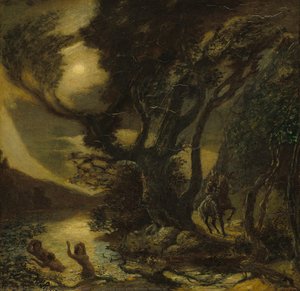
Notable works such as Misty Moonlight—inspired by his childhood memories of coastal New Bedford—exemplify Ryder’s capacity to transform personal experiences into universal expressions of longing and contemplation. Other significant paintings, like Siegfried & The Rhine Maidens, demonstrate his fascination with mythology and symbolism.
His influence extended beyond his immediate contemporaries; Jackson Pollock acknowledged Ryder as a precursor to Abstract Expressionism—a testament to Ryder’s enduring legacy as an innovator who reshaped the contours of American art history.
Ryder passed away on March 28, 1917, leaving behind a body of work that continues to captivate audiences today. A memorial exhibition held at the Metropolitan Museum of Art in New York in 1918 solidified his reputation as a major figure in American art.
Въпроси и отговори
Къде и през коя година е роден/а Алберт Пинкъм Райдер?
Алберт Пинкъм Райдер е роден в Ново Бъртсърд през 1847 г.
В коя историческа епоха е творил Алберт Пинкъм Райдер?
Алберт Пинкъм Райдер е творил в периода на XIX век. Този период определя историческия контекст на творчеството на художника.
В кой град и държава е роден/а Алберт Пинкъм Райдер?
Алберт Пинкъм Райдер е роден в Ново Бъртсърд, САЩ.