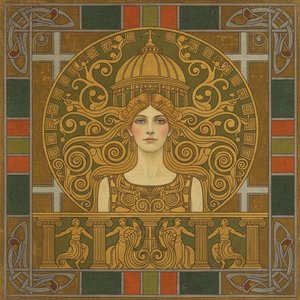
Ferdinand Andri: A Bridge Between Tradition and Modernity in Austrian Art
Ferdinand Andri, a name perhaps less familiar than some of his contemporaries within the vibrant artistic circles of late 19th and early 20th century Vienna, nevertheless represents a crucial figure in the evolution of Austrian art. Born in Waidhofen an der Ybbs in 1871, into a family deeply rooted in craftsmanship – his father a skilled gilder – Andri’s early life was inextricably linked to the tangible world of materials and form. This formative exposure, coupled with a demonstrable artistic talent from a young age, set him on a path that would ultimately lead him to become a key participant in the revolutionary Vienna Secession movement. His journey is one of constant evolution, seamlessly blending traditional techniques with a burgeoning embrace of modernism, resulting in a body of work characterized by both elegance and profound social commentary.Early Years and Artistic Foundations
Andri’s artistic education began modestly, apprenticed to woodcarver Johann Kepplinger in Ottensheim near Linz at the tender age of thirteen. This early experience wasn't merely about mastering a trade; it instilled within him an appreciation for meticulous craftsmanship, three-dimensional form, and the inherent beauty found in working with natural materials. He continued his artistic development at the Staatsgewerbeschule in Innsbruck, gaining foundational knowledge in various disciplines before ultimately enrolling at the prestigious Academy of Fine Arts in Vienna in 1886. There, he studied under influential figures such as Julius Victor Berger, Eduard von Lichtenfels, and August Eisenmenger – masters who exposed him to both the established conventions of academic art and the nascent currents of modern artistic thought. Crucially, Andri’s education extended beyond the confines of the studio; he embarked on extensive travels throughout Italy, France, England, and North America, immersing himself in diverse artistic styles and broadening his understanding of global cultural landscapes. These journeys weren't simply vacations; they were deliberate explorations aimed at absorbing new techniques, perspectives, and influences that would subtly shape his own evolving artistic vision. A pivotal moment arrived in 1897 with his marriage to Charlotte Hampel, a painter herself – eight years his senior – a union that undoubtedly fostered stimulating creative exchange and provided him with a valuable partner in navigating the complexities of the art world.Embracing Modernity: The Vienna Secession
The late 19th and early 20th centuries witnessed a profound shift in the artistic landscape of Austria, marked by a spirit of rebellion against the conservative norms of established institutions. Ferdinand Andri found himself at the heart of this movement as an active member of the Vienna Secession from 1899 to 1909. This group, comprised of artists like Gustav Klimt and Egon Schiele, bravely challenged the rigid hierarchies and restrictive practices of the traditional art academies, seeking new forms of expression that reflected the dynamism and anxieties of a rapidly changing world. Andri wasn’t merely a passive observer; he rose through the ranks, eventually serving as president of the Secession from 1905 to 1906, demonstrating his leadership and unwavering commitment to their innovative ideals. His involvement extended far beyond mere organizational duties – he actively contributed to *Ver Sacrum*, the Secession’s influential Art Nouveau magazine, a platform that showcased the group's groundbreaking work and disseminated their artistic philosophy. *Ver Sacrum* wasn’t just a publication; it was a manifesto, boldly rejecting academic conventions in favor of vibrant colors, flowing lines, and a celebration of nature and folk traditions. During this period, Andri demonstrated remarkable versatility, working across multiple disciplines – landscapes, genre paintings, portraits – each infused with the Secession's distinctive aesthetic sensibilities. He experimented with new techniques, incorporating elements of symbolism and abstraction into his work, pushing the boundaries of traditional artistic representation.War and Remembrance: A Painter of Conflict
The outbreak of World War I dramatically altered Ferdinand Andri’s artistic trajectory. From 1915 onward, he served as a war painter for the Imperial and Royal War Press Headquarters, tasked with documenting the realities of conflict on the front lines. This role took him to some of the most harrowing landscapes of the war – Belgrade, Montenegro, Albania, and the rugged Dolomites – where he captured scenes of both devastation and resilience. His work during this period wasn’t simply propaganda; it was an attempt to bear witness to the human cost of war, skillfully blending artistic talent with meticulous documentary observation. He depicted not only the brutal combat but also the suffering of civilians, the hardships endured by soldiers, and the quiet dignity found amidst the chaos. Andri's paintings from this era are particularly poignant for their unflinching honesty and emotional depth – a stark contrast to the often idealized portrayals of war prevalent at the time. Beyond his direct depictions of battlefields, he channeled his artistic talents into supporting the home front, creating powerful poster designs for organizations like the Children’s Relief Fund and wartime exhibitions, utilizing the graphic art skills honed during his time with the Vienna Secession. These posters served as poignant appeals to public sentiment, highlighting the suffering caused by the war and urging support for those affected.Legacy and Artistic Significance
Following the conclusion of World War I in 1918, Ferdinand Andri secured a long-sought teaching position at the Vienna Academy, relocating to St. Pölten before returning to Vienna. He remained there until 1939, imparting his knowledge and experience to a new generation of artists. Despite the challenges posed by the rise of Nazism and the subsequent suppression of modern art, Andri continued to create, producing works that reflected both his personal experiences and his enduring artistic vision. In 1950, he generously donated all remaining works from his possession to the city of St. Pölten, a testament to his commitment to his community and a lasting tribute to his artistic legacy. Ferdinand Andri passed away in Vienna on May 19, 1956, leaving behind a body of work that stands as a compelling reminder of the power of creativity to reflect, challenge, and ultimately transcend the complexities of its time. His paintings can be found in esteemed collections such as the Österreichische Galerie Belvedere in Vienna, the Lentos Kunstmuseum Linz, and the Museum Niederösterreich, ensuring that his vision continues to inspire and resonate with audiences for generations to come. Andri’s art represents a crucial bridge between traditional craftsmanship and the innovative spirit of modern artistic movements – a testament to his enduring influence on Austrian art history.Въпроси и отговори
В коя историческа епоха е творил Фердинанд Андри?
Фердинанд Андри е творил в периода на Модерно изкуство. Този период определя историческия контекст на творчеството на художника.
В кой град и държава е роден/а Фердинанд Андри?
Фердинанд Андри е роден в Вайдхофен ан дер Йбс, Австрия.