Early Life, Family and Training
The Black Forest village of Menzenschwand provides the setting for the birth of Franz Xavier Winterhalter on 20 April 1805. He enters the world as the son of Fidel Winterhalter, a farmer and resin producer, and Eva Meyer. The household is one of practical labor, yet the creative impulse runs deep within the family. His brother, Hermann Winterhalter, also pursues a life as a painter, establishing a familial connection to the visual arts.
Training begins in Freiburg, where the young artist develops his skills as a graphic artist. This early grounding in drawing and engraving provides the technical foundation for his later precision. The path leads from the rural landscapes of Germany to the academic rigor of Munich. He enrolls at the Academy of Arts, seeking to refine his talent within a formal structure. The transition from a graphic artist to a painter marks a significant shift in his technical development.
A crucial shift occurs between 1833 and 1834. A travel stipend carries him to Italy. This period of study allows him to engage with the artistic circles of the time, moving him beyond his initial training toward the international stage. He leaves the classroom behind to face the realities of the European art scene.
The Rise to Royal Favor in Baden
The transition from student to court professional occurs in 1828. Winterhalter enters the inner circles of the aristocracy when he is appointed drawing master to Sophie, Margravine of Baden, at Karlsruhe. This position provides more than mere instruction; it offers a direct conduit to the grand-ducal court. His presence in Karlsruhe marks the beginning of a professional relationship with the ruling family of Baden.
His reputation grows through direct service to the sovereign. He is appointed painter to the grand-ducal court of Baden, a role that demands both technical precision and an understanding of dynastic image. His brush captures the likenesses of Grand Duke Leopold of Baden and his wife, cementing his status within the regional power structure. These commissions move him beyond the realm of a simple graphic artist and into the specialized world of court portraiture.
Success and Commissions in Paris
Paris in 1836 becomes the center of Winterhalter's professional orbit. His arrival marks a shift from the regional courts of Germany to the high-stakes atmosphere of the French capital. At the Salon of 1836, his genre scene Il dolce Farniente attracts immediate notice, signaling his ability to navigate the competitive Parisian art scene. This moment transitions him from a talented newcomer into a figure of interest within the French artistic landscape.
The momentum builds as he enters the inner circle of King Louis-Philippe. Under the protection of the King, Winterhalter secures a massive undertaking: commissions to paint portraits of the entire royal family. This position cements his status as a premier court painter. His influence does not end with the July Monarchy; he later finds himself at the court of Napoleon III, maintaining his position at the heart of French power and imperial politics.
- Il dolce Farniente (1836)
The Victorian Era and British Royalty
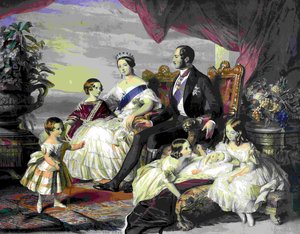
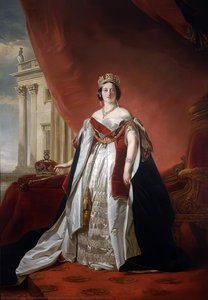
The year 1841 marks a shift in Winterhalter’s trajectory. Queen Victoria summons him to the English court, a move that pulls the German painter into the intimate orbit of the British monarchy. He arrives in England in 1842, beginning a long-standing relationship with the royal household. His presence in the palace is constant. He does not merely paint official likenesses; he documents the growing family of Queen Victoria and Prince Albert. His brush captures the private and public faces of the dynasty, producing at least 120 works for the Royal Collection.
The work is prolific. He moves between the formal requirements of the throne and the personal needs of the royals, creating a visual record of the Victorian era. His portraits of the royal family provide a sense of personality and emotion that goes beyond simple representation. These paintings become the primary way the world perceives the British monarchy during this period.
- Portrait of Victoria of the United Kingdom (1843)
- The Royal Family in 1846
- Portrait of Prince Albert of Saxe Coburg Gotha (1867)
Patrons and Imperial Commissions
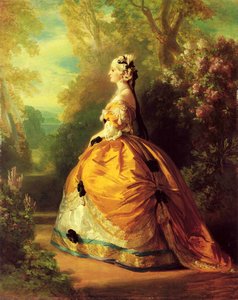
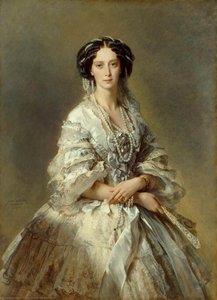
The reach of Winterhalter’s brush extends into the most guarded corridors of power. In France, Empress Eugénie becomes a central figure in his orbit, seeking his hand to define the visual identity of her court. This pattern of imperial patronage repeats across borders. In 1857, he turns his attention to the Russian court to paint the Tsarina Maria Alexandrovna. His ability to navigate these high-stakes environments makes him a fixture in the private lives of the era's most powerful figures.
The 1860s see his influence crossing the Atlantic. He captures the likenesses of the Imperial couple of the Second Mexican Empire, documenting a regime far from the European centers he usually inhabits. Even as political landscapes shift, his presence in the halls of power remains constant. In 1865, he moves to the Austrian court to paint Empress Elisabeth of Austria, a commission that places him at the heart of the Habsburg dynasty.
- Portrait of Empress Elisabeth of Austria (1865)
- Portrait of Tsarina Maria Alexandrovna (1857)
Technique and Artistic Style
Winterhalter’s early technical approach centers on a smooth, enamel-like surface. He achieves this through meticulous layering, creating a polished finish that defines his academic compositions. This precision extends to his ability to render the specific textures of silk, velvet, and fine lace. He often works directly on the canvas, frequently bypassing preliminary studies to capture his subjects. This directness allows for an immediate connection between the artist's hand and the material. His skill in lithography further demonstrates a technical versatility that complements his oil painting.
As his career progresses, the rigid precision of his early years gives way to a newfound freedom of brushwork. This shift introduces a certain Romantic charm to his later works. He masters the art of blending realism with flattery, presenting his sitters with an idealized grace that remains recognizably themselves. He does not merely record a likeness; he constructs an image of status and refinement. This ability to navigate the fine line between accurate representation and the social requirements of the aristocracy ensures his subjects appear both dignified and approachable.
Key Works and Masterpieces
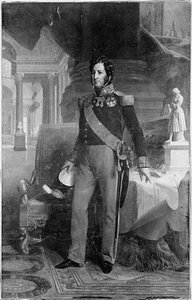
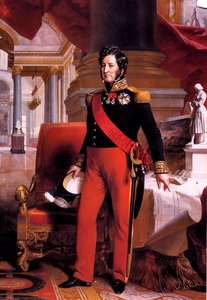
The year 1841 marks a significant shift as Winterhalter captures the French monarch, Louis Philippe I. The portrait places the king within the Galerie des Batailles at Versailles, presenting him in the uniform of a major general. He rests his hand upon architectural plans, a composition that celebrates the reopening of the palace as a museum. This work functions as a visual statement of the king's role in the restoration of French history.
In 1852, the artist moves toward a different atmosphere with Florinda. This work offers a sense of sun-drenched escapism, depicting figures in a landscape where the boundaries between humanity and nature dissolve. The composition relies on an organic harmony, utilizing a warm palette of gold, ochre, and deep forest greens to create a rhythmic flow of lines and textures along a riverbank sanctuary.
The mid-century reaches a peak of formal grandeur in 1855 with Empress Eugénie Surrounded by her Ladies in Waiting. This monumental oil on canvas depicts the Empress seated with regal composure. She is positioned centrally, flanked by twelve ladies-in-waiting arranged in carefully considered groupings. The painting emphasizes the social hierarchy of the Second French Empire through meticulous rendering of fabrics and light.
Later, in 1865, the focus shifts to the Austrian court. The Portrait of Franz Joseph I depicts the Emperor in the uniform of a field marshal. He wears the Order of Maria Theresa and the Order of the Golden Fleece. This portrait, created during a period of intense diplomatic and social shifts in Europe, captures the ruler in a highly formalized, decorated state.
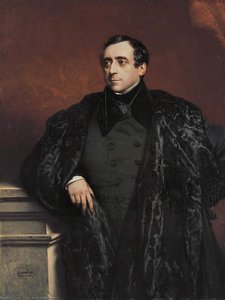
- Count Jenison-Walworth (1837)
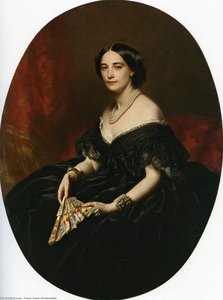
- Portrait of a lady with a fan (about 1850)
- Empress Elisabeth of Austria in dancing dress (1865)
Where to See the Works Today
The physical remnants of Winterhalter’s presence in the royal courts are scattered across the major cultural hubs of Europe and beyond. In London, the National Portrait Gallery holds his depictions of the British monarchy. Across the channel, the Musée d’Orsay in Paris and the Musée National du Château de Compiegne preserve his large-scale academic compositions, including his monumental depiction of Empress Eugénie and her ladies. These canvases remain in the spaces that once mirrored the grandeur of the Second French Empire.
The reach of his brush extends into the imperial collections of the East and the grand galleries of Central Europe. The Hermitage Museum in Saint Petersburg houses his portraits of the Russian aristocracy, while the Kunsthistorisches Museum in Vienna contains his depictions of the Austrian imperial family. In the United States, the Metropolitan Museum of Art in New York maintains his presence in the Western hemisphere, holding works like Florinda.
- Empress Eugénie Surrounded by her Ladies in Waiting (1855)
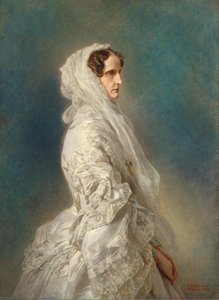
- Portrait of Empress Alexandra Feodorovna (1856)
- Portrait of Empress Maria Alexandrovna (1857)
- Portrait of Franz Joseph I (1865)
Въпроси и отговори
Къде и през коя година е роден/а Франц Ксавер Винтерхалтър?
Франц Ксавер Винтерхалтър е роден в Мензшенщанд през 1805 г.
В коя историческа епоха е творил Франц Ксавер Винтерхалтър?
Франц Ксавер Винтерхалтър е творил в периода на XIX век. Този период определя историческия контекст на творчеството на художника.