Early Life, Family and Training
Keith Breeden enters the scene on 25 March 1956. His early years are rooted in Northwich, where he attends St. Wilfred's Primary from 1962 to 1967. By 1967, he moves on to St Ambrose College, a setting that places him in a small, concentrated environment. In an A-level art class of only six pupils, Breeden finds himself studying alongside Peter Saville and Malcolm Garrett. This proximity to future design figures marks a quiet collision of talent. He does not stay at St Ambrose for the full term; he leaves the college prematurely, bypassing all public examinations.
The path toward formal training remains uneven. After a challenging foundation year at a technical college in Northwich, Breeden seeks out the Bath Academy of Art in Corsham in 1974. The expectation of fine art study meets a sudden friction with reality. He finds the curriculum dull and pointless. The connection to the academy breaks during his first year, as he abandons the course entirely. He moves away from the structured academic environment, leaving the traditional fine art route behind.
Graphic Design and Musical Collaborations
The transition from the underground to the professional studio happens in stages. In 1974, Breeden works as a cellarman in a casino in Berkeley Square. By the late 1970s, his visual language begins to define the sleeves of emerging acts. He designs covers for Gang of Four, Angelic Upstarts, and The Photos. The work is direct. It moves from these early projects into a period of intense collaboration with the sounds of the era.
The partnership with ABC marks a significant shift. His artwork for the band mirrors their musical evolution, moving from raw indie textures to polished pop. This ability to translate sonic shifts into imagery extends to his work with Scritti Politti, where he distills complex ideas into striking visuals. He also navigates the aesthetics of Pink Floyd, Roxy Music, and Fine Young Cannibals. In 1984, a brief period as a formal partner in Assorted Images ends, leading him to establish DKB (Design KB) alongside Peter Curzon and Martin Jenkins.
Visual storytelling reaches a peak through high-profile collaborations. Working alongside Malcolm Garrett, Breeden helps conceive the album covers for Duran Duran’s Seven and Roxy Music’s Electric. These projects rely on precise color palettes and specific compositional techniques to capture the moods of the music. His graphic work remains a study in how to make the intangible tangible through design.
Portraiture and Academic Commissions
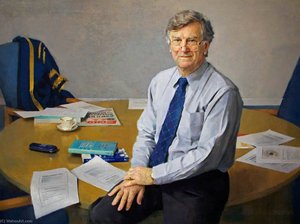
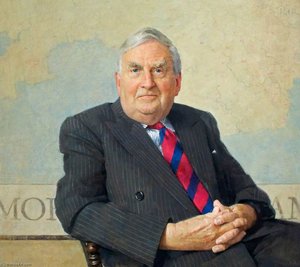
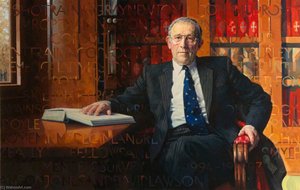
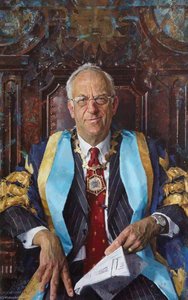
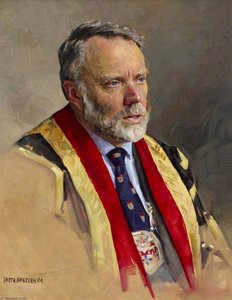
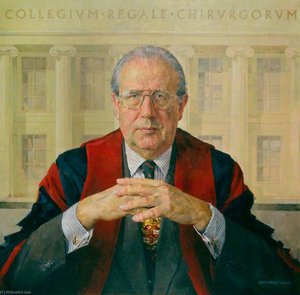
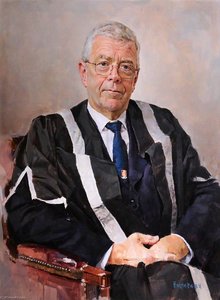
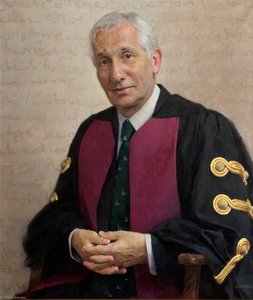
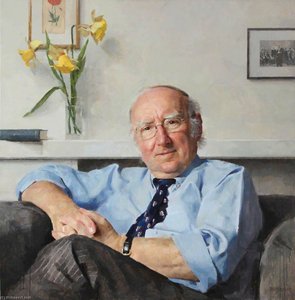
The transition from the graphic design studio to the formal portrait studio marks a significant shift in Breeden's practice. As a member of the Royal Society of Portrait Painters, he moves into a realm of precision and institutional weight. His subjects are no longer the abstract textures of an album sleeve but the faces of academic and professional leadership. He captures the likeness of individuals who hold significant authority within the structures of British academia and medicine.
The commissions arrive in a steady sequence. Around 2000, he paints John David Cash, CBE. This is followed by the portrait of Professor Sterling, Vice Chancellor (1990–2001), in 2001. The work continues through the early 2000s with Professor Roger Williams, Vice Chancellor of the University of Reading, in 2002. In 2003, the focus shifts toward the medical establishment, as he completes portraits of Professor Sir John Temple, FRCSEd (1969), PRCSEd (2000–2003), and Professor Peter Hutton, President of the Royal College of Anaesthetists (2000–2003). The period of intense academic portraiture extends into 2004 with Professor Roy Evans, Vice Chancellor (1995–2004).
Въпроси и отговори
В коя историческа епоха е творил Keith Breeden?
Keith Breeden е творил в периода на Contemporary. Този период определя историческия контекст на творчеството на художника.