LE JEUNE DEGUSTATEURФилип МерсиеNone
 Oil On Canvas
- WallArt
- Rococo
 Лувър
LE JEUNE DEGUSTATEUR – A Rococo Portrait Reflecting Nobility and Innocence
Philippe Mercier’s “Le Jeune Dégustateur” (The Young Taster) stands as a quintessential example of 18th-century Rococo art, capturing a fleeting moment of youthful exuberance within the opulent confines of aristocratic life. Painted in 1725/1730, this genre portrait transcends mere likeness; it’s imbued with symbolic resonance and masterful execution that speaks to the era's fascination with beauty, refinement, and idealized pastoral themes. The artwork resides at the Louvre Museum, accession number RF 1582, a testament to its enduring artistic merit.- Subject Matter: The painting depicts a young man—likely an apprentice wine taster or connoisseur—engaged in a seemingly casual activity: sampling wine alongside a substantial barrel. This deliberate juxtaposition underscores the importance of taste and discernment within the aristocratic circles of the time, reflecting not only social status but also intellectual curiosity.
- Composition & Perspective: Mercier employs a tightly cropped composition, centering on the boy’s upper body and immediate surroundings. The barrel dominates the lower portion of the image, creating an asymmetrical balance that draws the eye upwards towards the figure. Subtle perspective contributes to depth without resorting to dramatic spatial illusions—characteristic of Rococo's preference for illusionistic realism rather than grand theatricality.
- Color Palette & Use of Lines: The color palette is dominated by earthy tones – ochres, browns – punctuated by softer hues that illuminate the boy’s face and hands. Crimson accents appear in the wine glass, hinting at indulgence and pleasure. Mercier utilizes soft, blended lines throughout the painting, prioritizing textural nuance over sharp delineation. Contour lines define the boy's form with understated elegance, while the barrel exhibits more pronounced lines emphasizing its structural integrity.
- Technique & Materials: Executed in oil paint on canvas, “Le Jeune Dégustateur” showcases Mercier’s meticulous attention to detail and mastery of glazing techniques. Layers of translucent pigment create a luminous surface that captures the subtle nuances of light and shadow—a hallmark of Rococo painting's pursuit of atmospheric realism.
- Symbolism & Emotional Impact: The boy’s gaze directs slightly off-center, conveying introspection and observation – qualities valued in aristocratic youth. The barrel symbolizes abundance and craftsmanship, mirroring the wealth and status of its owner. More profoundly, Mercier captures a moment of youthful innocence and curiosity, reflecting the Rococo ideal of beauty as harmonious balance and refined sensibility.
Historical Context & Artistic Influences
“Le Jeune Dégustateur” emerged during the reign of Louis XV, marking a pivotal period in French art history. The Rococo style flourished amidst the lavish courts of Versailles and Dresden, rejecting the solemn grandeur of Neoclassicism in favor of playful ornamentation and sensual color palettes. Mercier’s work draws inspiration from artists like Jean-Baptiste Oudry and Antoine Watteau, who championed idealized landscapes and pastoral scenes—a deliberate contrast to the formal conventions of earlier Baroque art. The painting embodies the Rococo's celebration of aristocratic leisure and refined taste, reflecting a broader cultural preoccupation with pleasure and beauty.Further Research & Notable Reproduction
A stunning reproduction of “Le Jeune Dégustateur” can be found at Louvre Museum (Image Link). Explore this captivating artwork's beauty and historical significance—a testament to Philippe Mercier’s artistic legacy and the enduring allure of Rococo painting.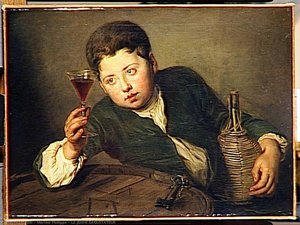
Artist Information
Philippe Mercier (1689 – 1760) was a French Huguenot artist who established himself in England during his lifetime. Recognized as one of the pioneers of Rococo style, Mercier profoundly influenced subsequent generations of English painters and cemented his place within art history.Филип Мерсие (1689 – 1760)
Филип Мерсие (1689-1760) е френски рококо художник, известен с елегантните си портрети на британската аристокрация, особено на принц Уелски Фредерик и неговото семейство. Разгледайте влиянието му върху английското изкуство.
Лувър (Пари, Франция)
Лувърът в Париж съхранява Мона Лиза и древноегипетски съкровища. Открийте тази легендарна колекция от световноизвестно изкуство днес.
За това произведение
- Заглавие: LE JEUNE DEGUSTATEUR
- Художник: Филип Мерсие
- Формат: Landscape
- Авторско право: Обществено достояние
- Местоположение на произведението: Лувър
- Материал и техника: Oil On Canvas
- Творчески период: Late Medieval
- Контекст на корпуса: british influence seen, symbol of status & wealth
- Основен цвят: Driftwood
- Предназначение: Accent
Бърза информация
- Title: Le Jeune Dégustateur
- Movement: École de Rococo
- Artist: Philippe Mercier
- Year: 1725/1730
- Subject or theme: Wine tasting; Portraiture
- Location: Louvre
Въпроси и отговори
Какъв е емоционалният тон на „LE JEUNE DEGUSTATEUR“ на Филип Мерсие?
„LE JEUNE DEGUSTATEUR“ на Филип Мерсие предава Romantic емоционален тон.
Каква е възприеманата светлост на „LE JEUNE DEGUSTATEUR“ на Филип Мерсие?
Възприеманата яркост на „LE JEUNE DEGUSTATEUR“ на Филип Мерсие е shadow. Тя може да бъде съобразена със светлината в предназначеното за нея пространство.
Какво настроение и емоция се преплитат в "LE JEUNE DEGUSTATEUR"?
Записаното настроение на „LE JEUNE DEGUSTATEUR“ на Филип Мерсие е Elegant, а неговият емоционален тон е Romantic.