Introduction
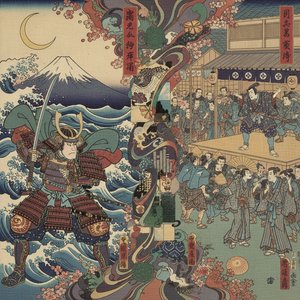
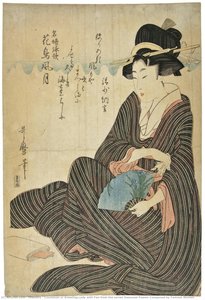
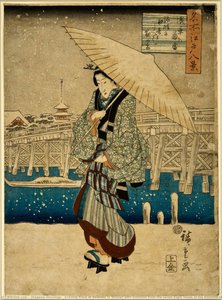
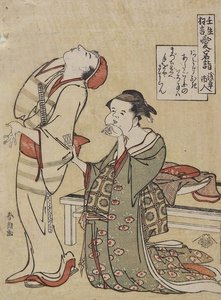
The floating world, known in Japanese as ukiyo, found its visual soul through a distinct movement of woodblock prints and paintings that flourished during the Edo period. These artists captured the ephemeral pleasures of urban life—the theater, the tea houses, and the shifting landscapes of a rapidly evolving Japan. Unlike the elite, aristocratic art of previous eras, these painters spoke to the rising merchant class, utilizing a sophisticated woodblock printing process that allowed for mass production and widespread cultural influence.
What unites these masters is a profound ability to distill complex emotions and natural beauty into bold, graphic compositions. Their work is characterized by striking outlines, flat planes of color, and unconventional perspectives that challenged traditional notions of depth. From the delicate, idealized beauty of courtesans to the dramatic tension of kabuki actors and the serene majesty of Mount Fuji, these artists documented the pulse of a society in transition.
The legacy of this movement extends far beyond the borders of Japan. When these prints reached Europe in the 19th century, they ignited a revolution among the Impressionists and Post-Impressionists, fundamentally altering the course of Western modern art. Today, the aesthetic language of these painters remains a cornerstone of global visual culture, influencing everything from graphic design to contemporary illustration. In the following sections, we examine the lives and stylistic contributions of the most significant figures of this movement, including masters such as Katsushika Hokusai, Utagawa Hiroshige, and Kitagawa Utamaro.
Katsushika Hokusai
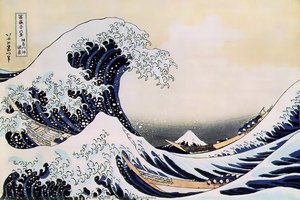 The Great Wave off Kanagawa - Katsushika Hokusai
Katsushika Hokusai (1760–1849) stands as a monumental figure within the ukiyo-e movement, a genre dedicated to capturing the transient "floating world" of Edo. After entering the studio of Katsukawa Shunshō at age twelve, Hokusai mastered the precision required for woodblock printing, yet he was never content with mere imitation. His career was defined by a restless, evolutionary spirit, evidenced by the fact that he changed his name over thirty times as his artistic vision expanded from urban scenes of actors and courtesans toward the vastness of the natural landscape.
His contribution to the ukiyo-e tradition was fundamentally altered by his ability to merge traditional Japanese perspectives with innovative materials. In his seminal series, Thirty-six Views of Mount Fuji, he utilized the newly imported Prussian blue to achieve a depth of color previously unseen in woodblock prints. His most iconic work, The Great Wave off Kanagawa, exemplifies this mastery. Through a dramatic, claw-like composition, Hokusai captures the terrifying tension between the ocean's power and the fragile human vessels, all while the sacred peak of Mount Fuji remains a silent, stable anchor in the distance. His work remains a profound study of the sublime forces of nature."
Yoshitoshi
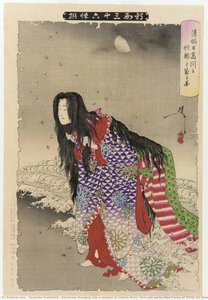 Kiyohime changing into a serpent at Hidaka River, from the series New Forms of Thirty-six Ghosts - Yoshitoshi
Tsukioka Yoshitoshi stands as a pivotal figure among Japanese ukiyo-e painters, serving as a bridge between the traditional Edo period and the rapid modernization of the Meiji era. Born Owariya Yonejiro in 1839 in the Shimbashi district of Edo, his career was defined by the tension of a changing nation. As a master of the woodblock print, he navigated the transition from the old ways to a world increasingly influenced by Western technology, ensuring the ukiyo-e tradition remained vital through his psychological depth and narrative innovation.
His work often explored the darker, more intense facets of Japanese folklore and history. In his evocative masterpiece, Kiyohime Changing Into A Serpent At Hidaka River, from the series New Forms of Thirty-Six Ghosts (1890), Yoshitoshi demonstrates his ability to capture supernatural metamorphosis. The print depicts the terrifying moment human passion transforms into monstrous vengeance amidst turbulent waters. Through bold outlines and a dramatic palette of deep blues and verdant greens, he elevated the ukiyo-e genre, moving beyond simple depiction to capture the volatile, unravelling spirit of his subjects. His legacy remains etched in these hauntingly beautiful depictions of myth and moonlight.
Suzuki Harunobu
 Actor with Falcon - Suzuki Harunobu
Suzuki Harunobu stands as a transformative figure within the Japanese ukiyo-e movement, a visionary whose technical innovations fundamentally altered the trajectory of woodblock printing. Born around 1725 into a lineage marked by the displacement of his family from Edo to Kyoto, Harunobu’s artistic identity was forged through a sophisticated synthesis of established traditions. He likely trained under the master Nishikawa Sukenobu, absorbing the stylistic nuances of the Torii and Ishikawa Toyonobu schools, while integrating elements from the Kanō and Kawamata traditions. This diverse foundation allowed him to transcend the conventional boundaries of his era.
Harunobu’s most significant contribution to ukiyo-e was the development of nishiki-e, or "brocade prints." Commissioned by literati samurai to create exquisite calendar prints, he pioneered the use of multiple woodblocks to achieve a full spectrum of color, moving the medium far beyond simple monochrome or limited-palette works. His masterpiece, Actor with Falcon, exemplifies this technical brilliance. Rendered in the narrow hashira-e format intended for architectural pillars, the work utilizes sophisticated ink layering and a striking palette to capture a moment of poised grace. Through his ability to blend social symbolism with revolutionary color application, Harunobu redefined the aesthetic possibilities of the ukiyo-e genre.
Utagawa Kuniyoshi
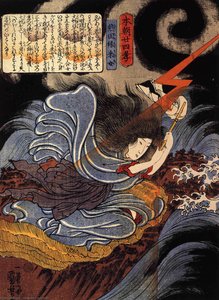 Uneme is exorcising the monstrous serpent from the lake - Utagawa Kuniyoshi
A central figure in the late 19th-century evolution of the Utagawa school, Utagawa Kuniyoshi (1798–1861) transformed the landscape of Japanese ukiyo-e through his unparalleled sense of drama and narrative complexity. Born Yoshisaburō in Edo, his early life was shaped by his father’s silk-dyeing business, a background that gifted him a profound sensitivity to vibrant color and intricate patterns. After entering the studio of Utagawa Toyokuni I in 1811, Kuniyoshi moved beyond the traditional portraiture of his predecessors to embrace the more fantastical and heroic elements of the "floating world.”
His mastery of the woodblock medium is vividly realized in Uneme is exorcising the monstrous serpent from the lake. This work exemplifies the ukiyo-e movement's fascination with folklore and the supernatural, utilizing bold, dynamic compositions to depict a spiritual struggle between a courageous woman and a colossal, chaotic serpent. By blending traditional Japanese themes with a sophisticated understanding of Western-influenced perspective and movement, Kuniyoshi secured his place as a visionary who expanded the boundaries of what ukiyo-e could express, moving from the domestic to the mythic.
Utagawa Kunisada Ii
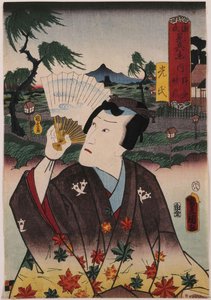 The Wintry Blast; Clear Weather After a Storm; The Actor Ichikawa Danjuro VIII as Ashikaga Mitsuuji - Utagawa Kunisada Ii
A visitor to the world of Japanese ukiyo-e painters can immediately identify the hand of Utagawa Kunisada II through his dramatic, theatrical compositions and an unparalleled ability to capture the essence of Edo-period celebrity. As a prominent figure within the Ukiyo-e movement, his work epitomizes the genre's fascination with the "floating world," specifically through his prolific output of yakusha-e (actor prints) and portraits of beautiful women. His lineage is deeply rooted in the Utagawa school; a pupil of Utagawa Kunisada I, he eventually inherited the school's leadership, signing much of his early work as Kunimasa III before adopting his most famous name around 1850.
His technical mastery is vividly displayed in The Wintry Blast; Clear Weather After a Storm; The Actor Ichikawa Danjuro VIII as Ashikaga Mitsuuji, where he balances intricate human emotion with dynamic natural elements. His style is characterized by a sophisticated use of line and a narrative depth that brings scenes from classical literature to life, such as his celebrated 1852 series based on the tale of the eight dog heroes. Whether depicting the poise of a geisha or the intensity of a Kabuki performer, Kunisada II's work remains a vital testament to the visual culture of 19th-century Japan.
Hiroshige I, Utagawa & Kiemon, Tsuruya
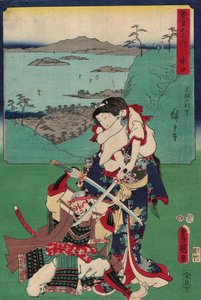 The Fifty-three Stations of the Tôkaidô by Two Brushes, station 51 - Hiroshige I, Utagawa & Kiemon, Tsuruya
A visitor can immediately recognize the hand of Hiroshige I, Utagawa & Kiemon, Tsuruya through his profound ability to capture the atmospheric essence of the Japanese landscape. His works are defined by a sophisticated use of vibrant colors and a delicate, evocative light that transforms everyday scenes into poetic meditations. As a central figure in the Ukiyo-e movement, he mastered the woodblock print medium, specializing in the "floating world" depictions of travel and nature that defined 19th-century Japanese art. His technical virtuosity is most evident in his ability to balance expansive vistas with intimate human drama.
In the representative work The Fifty-three Stations of the Tōkaidō by Two Brushes, station 51, we see the pinnacle of this mastery. This 1852 print showcases a rare synergy between landscape and character, where the serene natural elements of the Minakuchi station meet the dramatic tension of human figures. His collaboration with the publisher Tsuruya Kiemon allowed for the creation of iconic series that documented the Tōkaidō and Kiso Kaidō routes, leaving a legacy that would eventually profoundly influence Western art through its unique perspective and composition.
Utagawa Hiroshige
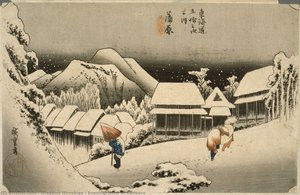 Evening Snow at Kanbara - Utagawa Hiroshige
Born Andō Tokutarō in 1797 in the bustling city of Edo, Utagawa Hiroshige emerged as a pivotal figure in the ukiyo-e movement, often regarded as its last great master. While many of his contemporaries focused on the popular depictions of courtesans and kabuki actors, Hiroshige’s artistic trajectory shifted significantly under the tutelage of Utagawa Toyohiro. This training allowed him to move beyond mere genre scenes, ultimately redefining the landscape genre within the "pictures of the floating world" tradition.
His work is characterized by a profound poetic sensibility, utilizing atmospheric perspective and a delicate sensitivity to the changing seasons to evoke the spirit of a location rather than just its physical form. A quintessential example of this mastery is his 1834 work, Evening Snow at Kanbara. In this piece, Hiroshige captures a serene, contemplative winter scene, using the vastness of snow-covered hills to create a sense of quietude and human resilience. By imbuing landscapes with such evocative mood and subtle color, Hiroshige secured his place as a master of the ukiyo-e style, leaving a legacy that would eventually resonate deeply with the Western Impressionists.
Kitagawa Utamaro
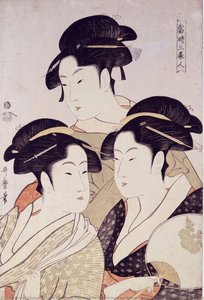 Toji san bijin (Three Beauties of the Present Day)From Bijin-ga (Pictures of Beautiful Women), published by Tsutaya Juzaburo - Kitagawa Utamaro
A central figure in the Ukiyo-e movement, Kitagawa Utamaro (1753–1806) redefined the genre through his profound mastery of bijin-ga, or portraits of beautiful women. Trained under the tutelage of Toriyama Sekien, Utamaro’s early career saw him illustrating popular literature and poetry. However, his artistic trajectory shifted significantly in 1782 through a pivotal partnership with the publisher Tsutaya Jūzaburō. This collaboration allowed him to move beyond traditional group compositions, instead pioneering the ōkubi-e style—large-head portraits that focused on the intimate, psychological nuances of individual subjects.
Utamaro’s work is characterized by an exquisite attention to detail, particularly in the rendering of complex hairstyles, delicate facial expressions, and the intricate patterns of textile fabrics. His ability to imbue subjects with distinct personalities helped elevate the woodblock print from mere mass-produced imagery to a sophisticated art form. His 1793 masterpiece, Toji san bijin (Three Beauties of the Present Day), serves as a definitive example of his genius. In this work, he captures the allure and social presence of three celebrated entertainers, utilizing elegant, elongated lines and a sophisticated sense of composition that would eventually leave a lasting impression on Western Impressionist masters.
Toyohara Kunichika
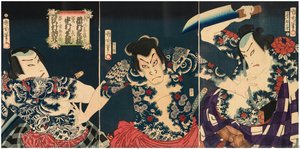 The kabuki actors (right to left) Ichimura Kakitsu IV as Asahina Tobei, Nakamura Shikan IV as Washi no Chokichi and Sawamura Tosshi II as Yume no Ichirobei, IV/1868 - Toyohara Kunichika
Toyohara Kunichika (1835–1900) stands as a monumental figure in the history of Japanese woodblock printing, serving as a vital bridge between the traditional Edo period and the transformative Meiji era. Entering the world of ukiyo-e as a dedicated student of the renowned Utagawa Kunisada at the age of thirteen, Kunichika eventually emerged as a master in his own right. His inclusion in the canon of ukiyo-e painters is defined by his profound ability to capture the ephemeral "floating world" through two primary genres: yakusha-e, or portraits of kabuki actors, and bijinga, the depiction of beautiful women.
His technical mastery is vividly realized in the 1868 work, The kabuki actors (right to left) Ichimura Kakitsu IV as Asahina Tobei, Nakamura Shikan IV as Washi no Chokichi and Sawamura Tosshi II as Yume no Ichirobei. This piece exemplifies his capacity for dramatic tension, utilizing precise linework to render the intricate textures of theatrical costumes and the stylized intensity of the performers' expressions. Whether portraying the elegance of a woman in a brocade robe or the high-stakes drama of the stage, Kunichika’s work preserved the soul of Japanese print-making during a period of immense social and political upheaval.
Kobayashi Kiyochika
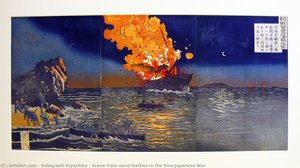 Scene from naval battles in the Sino-Japanese War - Kobayashi Kiyochika
Kobayashi Kiyochika (1847–1915) stands as a transformative figure within the tradition of Japanese Ukiyo-e painters, serving as a vital bridge between the Edo period and the modern Meiji era. While many of his predecessors focused on the hedonistic "floating world," Kiyochika expanded the movement's boundaries by documenting the seismic social and political shifts of a modernizing Japan. His unique contribution to the Ukiyo-e movement was the development of kōsen-ga, or "light and shade style," a technique that integrated Western principles of perspective and atmospheric lighting into the traditional woodblock medium.
His ability to synthesize these foreign influences with Japanese aesthetics is vividly realized in his 1894 work, Scene from naval battles in the Sino-Japanese War. In this dramatic composition, Kiyochika moves beyond mere illustration to become a visual chronicler of conflict. The piece captures the chaotic intersection of smoke, iron, and sea, utilizing his mastery of light and shadow to depict the tension of maritime warfare. Through such works, Kiyochika ensured that the Ukiyo-e tradition remained a relevant, evolving force capable of capturing the profound complexities of a nation in transition.
Conclusion
The legacy of these masters lies in their ability to capture the fleeting essence of a changing world, from the delicate lines of a courtesan's profile to the dramatic power of a crashing wave. Whether through the revolutionary color palettes of Harunobu or the profound landscapes of Hokusai and Hiroshige, these artists transformed everyday life into a timeless visual language. Each painter contributed a unique perspective to the movement, ensuring that the spirit of the floating world would endure long after the woodblocks were carved and the ink had dried.
For those seeking to bring this profound sense of history into a modern living space, we invite you to explore our full collection. At Mus3ums.com, we specialize in honoring these cultural treasures through museum-quality, hand-painted oil reproductions. By choosing a bespoke, hand-made work, you can experience the tactile depth and vibrant character of these iconic Japanese masterpieces in your own home.