Introduction
The 1950s in the United States marked a seismic shift in the global art landscape, as the center of the creative world moved from Paris to New York. This decade was defined by a profound tension between the structured, idealized imagery of post-war domestic life and the raw, explosive energy of abstraction. It was a period of intense experimentation where artists sought to express the complexities of the modern human condition, ranging from the subconscious depths of the psyche to the vibrant, graphic language of emerging consumer culture.
As the nation navigated the complexities of the Cold War and a burgeoning era of prosperity, art became a battlefield for new ideologies. On one hand, the movement of Abstract Expressionism introduced a visceral, gestural approach to the canvas, emphasizing the act of painting itself as a profound existential statement. On the other, the seeds of Pop Art were being sown, challenging the boundaries between high art and the everyday objects of mass media. This era saw the rise of monumental scales and bold, unapologetic textures that demanded a new way of seeing.
These works remain vital today because they represent the moment when American art found its unique, independent voice. The radical techniques developed during this decade—from the chaotic drips of action painting to the precise, mechanical aesthetics of comic-inspired imagery—continue to influence contemporary visual language and interior design. They serve as a bridge between the traditional mastery of the past and the conceptual freedom of the future.
The following selection explores ten significant works from this transformative decade, featuring the contributions of masters such as Jackson Pollock, Jasper Johns, and Georgia O'Keeffe, each capturing a distinct facet of the American spirit during this pivotal era.
Saying Grace - Norman Rockwell
 Saying Grace - Norman Rockwell
Created in 1951, Saying Grace stands as a quintessential example of American narrative realism, a style that defined much of the visual culture in the United States during the 1950s. This work captures a profound moment of spiritual stillness within the domestic sphere. The composition centers on a family gathered around a dining table, where a father leads his children in a quiet moment of prayer before their meal. This act of devotion creates a sense of sanctity that contrasts with the bustling, everyday details of the meal in progress.
Rockwell’s meticulous attention to detail brings the scene to life, from the specific arrangement of cups, bowls, and silverware on the table to the presence of two dogs resting nearby. The inclusion of these small, lived-in elements—a handbag, a clock on the wall, and the varied postures of the family members—transforms a simple ritual into a universal study of connection and faith. Through this composition, the artwork reflects the mid-century emphasis on family values and the quiet, sacred rhythms of American domestic life.
Number 1, 1949 - Jackson Pollock
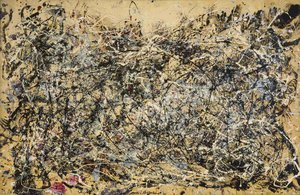 Number 1, 1949 - Jackson Pollock
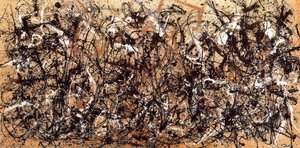
Created at the dawn of a transformative decade, Number 1, 1949 serves as a monumental cornerstone for the American artworks of the 1950s. This piece epitomizes the revolutionary spirit of Abstract Expressionism, marking the moment when the center of the art world shifted toward the United States. Through his radical "drip" technique, Jackson Pollock abandoned the easel to engage with the canvas as an arena for physical action.
The work is a dense, rhythmic web of splatters and streaks, where liquid paint was flung and poured to create a complex, all-over composition. Eschewing traditional focal points, the painting relies on a sophisticated interplay of texture and gesture. A predominantly muted palette of blacks, browns, and ochres is punctuated by subtle, energetic hints of reddish-pink, creating a sense of depth within a flattened, non-representational space. This gestural approach, often termed "action painting," prioritizes the artist's subconscious impulses and the raw energy of the creative act, establishing a new visual language that would define the aesthetic landscape of the 1950s.
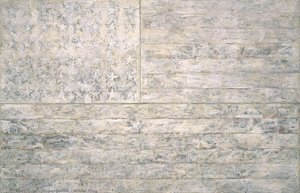
False Start - Jasper Johns
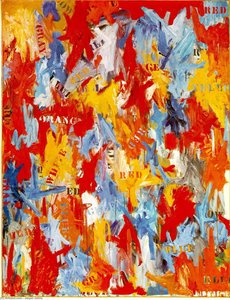
Upon first encounter, the eye is met by a chaotic, energetic surge of color that seems to vibrate across the canvas. A dense, rhythmic dance of overlapping brushstrokes and splatters dominates the field, utilizing an intense palette of mahogany, fiery orange, and deep red, punctuated by sudden bursts of blue and white. The surface is a landscape of heavy impasto, where the thick, tactile layers of oil paint create a rugged, three-dimensional topography that emphasizes the physical act of creation.
Created in 1959, this work serves as a quintessential example of American art from the 1950s, capturing the era's profound shift toward gestural abstraction. As a pivotal piece from this decade, it bridges the raw, emotional intensity of Abstract Expressionism with the emerging sensibilities of Neo-Dadaism. Rather than depicting recognizable objects, the composition focuses on the pure, expressive qualities of the medium, using amorphous shapes and spontaneous movement to translate turbulent energy into a visual experience. It stands as a testament to the decade's fascination with the intersection of spontaneous gesture and the structural logic of abstraction.
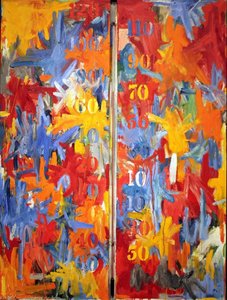
Thermometer - Jasper Johns
Jasper Johns’ 1959 work, Thermometer, serves as a profound example of the experimental spirit defining American artworks of the 1950s. This mixed-media assemblage breaks the boundaries of traditional painting by incorporating a functional, mechanical thermometer into the central axis of the canvas. This inclusion transforms the piece from a static image into a living object that responds to the immediate climate of its environment, marking a pivotal shift toward Neo-Dadaism.
The composition is characterized by a striking tension between industrial precision and gestural abstraction. On either side of the thermometer, thick, impasto-like applications of oil paint erupt in vibrant starburst shapes. The palette is energetic, utilizing bold reds, bright yellows, and deep blues, accented by orange and white. These chaotic, organic strokes contrast sharply with the rigid, stenciled numerical markings that run parallel to the gauge. By merging the expressive, hand-applied marks of the artist with the standardized accuracy of a measuring tool, Johns captures a unique moment in the 1950s where the raw emotion of Abstract Expressionism began to intersect with the cool, objective reality of the modern, industrial world.
White Light - Jackson Pollock
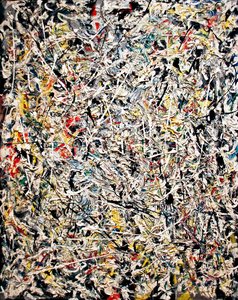 White Light - Jackson Pollock
Created in 1954, White Light serves as a profound exemplar of the American Abstract Expressionist movement that defined the 1950s. Jackson Pollock utilizes his signature drip technique, a method where he flings, pours, and drips liquid paint onto a canvas laid on the floor, allowing gravity and spontaneous movement to dictate the composition. This process transforms the act of painting into a physical performance, or action painting, where the canvas becomes an arena for gestural energy.
The work is characterized by a dense, chaotic network of lines and amorphous shapes that eschew a central focal point in favor of an "all-over" composition. The palette is incredibly diverse, featuring a rhythmic interplay of white, black, red, yellow, blue, and green. These vibrant primary colors are intertwined with neutral tones, creating a visual tension that evokes a sense of raw, visceral energy. Through thick impasto layers and a highly textured surface, Pollock captures a multidimensional quality where light and shadow dance across the ridges of dried pigment, reflecting the intense emotional spontaneity central to mid-century American art.
Vir Heroicus Sublimis - Barnett Newman
 Vir Heroicus Sublimis - Barnett Newman
Barnett Newman’s Vir Heroicus Sublimis stands as a monumental pillar of American Abstract Expressionism, a movement that defined the visual language of the United States during the 1950s. Created around 1950, this massive canvas—stretching nearly 18 feet wide—transcends mere decoration to become an immersive environment. The work is a profound exploration of scale, designed to envelop the viewer and evoke a sense of the sublime, as suggested by its Latin title, which translates to "Man, Heroic and Sublime."
The composition is dominated by a vast, saturated expanse of red that appears to pulse with atmospheric depth rather than remaining a static surface. This overwhelming field is interrupted by vertical, narrow bands known as "zips." These stripes slice through the red, providing a rhythmic tension and a sense of human scale within the infinite void. Through these precise vertical interruptions, Newman creates a spatial dialogue that challenges the viewer's perception of depth and presence, marking a pivotal moment in mid-century modernism where color and scale became tools for spiritual contemplation.
Mahoning - Franz Kline
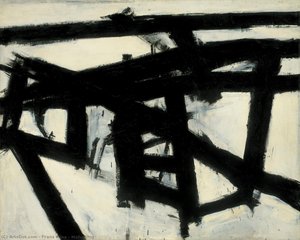 Mahoning - Franz Kline
Completed in 1956, Mahoning stands as a definitive example of the Abstract Expressionist movement that emerged from the United States during this decade. As a prominent figure of the New York School, Franz Kline utilized this period to move beyond traditional representation, focusing instead on the raw, kinetic energy of the artist's gesture. This work exemplifies the essence of Action Painting, where the canvas becomes a site of physical encounter between the creator and the medium.
The composition is defined by a visceral tension between heavy, muscular black brushstrokes and luminous white voids. Unlike the spontaneous drips often associated with his contemporaries, Kline’s approach in Mahoning possesses an architectural precision. He often employed a projector to scale his sketches, allowing for the deliberate, structural orchestration of form and space seen here. The interplay of thick impasto and stark tonal contrasts creates a textured, tactile surface that captures the dramatic pulse of mid-century urban life. Through this rhythmic collision of black enamel and white space, Kline transformed the canvas into a monumental event of pure, structural emotion.
The hero's return - Roy Lichtenstein
 The hero's return - Roy Lichtenstein
Roy Lichtenstein’s The hero's return serves as a compelling testament to the evolving visual language of American art during the 1950s. This work captures a dynamic scene centered on a man wielding a bow and arrow, positioned amidst a gathering of figures. The composition is meticulously layered, featuring a central protagonist surrounded by secondary characters and various objects, including a book, a cup, and a bottle, which lend a sense of narrative depth to the arrangement.
The piece exemplifies the artist's mastery of graphic precision, utilizing a palette where deep espresso tones anchor the composition. By employing bold outlines and a structured approach to form, Lichtenstein bridges the gap between traditional figurative painting and the burgeoning Pop Art movement. The interplay of these elements reflects the decade's shift toward exploring mass-media aesthetics and the simplification of complex human narratives into iconic, high-contrast imagery. Through this work, the tension between classical storytelling and modern graphic design becomes a defining characteristic of the era's artistic output.
PH-247 - Clyfford Still
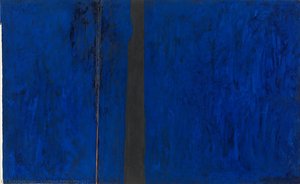 PH-247 - Clyfford Still
Created in 1951, PH-247 stands as a monumental testament to the power of American Abstract Expressionism during the 1950s. Often referred to by the nickname "Big Blue," this massive oil on canvas measures an imposing 117 by 192 inches, asserting a physical and emotional weight that defines the era's shift toward large-scale, immersive abstraction. Clyfford Still, a central figure in this movement, utilizes the canvas not as a window, but as a battlefield of color and texture.
The composition is dominated by deep, midnight blue tones that suggest an immense, liquid expanse. These vast fields of color are violently interrupted by jagged, vertical fissures of black, applied with a heavy, tactile quality that speaks to the artist's signature palette knife technique. The interplay between the dark accents and the glowing blues creates a sense of dramatic, fractured space, pulling the viewer into a profound, meditative encounter. As a vital piece within the Clyfford Still Museum's holdings, this work exemplifies the raw, spiritual intensity that characterized the most significant American art of the early 1950s.
Machu Picchu I - Georgia O'Keeffe
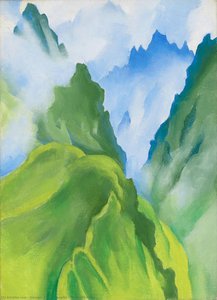 Machu Picchu I - Georgia O'Keeffe
Upon viewing Machu Picchu I, the eye is immediately drawn to the monumental, vertically oriented composition of the Andes. The landscape is defined by undulating, organic forms and a striking use of sea green and hazy blue, creating a profound sense of atmospheric perspective. Rather than focusing on topographical precision, the work emphasizes the sheer scale and tranquility of the mountain range through loose, expressive brushstrokes. The texture is palpably thick, utilizing an impasto-like application of oil paint that gives the rugged peaks a sculptural, physical presence.
This 1957 masterpiece belongs to the group of American artworks of the 1950s through its departure from traditional realism in favor of a deeply personal, modernist interpretation of nature. While many of her contemporaries were exploring abstraction, Georgia O'Keeffe utilized this period to distill the elemental essence of her travels into a sensory experience. By prioritizing mood and the immediate feeling of the Peruvian wilderness over photographic detail, she created a work that captures the spiritual vastness of the landscape, marking a significant chapter in mid-century American modernism.
Conclusion
The mid-century era in the United States served as a profound crossroads where the figurative storytelling of Norman Rockwell met the explosive, gestural energy of Jackson Pollock and the bold, graphic precision of Roy Lichtenstein. These works represent a pivotal shift in art history, capturing a decade that oscillated between the intimate details of American life and the radical, sweeping abstractions of the New York School. Whether through the rhythmic textures of an impasto landscape or the stark, monumental presence of a color-field canvas, these artists redefined the visual language of the twentieth century.
At Mus3ums.com, we invite you to bring this transformative period into your own space. Our master artists specialize in creating museum-quality, hand-painted oil reproductions that capture the authentic soul, visible brushstrokes, and deep tonal ranges of these iconic masterpieces. You can explore the breadth of this era by browsing our full collection and find the perfect piece to live with these historic expressions of American creativity.