Introduction
The final decade of the twentieth century in the United States served as a vibrant crossroads where the bold legacies of Pop Art and Minimalism collided with emerging explorations of identity, social commentary, and digital abstraction. As the nation navigated a period of profound cultural shifts, the art produced between 1990 and 1999 reflected a restless energy, moving away from the singular movements of the past toward a more pluralistic and fragmented visual language. This era was defined by a tension between the high-concept intellectualism of the previous decades and a renewed, visceral interest in the act of painting itself.
During this time, artists began to dismantle traditional boundaries. We see the evolution of iconic figures like Roy Lichtenstein and Keith Haring as they continued to influence the visual landscape, while others like Kerry James Marshall and Catherine Murphy pushed the boundaries of representation and materiality. The works of this period are characterized by a sophisticated dialogue between the hand of the artist and the expanding possibilities of new media, capturing a moment when the art world was simultaneously looking back at historical masters and forward toward a digital future.
These pieces remain vital today because they encapsulate the complexity of a world in transition. They represent the foundational shifts in how we perceive color, space, and the human condition in a globalized society. By examining these specific masterpieces, we gain insight into the stylistic pivots that continue to shape contemporary aesthetics. The following selection highlights ten significant works that define the spirit and diversity of American art during this transformative decade.
NUDE WITH BLUE HAIR - Roy Lichtenstein
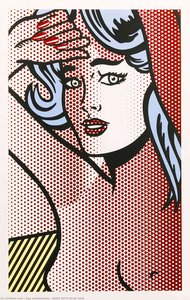 NUDE WITH BLUE HAIR - Roy Lichtenstein
Created in 1994, Nude with Blue Hair serves as a profound testament to the enduring influence of American Pop Art during the 1990s. In this work, Roy Lichtenstein masterfully bridges the gap between mass-media aesthetics and fine art, utilizing the decade's continued fascination with graphic, high-contrast imagery. The composition centers on a stylized female figure, whose direct, captivating gaze and provocative expression invite an intimate connection with the viewer.
The technical execution is a symphony of commercial art techniques reimagined for the gallery. Lichtenstein employs his signature Ben-Day dots to simulate texture and volume, creating a tactile depth that defies the inherent flatness of the medium. Thick, bold black outlines delineate the subject, while a vibrant, limited palette of blue, red, and white provides a striking visual punch. By referencing classic pin-up imagery through a modern, surrealist lens—emphasized by the subject's striking blue hair—the piece offers a nostalgic yet sharp commentary on idealized beauty and the visual language of consumer culture. This work exemplifies how 1990s American art continued to deconstruct and elevate the icons of mid-century pop culture.
Altarpiece: The Life of Christ - Keith Haring
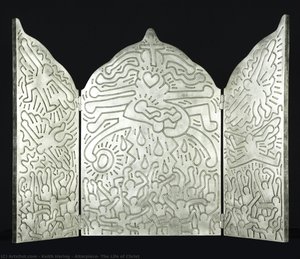 Altarpiece: The Life of Christ - Keith Haring
Keith Haring’s 1990 sculptural altarpiece, located within the Cathedral Church of St. John the Divine in New York City, represents a profound shift in the artist's trajectory during the early 1990s. Moving away from the ephemeral chalk drawings of the streets, this work utilizes gold leaf, bronze, and silver to engage with the permanent, sacred realm of liturgical art. The piece consists of three distinct metal sculptures arranged in a unified, rhythmic composition, where intricate patterns and detailed surface work create a sense of divine harmony.
The work serves as a visual meditation on the life of Christ, translating traditional religious narratives through a contemporary, graphic vocabulary. By employing simplified forms and bold, energetic lines, Haring bridges the gap between secular urban expression and communal devotion. This intersection of sacred history and modern sensibility exemplifies the era's movement toward monumental, complex themes. The physical weight of the precious metals provides a stark, mystical contrast to the artist's earlier pop-art roots, establishing a permanent dialogue between ancient tradition and the visual language of the late 20th century.
Quattro Stagioni, Autunno - Cy Twombly
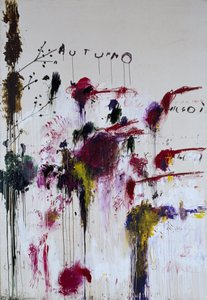 Quattro Stagioni, Autunno - Cy Twombly
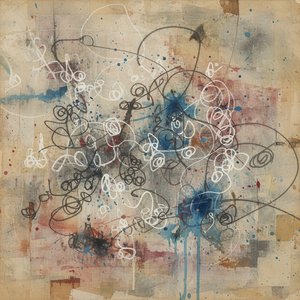
Created in 1995, Quattro Stagioni, Autunno stands as a profound testament to the late-period mastery of American abstract expressionist Cy Twombly. This work is a vital component of the artist's 1990s output, serving as one movement within a larger cycle of four canvases that map the cyclical passage of time. Following the sequence of Primavera, Estate, and Inverno, this specific piece captures the transient essence of the autumn season through a highly gestural and poetic visual language.
The composition is driven by a restless, chaotic energy, where thick, layered acrylics meet in a wet-on-wet application. Rather than depicting a literal landscape, Twombly utilizes spontaneous scribbles and calligraphic marks to evoke the mood of decay and transformation. Amorphous shapes of red, purple, yellow, and green bleed into a predominantly white background, suggesting the skeletal remains of foliage or the ghost of a bloom. The word ‘AUTUMNO’ is anchored across the top center in dark lettering, providing a heavy, linguistic weight to the swirling, dynamic motion. The result is a sensory exploration of movement, where the tension between urgent pigment and empty space captures the quiet beauty of a season in flux.
Blue Blanket - Catherine Murphy
 Blue Blanket - Catherine Murphy
In this 1990 oil on canvas, Blue Blanket, Catherine Murphy invites a quiet, focused attention toward the textures of the everyday. The work presents a blue blanket, its synthetic surface rippling over water, creating a sense of depth that draws the eye downward. It is a profound study in how light and material interact when the subject is stripped of grand narrative, focusing instead on the immediate presence of the object itself. This piece exemplifies the era's interest in the intersection of the mundane and the perceptual.
The composition is structured through a high vantage point, positioning the viewer as if looking down upon the scene. At the center lies the blue material, rendered with a texture that suggests a synthetic or plastic substance. This object rests over a body of water, where subtle ripples and waves disturb the surface beneath it. The interplay between the solid form of the blanket and the fluid movement of the water creates a quiet tension. In the background, a grassy area with patches of dirt provides a grounded, natural contrast to the synthetic subject, framing the interaction between man-made material and organic elements in a moment of profound stillness.
Icons - Keith Haring
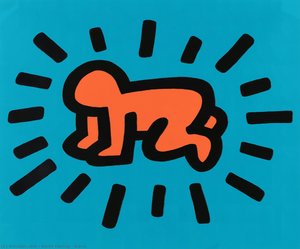 Icons - Keith Haring
Upon first encounter, the eye is immediately captured by the vibrant, high-contrast energy of the figures, most notably the Radiant Baby. Set against a deep teal background, the baby is rendered in bold orange and black, sitting with legs spread in a pose of pure, uninhibited existence. This striking use of color and simplified, rhythmic line work creates a visual language that is both playful and profoundly emotive, evoking a sense of hope through its graphic clarity.
Created in 1990, this work belongs to the American artworks of the 1990s as it represents a poignant final chapter in the career of Keith Haring. Produced during the year of his passing, the Icons series serves as a powerful distillation of his visual vocabulary. These figures—ranging from the innocent, glowing infant to the energetic, barking dog—transcend mere pop art to become universal symbols of human experience. By stripping away academic complexity in favor of direct, street-inspired communication, Haring’s work from this decade remains a vital testament to the intersection of social commentary and modern American iconography.
House III - Roy Lichtenstein
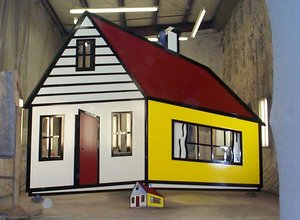 House III - Roy Lichtenstein
In the twilight of his illustrious career, Roy Lichtenstein turned his gaze toward one of the most enduring symbols of the American psyche: the suburban home. House III, conceived in 1997, stands as a profound meditation on domesticity and the idealized dream of the mid-century landscape. While many associate the Pop Art master with the explosive deconstruction of comic book aesthetics, this work reveals a more contemplative side of his late-century vision. It is a window into a collective memory, capturing the essence of a quiet, structured existence where every line serves to reinforce a sense of belonging and peace.
The composition presents a charmingly simplified structure, characterized by crisp white walls and a striking red roof that anchors the visual field. Through his signature use of bold outlines and flattened perspectives, Lichtenstein transforms a mundane architectural subject into something archetypal. The interplay between primary colors and stark, clean geometry creates a rhythmic visual language that is both playful and deeply disciplined. By utilizing an inverted perspective, the artist plays with the viewer's sense of depth, making the domestic scene feel both immediate and iconic.
Could This Be Love - Kerry James Marshall
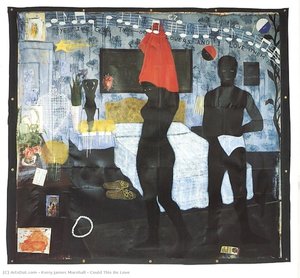 Could This Be Love - Kerry James Marshall
Created in 1992, Could This Be Love stands as a profound testament to the evolution of American contemporary art during the 1990s. In this work, Kerry James Marshall utilizes a complex mixed-media collage technique to explore the nuances of Black intimacy. The piece depicts two Black figures in a private, suspended moment within a bedroom setting, captured in the transitional act of undressing. This intimate scene is rendered through a dense, layered assemblage of fabric, paper, and found objects, creating a tactile and somewhat surrealist visual field.
The composition is characterized by an asymmetrical arrangement and a flattened perspective that rejects traditional depth. A sinuous line of musical notes and lyrics from Mary Wells’s song "Two Lovers" weaves through the imagery, binding the fragmented narrative together. A dominant, intense red in the central figure's clothing provides an emotional anchor against a palette of neutrals and espresso tones. By combining assemblage with painterly elements, Marshall asserts the dignity of his subjects, transforming a domestic fragment into a layered, melancholic, and deeply evocative exploration of human connection.
From the Mountain Top - Benny Andrews
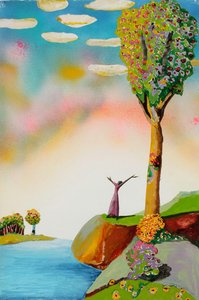 From the Mountain Top - Benny Andrews
Created in 1999, From the Mountain Top serves as a profound example of American expressionism from the final decade of the twentieth century. In this work, Benny Andrews utilizes a sophisticated combination of oil and collage on paper to construct a scene of immense spiritual weight and quietude. The piece belongs to the 1990s era through its masterful integration of mixed-media textures that define the landscape and the human form with tactile precision.
The composition centers on a solitary woman standing upon a hill's crest, her silhouette etched against a sky filled with heavy, moving clouds. Her pose suggests a deep, serene connection to the earth, looking out over a rhythmic landscape punctuated by stylized, lollipop-like clusters of trees. Two birds navigate the expansive atmosphere, adding fleeting points of life to the vista. Through a palette of blue, green, yellow, and pink, Andrews achieves a sense of warmth and hope, transforming a landscape into a meditative space of tranquility. This work is currently held in the Spelman College Museum of Fine Art collection.
Wall Drawing #831 - Sol LeWitt
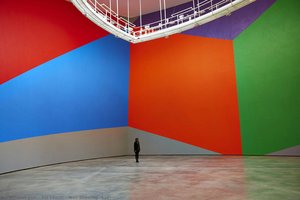 Wall Drawing #831 - Sol LeWitt
Sol LeWitt’s Wall Drawing #831, executed in 1997, stands as a profound example of American conceptualism during the final decade of the twentieth century. As a pioneer of both Minimalism and Conceptual Art, LeWitt famously proposed that the idea itself serves as the machine that produces the art. This work is not a spontaneous gesture but the physical manifestation of a pre-determined logical system, where the artist's hand follows a strict set of written instructions to dictate the interaction of form and space.
The visual impact of this mural is deeply immersive, characterized by a rhythmic, geometric tapestry of primary and secondary hues. Deep blues, fiery reds, lush greens, sunny yellows, warm oranges, and regal purples intertwine to create a pulsating energy. Unlike traditional representational art, this piece seeks to construct a new reality through pure abstraction and mathematical choreography. By stripping away spontaneous emotion in favor of a structured, systemic approach, LeWitt transforms the architectural environment into a labyrinth of color, where simple geometric repetitions blossom into complex, mesmerizing patterns that define the intellectual rigor of 1990s American art.
Pengwyryd - John Guerin
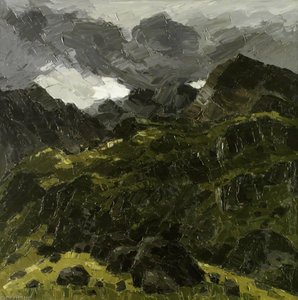 Pengwyryd - John Guerin
Created in 1999, Pengwyryd stands as a profound testament to the expressive potential of Contemporary Realism during the final decade of the 20th century. While the artist, Sir John Kyffin Williams, is celebrated for his evocative depictions of the Welsh landscape, this work exemplifies the era's movement toward tactile, emotive abstraction within a representational framework. The composition captures a rugged, mountainous vista where swirling clouds meet a rocky shoreline, creating a sense of dramatic atmospheric tension.
The painting is defined by its extraordinary sculptural presence, achieved through a masterful application of the impasto technique. Using a palette knife to build thick, heavy layers of oil paint, the artist imbues the canvas with a physical depth that mimics the grit of stone and the dampness of mist. The color palette is dominated by muted slate greys and deep blues, reflecting a tranquil yet powerful natural world. Subtle flashes of ochre and crimson break the somber tones, providing a flickering life to the landscape. Through this intense materiality, the work transcends mere topography to become a visceral experience of the earth's enduring spirit.
Conclusion
The American art landscape of the 1990s was a profound era of stylistic tension and evolution, where the bold legacies of Pop Art and Minimalism met the rising complexities of contemporary social narratives. From the rhythmic, graphic energy of Keith Haring to the sophisticated, layered textures of Catherine Murphy and the monumental presence of Kerry James Marshall, these artists collectively redefined the boundaries of visual language. Each work in this selection serves as a testament to a decade that refused to be categorized, blending high-concept abstraction with deeply humanistic expressions. Whether through the playful geometry of Sol LeWitt or the expressive, gestural marks of Cy Twombly, these pieces capture a pivotal moment in art history that continues to influence modern aesthetics.
At Mus3ums.com, we invite you to bring this vibrant era into your own space. Our master artists specialize in creating museum-quality, hand-painted oil reproductions that capture the true soul, texture, and brushwork of these iconic masterpieces. You can explore the breadth of this era by browsing our full collection and find the perfect piece to transform your home or office into a curated gallery of American excellence.