

Introduction
The dawn of the twentieth century in the United Kingdom marked a profound era of transition, where the romanticism of the Victorian age began to weave into the burgeoning complexities of the modern world. Artworks from this decade capture a unique cultural intersection, blending traditional academic mastery with a renewed fascination for light, movement, and the changing social landscape. From the lush, decorative patterns of the Arts and Crafts movement to the evocative, sun-drenched studies of maritime life and the nostalgic elegance of Pre-Raphaelite-inspired portraiture, these pieces reflect a nation navigating the shift from imperial grandeur to a more intimate, sensory exploration of life.
This collection of works remains vital today because they embody the tension between the old and the new. They offer a visual dialogue between the meticulous detail of the past and the expressive, atmospheric impulses that would eventually define modernism. Whether capturing the quiet dignity of a landscape or the spirited energy of a social gathering, these paintings serve as windows into a world on the cusp of radical transformation.
As we walk through this curated selection, we encounter the diverse perspectives of masters such as Edmund Blair Leighton, Henry Scott Tuke, and William Morris. Each artist brings a distinct voice to the decade, illustrating the breadth of British creativity through ten significant works that define the aesthetic spirit of the 1900s.
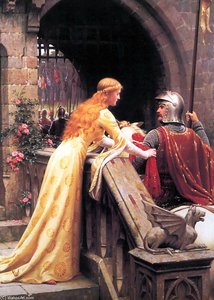
God Speed! - Edmund Blair Leighton
Created in 1900, God Speed! is a quintessential example of the romanticized medievalism that characterized British art at the turn of the century. This oil on canvas, exhibited at the Royal Academy, captures a poignant moment of chivalric farewell. The composition is anchored by a triangular arrangement, where the joined hands of a knight in full armor and a woman with flowing red hair form the emotional apex of the scene. The knight, mounted on a white horse and draped in a red cape adorned with fleur-de-lis, prepares for a quest, while the woman leans over a stone railing in an elegant yellow-gold dress.
Leighton’s technique demonstrates a profound mastery of texture and light, contrasting the polished sheen of the knight's armor against the rough, weathered stone of the castle architecture. The palette is rich with warm tones—golds, reds, and browns—balanced by the cool greys of the stone and the dark, receding shadows of the arched doorway. Through meticulous brushwork, the artist emphasizes the tension between the rigid verticality of the architecture and the graceful, curved lines of the woman's hair and drapery, embodying the Aesthetic movement's pursuit of harmony and emotional depth.
Famine - John Charles Dollman
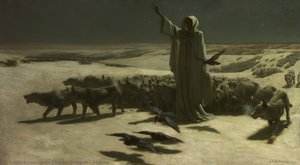 Famine - John Charles Dollman
Created in 1904, Famine is a profound example of the symbolic depth found in British artworks of the 1900s. John Charles Dollman, an RWS artist whose expressive brushwork suggests an affinity for the textures of Van Gogh, moves beyond mere social commentary to explore a spiritual void. This black and white composition strips away the distractions of color, focusing entirely on the raw, emotional weight of a man standing amidst a gathering of the starving. As he raises his arms toward the sky in a gesture of desperate prayer, the scene transcends physical hunger to depict the demise of the soul through neglect.
The atmosphere is heavy and somber, characterized by a dramatic manipulation of light and shadow. Dollman populates this desolate landscape with symbolic figures that heighten the sense of impending decay:
- A shrouded figure representing Death moving through the crowd.
- Hungry wolves, ironically modeled after well-fed animals from a local zoo.
- A battalion of crows and fluttering birds that add a restless energy to the stillness.
Through these elements, Dollman captures the haunting duality of physical suffering and the metaphorical emptiness of the spirit.
East Moriches - Thomas Moran
 East Moriches - Thomas Moran
Thomas Moran, a prominent figure associated with the Hudson River School, contributes a profound sense of atmospheric depth to this collection of British-born era works through his 1900 masterpiece, East Moriches. This landscape painting captures a serene yet melancholic riverbank scene under a heavy, overcast sky, embodying the Romanticist fascination with the emotional resonance of the natural world at the turn of the century.
The composition is masterfully structured, utilizing a prominent tree on the right as a vertical anchor to guide the viewer's eye along the river's path. The foreground, characterized by a muddy bank and scattered rocks, transitions through rolling hills into a hazy, distant city skyline. This juxtaposition of organic terrain against the geometric silhouettes of human settlement highlights the era's evolving relationship with the landscape. Moran employs a rich, impasto technique, particularly visible in the textured clouds and the rugged bark of the tree, which lends a tactile quality to the canvas. Through a muted palette of phthalo greens, browns, and soft grays, the work evokes a sense of solitude and quiet contemplation, perfectly reflecting the stylistic sensibilities of the 1900s.
Edward VII (1841–1910) - Luke Fildes
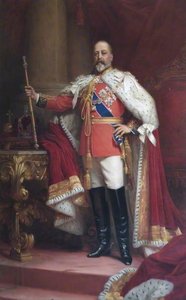 Edward VII (1841–1910) - Luke Fildes
Upon first glance, the viewer is met with the commanding presence of King Edward VII, rendered with a profound sense of stability and regal authority. Samuel Luke Fildes utilizes a symmetrical composition to anchor the monarch centrally, his figure framed by heavy, deep crimson curtains that evoke the grandeur of a royal court. The eye is immediately drawn to the intricate textures of the King's attire: the vibrant red of his tunic, the plush white fur trim, and the meticulous gold embroidery that catches the soft, diffused light. In his hand, he holds a scepter, a potent symbol of sovereignty, while a table laden with ceremonial regalia and crowns sits just behind him, reinforcing the weight of his office.
This 1901 oil-on-canvas portrait is a quintessential example of British artworks of the 1900s, capturing a pivotal moment of transition in the United Kingdom. Fildes, a master of social realism, applies his keen observational skills to this formal portraiture, blending realistic detail with the symbolic dignity required of a royal likeness. The work serves as a sophisticated visual record of the early Edwardian era, embodying the elegance and traditionalism of the British monarchy at the dawn of the new century.
Isabella and the Pot of Basil - Arthur Trevethin Nowell
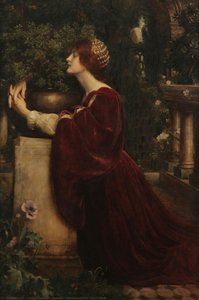 Isabella and the Pot of Basil - Arthur Trevethin Nowell
Created in 1904, this work exemplifies the atmospheric and psychological depth characteristic of British art during the first decade of the 20th century. Arthur Trevethin Nowell, a specialist in detailed realism, moves away from purely decorative portraiture to explore a more somber, dramatic narrative. The subject, a woman adorned in a striking red dress and a crown, is captured in a moment of profound stillness. Her presence, suggesting a Renaissance-inspired nobility, is anchored by the presence of a vessel—likely the titular pot of basil—which serves as a focal point for the interplay of light and shadow.
The composition is a masterclass in chiaroscuro, utilizing a low-key lighting scheme that favors deep shadows and a melancholic mood. Rather than relying on sharp outlines, Nowell employs gradual tonal gradations to define the textures of the fabric and the surrounding greenery. The inclusion of secondary figures and potted plants in the background adds a theatrical complexity, creating a sense of a story held in suspension. This piece highlights the era's ability to blend academic technical precision with a sensitive, evocative approach to human emotion.
Snakeshead - William Morris
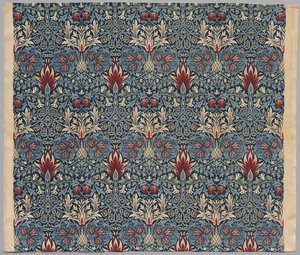 Snakeshead - William Morris
The eye is immediately drawn into a rhythmic dance of deep reds and stark blacks, where a dense thicket of color creates a sense of heavy, pulsing energy. This intricate textile design features the fritillary, or snakeshead, a wildflower that evokes the meadows of the English landscape. The composition is a sophisticated interplay of light and shadow, where delicate floral motifs move across the surface with a fluidity that mimics wildflowers swaying in a summer breeze. The vibrant blue and red tones are woven into a complex arrangement, providing a soft, botanical contrast to the strength of the darker hues.
As a seminal work by the leader of the British Arts and Crafts movement, this piece exemplifies the aesthetic transition of the early 20th century. It belongs to the group of United Kingdom artworks of the 1900s through its profound connection to the natural world and its role in defining the era's textile identity. The design captures a specific moment in decorative history, blending the botanical precision of the English countryside with the rich, warm influences of international craftsmanship, resulting in a pattern that feels both grounded and strikingly modern for its time.
Nude Boy on Rocks - Henry Scott Tuke
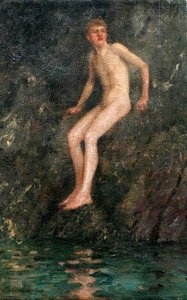 Nude Boy on Rocks - Henry Scott Tuke
Created in 1907, Nude Boy on Rocks stands as a quintessential example of the maritime naturalism that defined the Newlyn School during the first decade of the 20th century. This oil on canvas by Henry Scott Tuke captures a profound sense of tranquility, situating a solitary figure within a rugged coastal environment. The subject, a nude boy, is perched upon a cluster of stones amidst the water, his gaze directed toward an unseen point beyond the frame. This posture evokes a deep sense of introspection and vulnerability against the elements.
Tuke’s mastery is evident in the way he handles the interplay of light and texture. The composition relies on the contrast between the soft, illuminated skin of the boy and the hard, weathered surfaces of the geological formations. His loose, expressive brushwork captures the fluid movement of the surrounding sea and the shimmering quality of sunlight on water. As a significant work from the 1900s, this piece exemplifies the era's fascination with the human form in its most natural, unadorned state, harmonizing the physical presence of the individual with the vast, serene rhythms of the maritime landscape.
Deutsch Allalin , Strahl und Rimpfischhorn von der Ostflanke des Alphubel - Edward Theodore Compton
 Deutsch Allalin , Strahl und Rimpfischhorn von der Ostflanke des Alphubel - Edward Theodore Compton
Created in 1903, this work by Edward Theodore Compton exemplifies the intersection of scientific surveying and dramatic landscape art characteristic of British topographical interests during the 1900s. This piece offers a detailed, black and white topographical view of the Allalin, Strahl, and Rimpfischhorn peaks as seen from the eastern flank of the Alphubel. Utilizing a photogravure-style process, the work employs fine lines and hatching to suggest the rugged textures of stone and ice, achieving a sophisticated range of tonal variations despite the subdued, diffused light of an overcast sky.
The composition is a masterclass in atmospheric perspective, using receding mountain ranges to establish an immense sense of depth. Geometric precision is evident in the triangular summits and the irregular, rocky terrain of the foreground, where a small human figure provides a vital sense of scale against the vast alpine environment. Through linear perspective and meticulous shading, Compton captures the grandeur of the Swiss Alps, reflecting the era's fascination with exploration and the monumental power of the natural world.
The Fancy Dress Ball - Alfred Munnings
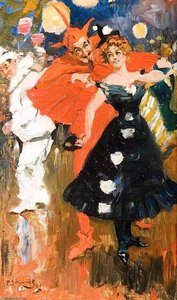 The Fancy Dress Ball - Alfred Munnings
Completed in 1901, Alfred Munnings’ The Fancy Dress Ball serves as a vibrant snapshot of the social fabric of the Edwardian era. As a quintessential work from the first decade of the 1900s, it captures the fleeting energy of a high-society gathering through a distinctly Impressionistic lens. Rather than focusing on rigid, meticulous detail, Munnings prioritizes the interplay of light and color to evoke the atmosphere of a bustling ballroom.
The composition is masterfully dynamic, utilizing diagonal lines to guide the eye across a crowd of masked attendees. A central female figure in a striking black dress commands the foreground, her presence anchored by the rich, warm tones of the setting. Munnings employs a heavy impasto technique, applying thick layers of oil paint to create a tactile, physical texture that mirrors the movement of the dancers. Through loose, expressive brushstrokes and a palette dominated by deep reds, blacks, and luminous yellows, the artist transforms a static scene into a celebration of joy and anonymity. The blurred, layered background creates a sense of depth, immersing the viewer in the rhythmic, swirling motion of the festivities.
Lamia - Sir George James Frampton
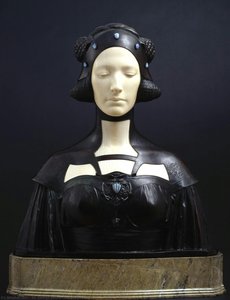 Lamia - Sir George James Frampton
Completed at the turn of the century, Sir George James Frampton’s Lamia serves as a quintessential example of British sculpture from the 1900s. This work captures the transition of the era, blending the sinuous rhythms of the Art Nouveau movement with the profound emotional depth of Symbolism. Inspired by the haunting poetry of John Keats, the piece reimagines the mythological figure as a seductive, ethereal presence, embodying the melancholic beauty of unattainable desire.
Frampton, a prominent figure in the New Sculpture movement, achieved a remarkable textural interplay by utilizing bronze and ivory. This combination allows for a striking contrast between the dark, metallic surfaces and the luminous, delicate qualities of the inlay. The sculpture is defined by its organic, flowing lines and undulating forms that mirror a serpentine grace, a hallmark of the period's rejection of rigid academic conventions. Through his masterful technical skill, Frampton transformed myth into a tactile, romantic experience, securing his place among the most evocative creators of the early twentieth century.
Conclusion
The dawn of the twentieth century in the United Kingdom was a period of profound stylistic transition, where the romanticism of the Victorian era met the burgeoning sensibilities of modernism. From the luminous, sun-drenched figures of Henry Scott Tuke to the intricate, decorative patterns of William Morris, these works represent a decade of immense creative diversity. Whether capturing the dramatic narratives of Edmund Blair Leighton or the delicate textures of Alfred Munnings, each artist contributed a unique visual language that defined the British aesthetic at the turn of the century. This collection serves as a testament to a transformative era, bridging the gap between classical tradition and the evolving spirit of a new age.
At Mus3ums.com, we invite you to bring these historical masterpieces into your own living space. Our master artists specialize in creating museum-quality, hand-painted oil reproductions that capture the authentic texture and soul of these iconic works. You can explore our full collection and find the perfect piece to transform your home with the timeless elegance of British art from the 1900s.