Introduction
The 1940s in the United Kingdom represented a decade of profound transformation, where the turbulence of the Second World War met a burgeoning desire for modernism and reconstruction. This era's art was shaped by a tension between the visceral realities of wartime life and a radical shift toward abstraction and organic form. As the nation navigated through darkness and eventual recovery, artists sought new visual languages to express the human condition, moving away from traditional Victorian sensibilities toward something more essential, structural, and often deeply psychological.
During this period, the British landscape was redefined not just by its physical geography, but by the conceptual shifts occurring in studios and design offices. From the stark, emotive carvings of modern sculpture to the intricate, rhythmic patterns of wartime graphic design and landscape painting, the art of this decade captured a country in flux. It was a time when the boundaries between fine art and functional design often blurred, as seen in the collaborative efforts of architects and designers working to rebuild the social fabric of the nation.
These works remain vital today because they embody the resilience and the intellectual courage of a generation that refused to let creativity be stifled by crisis. They offer a window into a pivotal moment when the foundations of contemporary British art were being laid, influencing everything from public architecture to the minimalist aesthetics of the mid-century. By examining these pieces, we witness the birth of a modern visual identity that continues to resonate in contemporary galleries and design studios alike.
The following selection highlights ten significant works from this transformative decade, featuring the contributions of masters such as Henry Moore, Barbara Hepworth, and Eric Ravilious, each offering a unique perspective on the spirit of the 1940s.
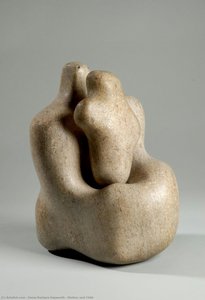
Rhythmic Form - Barbara Hepworth
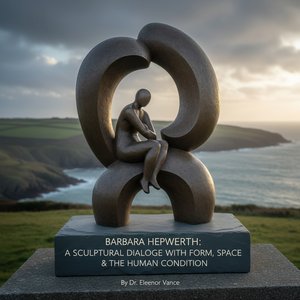
Barbara Hepworth, a preeminent figure in British modernism, redefined the boundaries of three-dimensional art through her radical exploration of negative space. Her 1949 sculpture, Rhythmic Form, stands as a quintessential example of the sculptural innovation emerging from the United Kingdom during this decade. Carved from Rosewood using the direct carving method, the work demonstrates Hepworth's mastery in manipulating organic materials to achieve a sense of movement and resonance.
The piece is defined by its monumental presence and a striking central void, a signature technique used to create a tension between presence and absence. This hole serves as a deliberate gesture to unify opposing forces, allowing space to flow through the solid medium. The surface, polished to a smooth finish, retains subtle textural variations from the carving process, highlighting the natural grain of the wood. By integrating geometric design with organic fluidity, Hepworth created a tranquil, serene composition that exemplifies the shift toward abstraction in mid-century British sculpture.
Wesley Girls School, Cape Coast - Office of Maxwell Fry and Jane Drew
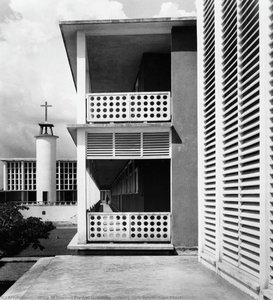 Wesley Girls School, Cape Coast - Office of Maxwell Fry and Jane Drew
This 1947 photograph of the Wesley Girls School in Cape Coast serves as a profound testament to the emergence of Tropical Modernism, a movement that defined much of the architectural discourse in the 1940s. Produced by the Office of Maxwell Fry and Jane Drew, the work captures a pivotal moment where British architectural innovation met the specific climatic requirements of West Africa. The composition is a study in geometric precision, utilizing a dynamic, angled perspective that emphasizes the rhythmic repetition of rectangular windows and balconies. A prominent clock tower provides a vertical counterpoint to the strong horizontal lines of the roofline, injecting a sense of institutional order and progress into the frame.
The grayscale medium highlights the textural nuances of the concrete facade, showcasing a design that prioritizes functionality and light diffusion over Victorian ornamentation. By eschewing heavy decoration for clean lines and structural clarity, Fry and Drew’s work reflects the decade's broader shift toward a modern, rationalist aesthetic. The resulting image is one of serene formality, capturing an architectural language that sought to harmonize international modernist principles with local environmental contexts.
The Right Honourable Sir Winston Churchill (1874–1965), KG, OM, CH, MP, Chancellor (1929–1965) - Frank O. Salisbury
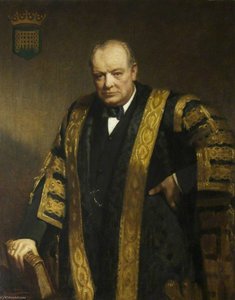 The Right Honourable Sir Winston Churchill (1874–1965), KG, OM, CH, MP, Chancellor (1929–1965) - Frank O. Salisbury
Created in 1943, this portrait serves as a profound testament to the leadership of the United Kingdom during a decade of global upheaval. Frank O. Salisbury, often regarded as Britain's 'Painter Laureate,' brings his academic mastery to this depiction of Winston Churchill. The work belongs to this 1940s collection as it captures a pivotal statesman during the height of the Second World War, embodying the era's gravity through a lens of Academic Realism.
The composition is defined by a sense of institutional permanence, with Churchill positioned before a wall adorned with a formal coat of arms. He is rendered in ceremonial attire, wearing a suit and tie paired with a heavy robe that suggests a moment of immense historical weight. Salisbury utilizes a controlled palette, dominated by deep tones like Phthalo Green, to emphasize the textures of the fabric and the resolute, stern expression etched upon the subject's face. Through precise brushwork and a deliberate play of light, the artist captures the quiet strength and the heavy mantle of duty carried by one of the most influential figures in British history.
Mrs Hoy as Women's Auxiliary Air Force Officer (1939–1945) - Maurice Codner
 Mrs Hoy as Women's Auxiliary Air Force Officer (1939–1945) - Maurice Codner
Maurice Codner’s 1940 portrait, Mrs Hoy as Women's Auxiliary Air Force Officer (1939–1945), stands as a poignant representative of British art during the early 1940s. This work captures a pivotal moment in social history, documenting the shifting roles of women as they entered military service during the Second World War. The subject is depicted sitting upon the ground in a state of quiet, steady repose, her hands clasped in a manner that suggests both dignity and a somber awareness of the era's gravity.
Codner utilizes a precise handling of form to define the sitter, employing a sophisticated interplay of light and shadow across the structured folds of her uniform. The military attire—complete with a hat and tie—serves as a powerful symbol of a new identity defined by duty. By placing the figure against a soft, expansive landscape, the artist anchors the subject to the earth, creating a sculptural presence that feels both grounded and monumental. The composition remains intensely focused on the individual, using detailed brushwork to trace the contours of the face and the specific textures of the service dress, effectively recording a person caught at the intersection of private life and public mobilization.
Before the Start, Newmarket - Alfred Munnings
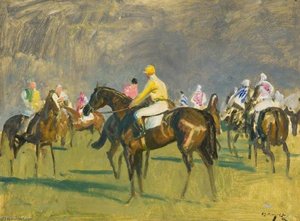 Before the Start, Newmarket - Alfred Munnings
Painted in 1949, Before the Start, Newmarket serves as a quintessential example of British equine Impressionism from the 1940s. Sir Alfred James Munnings utilizes an oil-on-panel technique to capture the palpable tension of the Newmarket racecourse. The composition centers on a jockey in a vibrant yellow jacket mounted upon a rich brown horse, a focal point that pierces through the more muted, earthy tones of the surrounding competitors. This strategic use of color creates a sense of immediate, nervous energy poised to erupt into motion.
The palette is characterized by a sophisticated interplay between the warm, pale yellow of the ground and the soft, cool grays of a cloudy sky. This atmospheric lighting reflects the nuanced approach to light and landscape prevalent in mid-century British art. Munnings’s mastery is evident in the way he depicts the varied shades of the horses, providing a sense of depth and anatomical accuracy. The work transcends mere documentation, instead freezing a fleeting moment of anticipation and camaraderie within the high-stakes world of equestrian sport, embodying the nostalgic and romantic spirit of the era.
A Miner at Work - Henry Moore
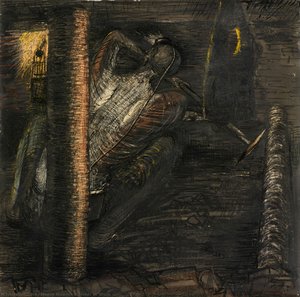 A Miner at Work - Henry Moore
Created in 1942, "A Miner at Work" stands as a profound meditation on human resilience during the Second World War. This work by Henry Moore exemplifies the shift in British art during the 1940s, moving away from traditional realism toward a sophisticated semi-abstraction. Moore captures a solitary figure at the coal face, utilizing simplified forms and organic voids to explore the essence of labor rather than mere physical likeness. The subject's hunched posture conveys the heavy, subterranean weight of the mining environment while maintaining a sense of quiet dignity.
Technically, the piece demonstrates a mastery of form through the use of geometric shapes and strategic negative space, inviting a deep psychological engagement with the figure. The palette is dominated by somber, espresso tones, reflecting a dramatic and introspective atmosphere. By emphasizing the relationship between the human body and the earth, Moore’s work reflects the era's preoccupation with the strength required to sustain a nation under siege. This piece remains a quintessential example of how British modernism during this decade sought to find monumental meaning within the most grueling of human experiences.
Moody - Russell Drysdale
 Moody - Russell Drysdale
In Moody, painted in 1941, Russell Drysdale offers a profound meditation on the stillness of rural life, a work that exemplifies the shifting perspectives of the 1940s. Although Drysdale is a titan of Australian Modernism, this piece belongs to our study of British artworks of the 1940s due to the artist's profound connection to the United Kingdom, where his formative years and stylistic evolution were deeply influenced by the European modernism that shaped the era's global aesthetic.
The composition captures a tableau vivant on a sidewalk in front of the Royal Hotel at Seymour. A group of five individuals stands in quiet camaraderie, their postures conveying a sense of laconic resilience. The scene is anchored by a parked truck in the foreground, grounding the viewer in this specific, nostalgic moment. Rendered with a striking, almost documentary-like quality, the palette leans into a muted, sea-green undertone that enhances the atmospheric, timeless feel of the street scene. Through his masterful use of light and shadow, Drysdale transforms a simple urban moment into a poignant study of character and landscape.
Wave - Barbara Hepworth
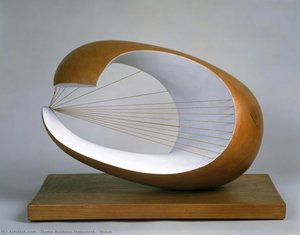 Wave - Barbara Hepworth
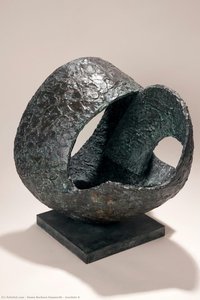
Created in 1943, Wave stands as a profound meditation on movement and the elemental power of nature, marking a pivotal moment in the evolution of British Modernism. During this decade, the artist sought refuge and inspiration in the rugged Cornish coastline, a landscape that deeply informed her aesthetic. This work belongs to the 1940s group through its radical departure from traditional representation, favoring instead a reductive approach that captures the very essence of a breaking wave rather than its literal likeness.
The sculpture is characterized by its masterful use of negative space, a signature technique of the artist. Crafted from wood and polished to a luminous sheen, the piece features a gently curving line extending from a central, circular core. This composition creates a dynamic tension between presence and absence, translating the rhythm of the sea into a tangible, three-dimensional form. By stripping away extraneous detail, the work emphasizes the relationship between organic texture and geometric abstraction, embodying the tranquil yet powerful spirit of mid-century British sculpture.
Study for 'Early Morning, Newmarket' - Alfred Munnings
 Study for 'Early Morning, Newmarket' - Alfred Munnings
The eye is immediately drawn to the visceral energy of four magnificent horses captured in mid-gallop across an expansive, open field. In this 1949 oil study, Alfred Munnings utilizes expressive, loose brushstrokes and a heavy impasto technique to convey the raw power and speed of the animals. The composition is dominated by the rhythmic, organic curves of the horses' bodies and the flowing lines of their manes, which seem to blur into the background, emphasizing a sense of continuous motion. A muted, earthy palette of rosy browns, ochres, and subtle blues creates a hazy, atmospheric depth, suggesting the diffused light of an overcast English dawn.
As a work executed in 1949, this piece is a quintessential example of British art from the 1940s. It reflects the era's fascination with capturing the fleeting essence of rural life and equestrian tradition through a lens influenced by Expressionism. By focusing on the muscularity and grace of the horses, Munnings provides a profound glimpse into the enduring connection between the English landscape and the spirit of movement that defined much of the period's figurative mastery.
De-Icing Aircraft - Eric Ravilious
 De-Icing Aircraft - Eric Ravilious
The viewer is immediately confronted by the stark, detailed rendering of a Bristol Blenheim light-bomber's tail fin, which dominates the left side of the composition. This large, icy structure serves as the anchor for a scene of quiet, wintry labor on a snow-covered airfield. In the mid-ground, a second aircraft appears more distant, its form softened by atmospheric perspective, while small figures work amidst the drifts. The palette is defined by cool, muted tones and celadon hues, capturing the diffused light of an overcast sky and the biting chill of a landscape transformed by frost.
Created in 1942, this watercolor is a quintessential example of British wartime art from the 1940s. It reflects the era's preoccupation with the realities of military aviation and the resilience required to maintain technological strength against the elements. Through a masterful use of wet-on-wet watercolor techniques and expressive, broken brushstrokes, Ravilious achieves a sense of Magic Realism. The work balances the meticulous detail of the aircraft with a dreamlike, reflective stillness, transforming a mundane maintenance task into a poignant meditation on isolation and endurance during the conflict.
Conclusion
The British art scene of the 1940s was a profound intersection of resilience and radical transformation, where the organic abstraction of Henry Moore and Barbara Hepworth met the structured, modern sensibilities of the architectural avant-garde. From the evocative landscapes of Eric Ravilious to the intricate, often surrealist textures of the era, these works collectively captured a nation in flux, balancing a deep respect for traditional form with an urgent need to redefine the visual language of a new world. Whether through the sculptural weight of modernism or the delicate precision of wartime design, this decade left an indelible mark on the history of art.
At Mus3ums.com, we invite you to bring this era of profound creativity into your own space. Our master artists specialize in creating museum-quality, hand-painted oil reproductions that capture the authentic texture and soul of these mid-century masterpieces. You can explore the breadth of this era by browsing our full collection and find a piece that resonates with your personal aesthetic, allowing you to live with the enduring beauty of British modernism every day.