Introduction
The final decade of the nineteenth century in the United Kingdom marked a profound era of aesthetic transition, where the romanticism of the past met the sharp, often provocative edges of modernity. This period was defined by a tension between the lush, decorative ideals of the Aesthetic Movement and the emerging psychological depth of Symbolism. As the Victorian era drew to a close, British artists began to move away from purely narrative or moralistic painting, instead exploring the evocative power of line, the sensuality of color, and the intricate patterns of the natural and imaginary worlds.
Culturally, this was a time of intense creative ferment. The influence of the Pre-Raphaelites continued to resonate, while new voices like Aubrey Beardsley and William Morris redefined the boundaries between fine art and design. The works of this decade reflect a society navigating the complexities of industrialization through a lens of exquisite craftsmanship and often melancholic beauty. From the dramatic, soulful portraiture of Dante Gabriel Rossetti to the delicate, stylized compositions that anticipated the coming Art Nouveau, the art of the 1890s captures a unique moment of cultural refinement and stylistic experimentation.
Today, these masterpieces remain vital for their ability to evoke deep emotion and their significant impact on the evolution of modern graphic design and decorative arts. They serve as a bridge between the classical traditions of the academy and the radical shifts of the twentieth century. The following selection highlights ten significant works from this transformative decade, showcasing the diverse mastery of artists who shaped the visual identity of a nation at the dawn of a new age."
The Doctor - Luke Fildes
 The Doctor - Luke Fildes
Painted in 1891, The Doctor stands as a profound testament to the social realism that emerged from the United Kingdom during the 1890s. This oil on canvas, commissioned by Henry Tate, captures a moment of intense human vulnerability within a modest, dimly lit interior. The scene depicts a physician attending to a sick child, a composition that draws the viewer into a quiet drama of caregiving and desperation. The atmosphere is heavy with a somber, melancholic tone, characteristic of the era's interest in the emotional realities of the working class.
The work is deeply personal, as Luke Fildes drew upon his own experience of losing his son to typhoid fever to inform this narrative. This intimate connection is visible in the dramatic chiaroscuro lighting, where a single lamp casts a warm, steady glow upon the doctor’s focused hands and the pale face of the patient, piercing through the surrounding gloom. While the color palette is dominated by dark, muted tones and phthalo greens, the strategic use of light creates a powerful tension between the exhaustion of the parents and the steady, quiet presence of the medical professional.
Flaming June - Frederic Leighton
 Flaming June - Frederic Leighton
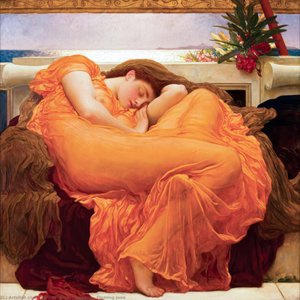
Painted in 1895, Flaming June stands as a definitive masterpiece of the 1890s, representing the pinnacle of Sir Frederic Leighton's career. This work exemplifies the Academic Classicism prevalent in the United Kingdom during this decade, moving away from the spontaneous gestures of Impressionism toward a more sculptural and disciplined precision. The composition centers on a reclining female figure, draped in vibrant, coral-toned fabric that cascades in heavy, silken folds around her. Through a masterful application of chiaroscuro, Leighton sculpts the subject with a luminous quality, where light and shadow define the soft musculature of her relaxed limbs and the intricate textures of her gown.
The painting’s atmosphere is one of profound tranquility and Mediterranean warmth. While the foreground focuses on the intimate, sleeping figure, the background offers a glimpse through an ornate window toward a distant landscape of sea and mountains, providing a sense of depth and classical scale. By marrying rigorous technical realism with a romanticized, dreamlike mood, Leighton created an icon of the late Victorian era that remains a cornerstone of British art history.
Jane Burden (1839–1914), Mrs William Morris - Dante Gabriel Rossetti
 Jane Burden (1839–1914), Mrs William Morris - Dante Gabriel Rossetti
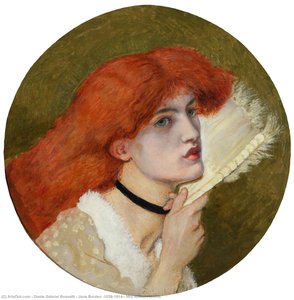
The viewer is immediately arrested by the striking presence of a woman with cascading red hair, her gaze meeting the observer with an intensity that borders on the melancholic. Dressed in a luminous white gown and adorned with a delicate necklace, she holds a parasol that serves less as a functional object and more as a symbolic barrier, hinting at a private, inner world. The composition is anchored by a rich, sophisticated palette of espresso and gold tones, which provides a deep, dramatic contrast to the brightness of her attire and the warmth of her hair.
Completed in 1893, this portrait by Dante Gabriel Rossetti stands as a quintessential example of British art from the 1890s, capturing the late-Victorian fascination with the Pre-Raphaelite ideal. As a leader of the movement, Rossetti utilizes the subject, Jane Burden, to explore themes of sensual beauty and symbolic depth. This work exemplifies the decade's aesthetic shift toward highly stylized, evocative portraiture, where the sitter is transformed into a romanticized muse, embodying the profound emotional and visual complexity characteristic of the era's most celebrated British masters.
Frontispiece for 'The Yellow Book: An Illustrated Quarterly' - Aubrey Beardsley
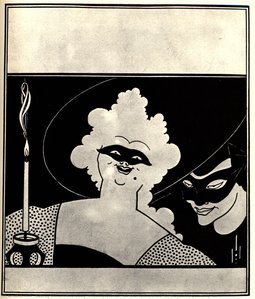 Frontispiece for 'The Yellow Book: An Illustrated Quarterly' - Aubrey Beardsley
The eye is immediately drawn to the stark, dramatic tension between deep black ink and the stark white of the page, a hallmark of Aubrey Beardsley’s graphic mastery. In this 1894 composition, two enigmatic female figures emerge from a flattened, dreamlike space, their identities partially concealed by elaborate masks and extravagant, architectural hats. The composition captures a sense of theatrical intimacy, where the figures appear caught in a quiet, secretive moment. Beardsley utilizes bold, rhythmic lines and heavy hatching to create texture and volume, drawing significant influence from the aesthetic of Japanese woodcuts. This work is a quintessential representative of British artworks of the 1890s, embodying the Decadent movement and the burgeoning Art Nouveau style that defined the era's visual language. Through its stylized, slightly surreal quality and its focus on themes of hidden identity and opulence, the piece serves as a profound manifesto of the aesthetic revolution occurring in the United Kingdom during this transformative decade.
Stephen Alley - John Lavery
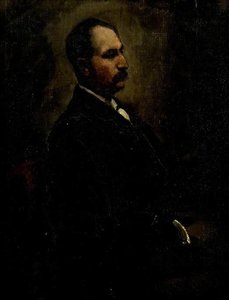 Stephen Alley - John Lavery
Executed around 1890, Stephen Alley serves as a profound example of the portraiture emerging from the United Kingdom during this decade. Sir John Lavery, an artist renowned for his ability to capture high society with refined tonal harmony, utilizes this piece to demonstrate the intersection of academic precision and subtle Impressionistic nuances. The work is a striking study in monochromatic tones, relying on a sophisticated palette of grays, blacks, and whites to establish a somber and dignified atmosphere.
The composition features the subject in a three-quarter pose, positioned against a dark, indistinct background that emphasizes his formal attire and social standing. Lavery’s technical mastery is evident in the dramatic use of light and shadow; a strong light source from the front-left illuminates the subject's facial features while casting deep shadows that provide a remarkable sense of three-dimensionality. Through the careful layering of oil paint on canvas, the artist achieves a soft, painterly effect where lines are blended rather than sharply defined, capturing a sense of quiet introspection and the elegant, formal essence characteristic of late Victorian portraiture.
Photograph of Chichén Itzá taken by A.P. Maudslay - Alfred Percival Maudslay
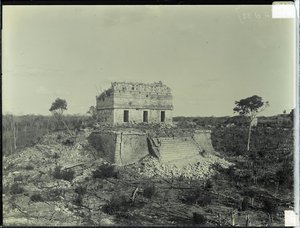 Photograph of Chichén Itzá taken by A.P. Maudslay - Alfred Percival Maudslay
Captured in 1894, this silver gelatin print by Alfred Percival Maudslay serves as a profound testament to the pioneering spirit of British documentary photography during the 1890s. As a specialist in the archaeology of Central America, Maudslay utilized the meticulous wet plate collodion process to preserve the grandeur of the Mayan civilization. This specific work belongs to the 1890s group of British artworks due to its era-defining technical precision and its role in the late 19th-century movement to document global historical sites.
The composition is dominated by the imposing, geometric tiers of the Chichén Itzá pyramid, which rises with monumental stability against a backdrop of organic foliage. By stripping away the distraction of color, the monochromatic palette emphasizes the tactile reality of the weathered stone, highlighting the rough textures and ancient patina of the ruins. The diffused lighting creates subtle gradations of gray, lending a serene yet melancholic atmosphere to the scene. Through this lens, the photograph transcends mere documentation, offering a timeless meditation on the endurance of architectural achievement amidst the passage of centuries.
Priestess of Delphi - John Collier
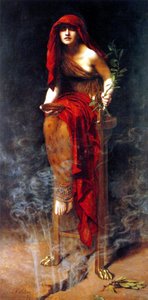 Priestess of Delphi - John Collier
Created in 1891, Priestess of Delphi stands as a profound example of British art from the 1890s, a decade where narrative depth and classical revivalism flourished. Executed by John Collier, a distinguished English portraitist and a key figure in the late Pre-Raphaelite tradition, this oil on canvas moves beyond the formal constraints of high-society commissions to embrace a more mystical and theatrical realm. The work exemplifies the era's fascination with antiquity and the spiritual, utilizing a sophisticated palette to evoke a sense of ancient mystery.
The composition is defined by a dramatic use of chiaroscuro, where a deep, espresso-toned darkness envelops the scene, pushing the central figure into sharp focus. The woman, draped in vibrant red clothing and a matching veil, appears caught in a moment of ritualistic trance. She holds a sacred laurel branch in one hand and a bowl of water in the other, while vapors curl upward from a fissure near her bronze seat. Through this meticulous attention to detail and symbolic objects, Collier captures a scene steeped in the enigmatic atmosphere of the temple of Apollo.
The Little Tree (Hammersmith Rug) - William Morris
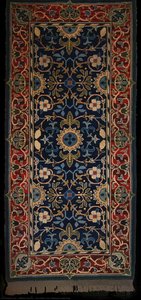 The Little Tree (Hammersmith Rug) - William Morris
Upon first glance, The Little Tree (Hammersmith Rug) captivates with a striking interplay of deep blues and vibrant red accents. The eye is immediately drawn to the intricate, rhythmic patterns of stylized flora and the delicate presence of birds scattered throughout the composition. These motifs, rendered with obsessive botanical detail, create a dense, layered tapestry where every inch of the surface is alive with movement and texture. The design features a rich palette of greens, ochres, and cool blues that emerge from the dark, grounding background, inviting a sense of quiet contemplation.
Completed in 1895, this work is a quintessential example of British art from the 1890s, specifically embodying the peak of the Arts and Crafts movement. Through this textile design, William Morris expressed a profound rejection of industrial mass-production, instead championing the medievalist ideals of handcrafted artistry and organic beauty. By weaving together elements of English folklore and the structured elegance of illuminated manuscripts, Morris created a piece that serves as a nostalgic bridge between the romanticized Middle Ages and the burgeoning design sensibilities of the late Victorian era.
The Heart of the Rose - Edward Burne-Jones
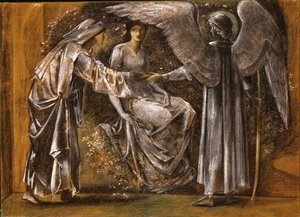 The Heart of the Rose - Edward Burne-Jones
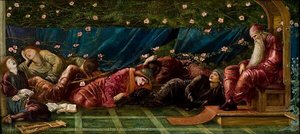
Edward Burne-Jones’s The Heart of the Rose stands as a quintessential example of the ethereal and melancholic spirit defining British art at the turn of the decade. Created in 1890, this work exemplifies the Pre-Raphaelite movement's fascination with medievalism and symbolic storytelling. The composition orchestrates a solemn, dreamlike encounter between a contemplative woman, a serene angel offering a rose, and a shadowed male figure whose presence introduces an element of mystery and potential judgment.
The painting is a masterclass in texture and dramatic lighting. Burne-Jones employs a rich, velvety palette and meticulous brushwork to create a sense of profound materiality, particularly in the flowing, organic drapery. His technique utilizes a combination of glazing and dry brushwork to build depth, resulting in a flattened perspective that prioritizes emotional and spiritual impact over strict realism. This emphasis on intricate detail and the use of symbolic figures—such as the angel’s wings representing divine intervention—captures the decade's preoccupation with the intersection of the sacred and the romantic, making it a definitive piece of the 1890s aesthetic.
Sara Bernhardt (1844–1923) - William Nicholson
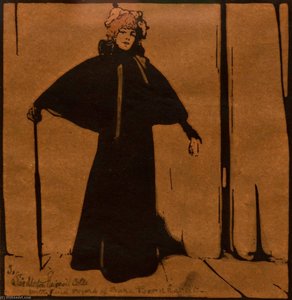 Sara Bernhardt (1844–1923) - William Nicholson
In this evocative monochrome portrait from 1897, Sir William Nicholson captures the magnetic presence of the incomparable Sara Bernhardt. As a quintessential work from the 1890s, this piece reflects the era's fascination with the theatricality of the Belle Époque. Nicholson, a British painter known for his bold silhouettes and insightful character studies, eschews color to focus entirely on texture, silhouette, and the dramatic interplay of shadow.
Bernhardt is depicted poised upon a stage, draped in an exquisite long dress and crowned with a sophisticated hat. Through a masterful use of black and white, Nicholson sculpts light around her form, creating a sense of depth that makes the subject feel almost tangible. The delicate folds of her gown and the structured elegance of her millinery are rendered with a precision that highlights the artist's disciplined training during this formative period of his career. This portrait transcends mere likeness, offering a soulful meditation on fame and the ephemeral nature of performance, serving as a profound example of British Realism at the turn of the century.
Conclusion
The decade of the 1890s in the United Kingdom served as a profound crossroads where the romanticism of the Pre-Raphaelites met the sharp, graphic elegance of the Aesthetic movement and the emerging sensibilities of modernism. From the intricate, flowing lines of Beardsley to the soulful, dramatic portraiture of Rossetti and the atmospheric landscapes of Lavery, these artists collectively defined an era of intense visual storytelling and stylistic experimentation. Each work captured a unique facet of the British spirit, whether through the delicate textures of a floral motif or the bold, sweeping gestures of a grand oil composition.
At Mus3ums.com, we invite you to bring this transformative era into your own living space. Our master artists specialize in creating museum-quality, hand-painted oil reproductions that preserve the tactile soul and visible brushstrokes of these historical masterpieces. Whether you are looking to anchor a room with a large-scale canvas or seeking a bespoke tribute to the fin de siècle style, you can explore our full collection to find the perfect piece for your home or gallery.