Introduction
The 1870s in France marked a seismic shift in the history of visual expression, a decade where the rigid structures of the Academy began to dissolve under the weight of a new, sensory reality. Amidst the political transformations of the era, a group of visionary painters moved away from the polished, historical narratives of the past to capture the fleeting nuances of light, atmosphere, and modern life. This period saw the birth of a revolutionary way of seeing, where the brushstroke became an independent entity, vibrating with the energy of the moment rather than serving a strictly defined contour.
As the urban landscape of Paris evolved and the countryside offered new vistas of light, artists like Claude Monet, Pierre-Auguste Renoir, and Alfred Sisley began to experiment with the ephemeral qualities of the natural world. Their work was not merely a depiction of subjects, but an investigation into how light interacts with color and how the human eye perceives a changing environment. This era challenged the very definition of art, prioritizing the subjective experience of the artist over the objective perfection of the subject.
Today, these works remain vital because they represent the dawn of modernity. They teach us to find beauty in the transient—the shimmer of water, the dappled shade of a garden, or the bustling movement of a city street. The textures and color palettes developed during this decade continue to influence how we interpret the world around us, bridging the gap between the classical tradition and the expressive freedom of the modern age.
The following selection explores ten significant masterpieces from this transformative decade, showcasing the diverse approaches of the masters who redefined the boundaries of the canvas.
Gare Saint Lazare, Pari - Claude Monet
 Gare Saint Lazare, Pari - Claude Monet
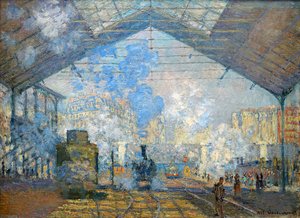
Painted in 1877, this iconic work offers a captivating glimpse into the heart of Parisian life during a period of rapid industrialization. As a cornerstone of French art from the 1870s, Gare Saint Lazare, Paris demonstrates how Claude Monet transitioned from traditional landscapes to the pulse of the modern cityscape. Rather than merely depicting a railway station, Monet translates the energy, atmosphere, and the very feeling of modernity onto canvas, making it a poetic statement about progress and transience.
A quintessential example of Impressionism, this piece prioritizes the fleeting effects of light and atmosphere over precise detail. Monet’s signature loose brushwork creates a dynamic surface, where steam is rendered not as a solid form, but as an ethereal presence that envelops the scene. The composition is dominated by a vast, arched ceiling that draws the eye into a bustling interior of movement and human interaction. Through a palette of muted blues, grays, and whites, punctuated by warm ochres, he captures the hazy, diffused light of the station, immortalizing a moment of industrial majesty that defined the era.
Man at the Window - Gustave Caillebotte
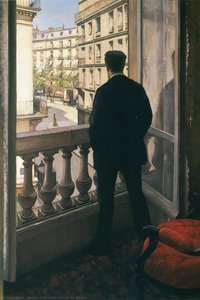 Man at the Window - Gustave Caillebotte
Gustave Caillebotte’s 1875 masterpiece offers a captivating glimpse into modern Parisian life, transcending mere representation to become a poignant study of urban isolation and quiet contemplation. This meticulously detailed painting invites viewers to share in the private moment of a man lost in thought, gazing out upon the bustling cityscape from the stillness of an interior.
As a significant work from the 1870s, this piece highlights Caillebotte’s unique position within the French art scene. While he was a key participant and patron of the Impressionist movement, his style here is distinctly rooted in Realism. He masterfully blends precise observation with an emerging sensitivity to light and atmosphere, foreshadowing the aesthetic revolutions of his contemporaries. Unlike works focused solely on fleeting light, Caillebotte delivers a scene grounded in tangible, architectural precision. The composition uses geometric lines and a muted palette of dark browns, grays, and blacks—punctuated by the warmth of a red cushion—to create a profound sense of depth. Through careful brushwork and a focus on the man's reflective posture, the painting captures the psychological weight of the modern urban experience.
The Walk. Lady with a Parasol - Claude Monet
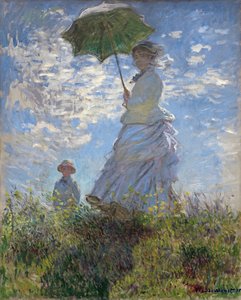 The Walk. Lady with a Parasol - Claude Monet
Upon first glance, the eye is immediately drawn to the luminous interplay of light and movement in this 1875 composition. A woman, her dress billowing softly in a gentle breeze, strides through a lush field of wildflowers, accompanied by a child. The scene is bathed in the ethereal, diffused glow of a setting sun, which transforms the sky into a delicate tapestry of soft blues, warm pinks, and oranges. The composition utilizes a sophisticated balance of horizontal lines from the receding landscape against the verticality of the parasol, creating a sense of spontaneous, fleeting time.
As a quintessential work from the 1870s, this painting epitomizes the radical shift in French art during this decade. It exemplifies the Impressionist movement's devotion to en plein air painting, prioritizing the immediate sensory perception of light and atmosphere over strict academic realism. Through loose, visible brushstrokes and a vibrant, layered palette, the artist captures the transient essence of a tranquil afternoon, marking a definitive moment in the evolution of modern landscape painting.
Dance at the Moulin de la Galette - Pierre-Auguste Renoir
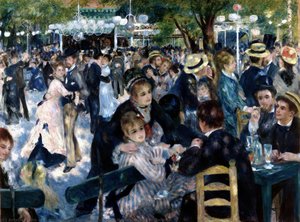 Dance at the Moulin de la Galette - Pierre-Auguste Renoir
Renoir’s 1876 masterpiece serves as a definitive emblem of the 1870s, capturing the vibrant pulse of Parisian social life during a decade of profound cultural shifts. This work transports the viewer to a sun-drenched afternoon at the Moulin de la Galette in Montmartre, offering a spontaneous snapshot of leisure and modern interaction. Rather than adhering to the rigid structures of traditional realism, the painting prioritizes the sensory experience of a fleeting moment.
The composition is a dynamic symphony of movement, where figures in fashionable attire engage in dance and conversation. Renoir employs the quintessential Impressionist technique of broken color and short, visible brushstrokes to simulate the dappled sunlight filtering through the trees. This approach creates a shimmering, atmospheric surface that evokes the warmth of the sun and the energy of the crowd. Through a delicate palette of pastels and soft, diffused light, the artist captures the essence of joy and the ephemeral beauty of everyday life, making this work a cornerstone of the French Impressionist movement.
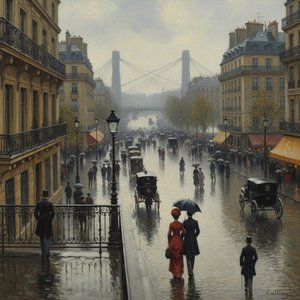
Paris street, Rainy Day - Gustave Caillebotte
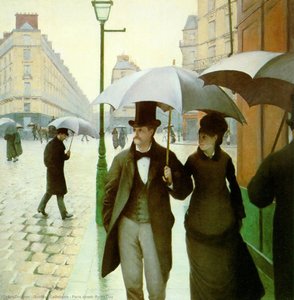 Paris street, Rainy Day - Gustave Caillebotte
Gustave Caillebotte’s 1877 masterpiece, Paris street, Rainy Day, stands as a definitive work of the 1870s, capturing the transformative energy of a modernizing metropolis. This oil on canvas offers an arresting glimpse into the atmosphere of a subdued, overcast day in Paris, where the soft, diffused light reflects off wet cobblestones to create a sense of profound depth. As a key figure in the transition toward Impressionism, Caillebotte utilizes a unique blend of Realism and Impressionistic observation to depict the urban experience.
The composition is remarkably cinematic, employing a precise linear perspective that guides the eye through the receding architecture of the boulevard. At the heart of this scene, an elegantly dressed couple walks under umbrellas, their presence providing a focal point of human intimacy amidst the vast, structured city. Caillebotte’s technique is characterized by:
- Atmospheric Perspective: Using a muted palette and softening details in the distance to simulate the effect of rain and mist.
- Structural Precision: A strong emphasis on the geometry of buildings and the rhythmic lines of the pavement.
- Textural Realism: Smoothly blended brushstrokes that capture the specific sheen of damp surfaces and the heavy fabric of 19th-century attire.
Nana - Édouard Manet
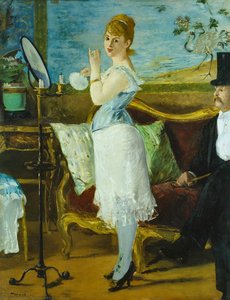 Nana - Édouard Manet
Upon first glance, the eye is drawn to the luminous, central figure of a woman admiring herself in a mirror, her presence commanding the foreground with an air of refined elegance. She is dressed in a delicate light blue bodice and a white lace skirt, her sophisticated updo and fine jewelry catching the diffused light that spills into the room. Beside her, a man observes the scene from a seated position, adding a layer of social complexity to this intimate boudoir setting. The composition uses a mirror to create a sense of depth, reflecting the scene and layering the space, while a window in the background offers a soft glimpse of water and sky.
Created in 1877, this work is a quintessential example of French art from the 1870s, a decade defined by the transition from Realism to Impressionism. Manet captures the pulse of modern Parisian life, eschewing traditional mythology for the vibrant, fleeting realities of contemporary society. Through loose, expressive brushstrokes and a focus on the interplay of light and atmosphere, the painting achieves a sense of quiet contemplation and sophisticated modernism.
The Apparition - Gustave Moreau
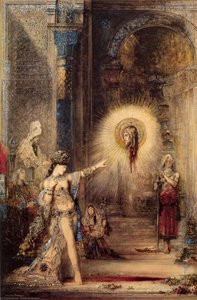 The Apparition - Gustave Moreau
Gustave Moreau’s The Apparition, created in 1876, stands as a profound testament to the shifting artistic landscape of 1870s France. While many of his contemporaries were exploring the fleeting effects of light in the natural world, Moreau turned inward, venturing into the realms of myth, mystery, and the subconscious. This work is a cornerstone of the Symbolist movement, prioritizing the expression of emotional and spiritual states over the literal depiction of reality.
The composition captures a dramatic, mystical vision: the biblical moment where Salome’s dance is haunted by the severed head of John the Baptist. Set within an opulent, Moorish-style architectural space, the scene is characterized by a complex, crowded arrangement of figures that creates a sense of dynamic chaos. Moreau utilizes a theatrical, chiaroscuro-like lighting, where a radiant halo illuminates the central figure, casting deep shadows that heighten the sense of horror and spiritual intensity. Through loose, expressive brushwork and a rich, layered application of paint, Moreau transforms a historical religious event into a dreamlike spectacle of the sublime, marking a significant departure from the academic traditions of the era.
Rue Mosnier with Flags - Édouard Manet
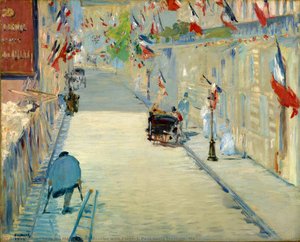 Rue Mosnier with Flags - Édouard Manet
Édouard Manet's 1878 masterpiece, Rue Mosnier with Flags, serves as a quintessential example of French art from the 1870s, capturing the vibrant energy of Parisian urban life during a period of celebration. This work exemplifies the transition toward Impressionism, utilizing loose, expressive brushstrokes that prioritize atmospheric effects and the sensation of movement over rigid, photographic detail. The composition is defined by a deep linear perspective, drawing the viewer down a narrow street lined with buildings and festive banners.
The palette is a sophisticated play of light and color; cool blues and greens provide a serene backdrop for the dynamic, warm accents of red, yellow, and white found in the flags and decorations. Through a technique of layering short, broken strokes, Manet creates a shimmering, almost dreamlike quality that captures a fleeting moment of community spirit. The presence of soldiers, civilians, and horse-drawn carriages within this receding perspective highlights the bustling, patriotic fervor of the era, making this piece a profound testament to the evolving visual language of 19th-century France.
The Saint Martin Canal in Paris - Alfred Sisley
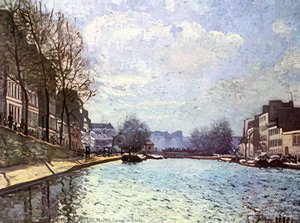 The Saint Martin Canal in Paris - Alfred Sisley
Upon first glance, the viewer is drawn into the tranquil expanse of the Canal Saint-Martin, where the eye follows the gentle, horizontal recession of the waterway toward a soft, hazy horizon. Alfred Sisley captures a fleeting moment of Parisian life, where the interplay of water, sky, and architecture creates a sense of profound stillness. The composition is defined by a balanced structure, with buildings lining the banks and a gentle slope leading the gaze down to the water's edge, creating a subtle sense of depth through a flattened, Impressionistic perspective.
This work is a quintessential example of French art from the 1870s, a decade that saw the crystallization of the Impressionist movement. Sisley employs a sophisticated technique of broken color and visible, textured brushstrokes to prioritize the atmospheric effects of light over rigid, realistic detail. The palette, dominated by cool blues and grays with muted hints of warmth, evokes a serene, perhaps wintry, atmosphere. By focusing on the transient qualities of light and the organic, flowing lines of the canal, Sisley captures the very essence of the era's revolutionary approach to landscape painting.
A Road in Louveciennes - Pierre-Auguste Renoir
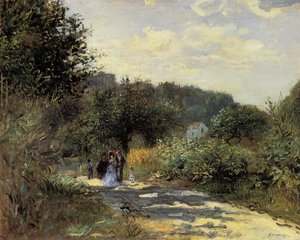 A Road in Louveciennes - Pierre-Auguste Renoir
Painted in 1870, A Road in Louveciennes serves as a profound testament to the early evolution of Impressionism, a movement that would come to define the French art of the 1870s. Pierre-Auguste Renoir captures a tranquil, pastoral moment, focusing on the sensory experience of a rural landscape rather than rigid, photographic realism. The composition is anchored by a winding central pathway that draws the viewer's gaze into the depth of the scene, framed by dense, lush foliage and glimpses of figures engaged in a leisurely stroll.
Renoir’s technique is characterized by a masterful use of impasto, where thick, visible brushstrokes create a palpable surface texture that mimics the organic flow of nature. The color palette is a sophisticated arrangement of earthy tones and vibrant greens, utilizing broken color to suggest the way sunlight filters through an overcast sky. By prioritizing atmospheric perspective and the fleeting effects of light over sharp outlines, Renoir achieves a sense of hazy, luminous beauty. This work exemplifies the decade's shift toward capturing the ephemeral essence of light and the quiet, contemplative connection between humanity and the natural world.
Conclusion
The decade of the 1870s stands as a transformative era in art history, where the foundations of modernism were laid through the revolutionary brushwork of masters like Monet, Renoir, and Caillebotte. These works collectively captured a world in transition, moving from the structured traditions of the past toward the fleeting light and spontaneous emotion that would define the Impressionist movement. Whether through the atmospheric landscapes of Sisley or the bold, social realism of Manet, the artists of this period redefined how we perceive color, light, and the very essence of a moment captured on canvas.
At Mus3ums.com, we invite you to bring this vibrant era into your own living space. Our artisans specialize in creating museum-quality, hand-painted oil reproductions that preserve the tactile soul and visible brushstrokes of these historical masterpieces. You can explore our full collection to find the perfect piece and experience the enduring beauty of 19th-century French art through a bespoke, handmade creation.