Introduction
The 1920s in Switzerland served as a profound crossroads for European modernism, where the quiet stability of the Alpine landscape met the radical, fractured energies of the post-war avant-garde. During this decade, Swiss artists became pivotal architects of new visual languages, moving away from traditional representation toward the abstraction of form, the geometry of color, and the psychological depth of the subconscious. It was a period defined by a unique tension between the precision of Swiss craftsmanship and the experimental spirit of movements like Surrealism and Constructivism.
This era saw the emergence of visionary thinkers who redefined how we perceive space and emotion. Artists such as Paul Klee, Giovanni Giacometti, and Hans Emmenegger navigated this transformative landscape, contributing works that bridged the gap between the tangible world and the dreamscape. Their explorations of line, rhythm, and the interplay of light and shadow provided a blueprint for the modern era, proving that art could be both a structural investigation and a deeply personal expression of the human condition.
Today, these works remain vital, offering a window into a decade that fundamentally altered the trajectory of 20th-century art. They continue to resonate in contemporary spaces, challenging our perceptions of balance and abstraction. The following selection highlights ten significant works from this period, showcasing the diverse mastery of Swiss artists who shaped the visual identity of the 1920s.
New Angel - Paul Klee
 New Angel - Paul Klee
Created in 1920, New Angel by Paul Klee serves as a profound example of the experimental spirit defining Swiss-born artists of the 1920s. This work is a monoprint, a choice that reflects Klee's fascination with the unique, unrepeatable qualities of a single impression. Executed through his innovative oil transfer method—applying pigment onto paper coated with a wax emulsion—the piece achieves a sculptural texture and depth that transcends traditional painting methods.
The composition is characterized by a striking, stark black and white palette, stripping the subject down to its essential geometric forms. At the center, a bird's head is positioned in an upward gaze, creating a sense of quiet, mystical movement. This motif, which Klee returned to frequently, appears here with an intelligent curiosity, as if the figure is caught in a moment of silent observation. Through the masterful interplay of light and shadow, the work moves away from literal representation toward a rhythmic abstraction, embodying the contemplative and transformative energy of the early twentieth-century avant-garde.
Landscape with Yellow Birds - Paul Klee
 Landscape with Yellow Birds - Paul Klee
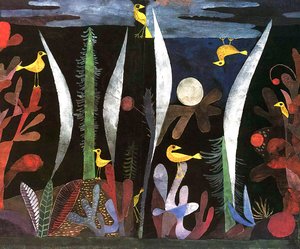
Upon first glance, the eye is immediately drawn to the rhythmic, stylized yellow birds that punctuate the composition, acting as vibrant focal points against a more somber, structured backdrop. This 1923 masterpiece by Paul Klee presents a dreamlike landscape where the natural world is distilled into a series of geometric and organic forms. The scene is dominated by dark, vertical structures reminiscent of trees, which create a sense of depth and architectural stability. Within this space, at least thirteen birds are depicted in various states of flight or rest, their bright plumage providing a striking contrast to the deep, espresso tones of the environment.
As a seminal work from the 1920s, this painting exemplifies the era's radical shift toward abstraction and the exploration of the subconscious. Klee, a Swiss-born artist who became a central figure at the Bauhaus, utilizes a scientific yet poetic approach to color theory and line. By blending elements of expressionism and surrealism, he transforms a traditional landscape into a rhythmic, musical arrangement of shapes. This piece stands as a definitive example of Swiss-born modernism during this transformative decade.
Rose Garden - Paul Klee
 Rose Garden - Paul Klee
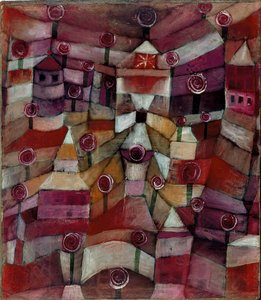
Paul Klee’s 1920 masterpiece, Rose Garden, serves as a quintessential example of the rhythmic abstraction defining Swiss-born artists during the 1920s. This work captures a pivotal moment in Klee's evolution, showcasing a sophisticated blend of Cubist-inspired geometry and a whimsical, almost musical spontaneity. Rather than a literal landscape, the piece presents a fractured, architectural reimagining of nature, where the essence of a garden is distilled into a symphony of overlapping triangles and rectangles.
The palette is a vibrant exploration of color theory, dominated by warm tones of quinacridone magenta, reds, and oranges that evoke a sun-drenched atmosphere. These heated hues are masterfully balanced by cooler accents of purple, white, and grey, creating an illusory sense of depth within a flattened, decorative plane. Through the use of mixed media—likely watercolor, gouache, and pencil—Klee achieves a textured, layered effect that softens the sharp edges of his geometric forms. The result is a serene, highly structured composition that exemplifies the era's movement toward distilling complex organic life into pure, rhythmic form.
Schoolhouse - Paul Klee
 Schoolhouse - Paul Klee
In Schoolhouse, painted in 1920, Paul Klee presents a fragmented vision that epitomizes the shift toward abstraction seen in Swiss art during this decade. The composition rejects traditional perspective, opting instead for a dreamlike, non-linear arrangement where architectural forms and biological shapes collide. On the left, a skeletal, grid-like tower rises against a dark, layered background, while a stylized sunflower with a crimson center provides a singular, vibrant focal point. To the right, a simplified, mask-like humanoid figure emerges from the periphery, contributing to the work's profound psychological depth.
The technical execution is defined by heavy, impasto textures and visible brushstrokes that lend a tactile, expressive quality to the canvas. Klee utilizes a somber palette of deep blacks, earthy browns, and phthalo greens, which are dramatically interrupted by sharp accents of pale white, lavender, and red. Rather than relying on external light, the objects appear to possess an internal glow, creating a high-contrast environment that feels both mystical and unsettling. This rhythmic, gestural approach demonstrates how Swiss artists of the 1920s moved beyond literal representation to explore the tension between the structured and the fluid.
May Picture - Paul Klee
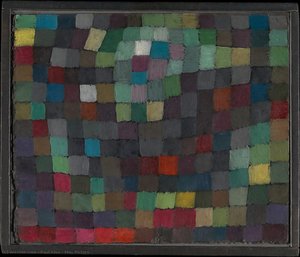 May Picture - Paul Klee
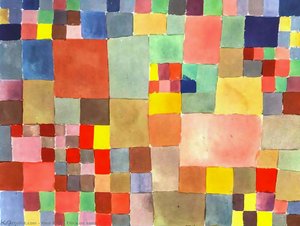
Paul Klee’s 1925 oil painting, May Picture, serves as a quintessential example of Swiss-born abstraction during the 1920s. Created during his influential tenure at the Bauhaus, this work reflects the decade's radical shift toward geometric experimentation and rhythmic composition. The piece is a mesmerizing mosaic of interlocking squares and rectangles, utilizing a palette of vibrant reds, greens, serene blues, and yellows to create a sense of structured dynamism.
The technique employed by Klee involves layering thin washes of pigment on board, a method that achieves a remarkable luminosity and textural depth. This approach allows the colors to vibrate against one another, mirroring the musical rhythms Klee often sought to translate onto canvas. While the composition is deeply rooted in Expressionism, it also draws from Cubist influences, breaking down the landscape into a series of chromatic harmonies. By distilling the essence of a Tunisian landscape into a purely abstract language of form and color, Klee produced a work that defines the sophisticated, scientific approach to color theory that characterized much of the era's Swiss avant-garde output.
Prestidigitator (Conjuring Trick) - Paul Klee
 Prestidigitator (Conjuring Trick) - Paul Klee
In Prestidigitator (Conjuring Trick), created in 1927, Paul Klee exemplifies the profound shift toward rhythmic abstraction that defined Swiss art during the 1920s. This work serves as a masterclass in the era's fascination with the intersection of geometric precision and organic, dreamlike movement. The composition presents a cluster of shapes that refuse to settle, where a dark, heavy orb sits against a mottled background of red and pink, reminiscent of an eye watching from behind a curtain.
Klee utilizes thin, black lines to trace skeletal structures across the surface, connecting rigid rectangles to fluid, anthropomorphic silhouettes. This creates a grid-like architecture that feels both fragile and intentional, a hallmark of the period's move away from spatial realism. The palette, dominated by warm clay, orange, and soft pink tones, is punctuated by sharp navy blue and black accents, functioning much like a musical score where every line acts as a visual note. Through a flattened perspective and layered, scumbled textures, Klee performs a visual sleight of hand, transforming the canvas into a mystical landscape of symbols where the physical world dissolves into a quiet, enigmatic mystery.
Analysis of Various Perversities - Paul Klee
 Analysis of Various Perversities - Paul Klee
Created in 1922, Analysis of Various Perversities stands as a profound example of the rhythmic abstraction and mystical inquiry that defined Swiss-born Paul Klee's output during the 1920s. This work, deeply rooted in the Cubist movement, utilizes a complex, layered arrangement of geometric and organic shapes to explore the subconscious. The composition is characterized by a translucent, parchment-like surface achieved through the delicate application of India ink and watercolor, creating a shallow sense of depth where elements overlap in a dreamlike state.
The visual language is highly symbolic, featuring a cryptic vocabulary of mask-like faces, mechanical apparatuses resembling gears, and a central clock that evokes the cyclical nature of time. Klee employs a sophisticated palette of muted tones—including violet, magenta, and dusky rose—interspersed with pale cream and grey to establish a sense of atmospheric tension. Through the use of fine black ink strokes and directional arrows, the artist balances structured, mechanical logic with the unpredictable, fluid pulse of human emotion, marking a pivotal moment in the evolution of modern abstraction during this decade.
Strong Dream - Paul Klee
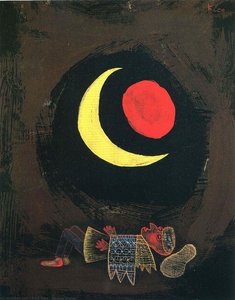 Strong Dream - Paul Klee
Created in 1929, Strong Dream serves as a profound testament to the Swiss-born Paul Klee's ability to translate the intangible into visual form. As a pivotal work from the 1920s, it exemplifies the era's shift toward exploring the subconscious through a lens of rhythmic abstraction and symbolic imagery. This piece belongs to the vibrant movement of Swiss art during this decade, a period where Klee, a master of color theory and a prominent figure at the Bauhaus, moved beyond mere representation to map the internal landscapes of the human psyche.
The composition is dominated by a dark, circular void that heightens the sense of mystery. A bright yellow crescent moon and a central red orb act as celestial focal points, casting a dramatic light over a reclining, stylized human figure. Composed of angular, geometric shapes in shades of red and black, the figure feels both organic and architectural. The thick, impasto-like application of oil paint creates a tactile, expressive surface, where gestural brushstrokes convey a sense of melancholy and intensity. Through this juxtaposition of geometric precision and surrealist distortion, Klee captures the essence of a dreamscape, turning a modest canvas into a vast, mystical exploration of fate and destiny.
Il Mattino - Morgenritt - Giovanni Giacometti
 Il Mattino - Morgenritt - Giovanni Giacometti
Created in 1924, Il Mattino - Morgenritt serves as a profound example of Swiss landscape painting from the 1920s. This oil on canvas by Giovanni Giacometti captures a pivotal moment in the artist's evolution, showcasing his transition from Impressionist sensibilities toward a more expressive handling of light and atmosphere. Born in Stampa, the Grisans, Giacometti maintained a lifelong connection to the Swiss terrain, and this work exemplifies his ability to translate the ruggedness of his native environment into a serene visual narrative.
The composition centers on a tranquil scene where the vastness of the mountains meets the stillness of a body of water under a heavy, cloud-filled sky. A man riding a horse moves along a path at the water's edge, providing a sense of quiet movement against the expansive backdrop. Scattered boats and additional figures near the shore ground the scene, suggesting a lived-in landscape. Through this interplay of human presence and the alpine environment, Giacometti achieves a picturesque quality that defines the tranquil, atmospheric essence of his mid-career period.
Flower Bowl - Hans Emmenegger
 Flower Bowl - Hans Emmenegger
Created in 1924, Flower Bowl is a profound example of the minimalist sensibilities that emerged during this era. As a work produced by the Swiss-born artist Hans Emmenegger, it stands as a quintessential representative of Swiss art from the 1920s, capturing the decade's shift toward New Objectivity and a heightened scrutiny of the everyday. The composition is a masterclass in quietude, centering on a vibrant yellow vessel that commands the viewer's attention through its singular, isolated presence on a pale, neutral surface.
The artist employs a sophisticated visual language to achieve this equilibrium. A thin, decisive red rim traces the upper edge of the bowl, creating a sharp boundary that defines its form against the ambient light. The surface of the ceramic is punctuated by rhythmic black dots—three clustered centrally and a solitary fourth drifting toward the upper right—which disrupt the smooth curvature and introduce a subtle, organic tension. Through controlled brushwork and a focus on essential geometry, Emmenegger transforms a simple domestic object into a meditative study of light, color, and stillness, embodying the refined aesthetic of the mid-1920s.
Conclusion
The artistic output of Switzerland during the 1920s represents a profound intersection of geometric abstraction, psychological depth, and the evolving language of modernism. From the rhythmic, lyrical compositions of Paul Klee to the evocative, sculptural sensibilities found in the works of Giovanni Giacometti, these pieces collectively define a decade of intense formal experimentation. Whether through the delicate balance of color or the stark, emotive lines of the era, these works capture a pivotal moment in European art history, bridging the gap between traditional representation and the radical new visions of the avant-garde.
For those looking to expand their own curation, our full collection offers a deeper exploration of this transformative period. At Mus3ums.com, we invite you to bring the spirit of this era into your personal space through our museum-quality, hand-painted oil reproductions, meticulously crafted to preserve the texture and soul of these historical masterpieces.