


Introduction
The 20th century in Switzerland was a period of profound artistic metamorphosis, where the tranquil landscapes of the Alps met the radical, fragmented energy of European modernism. As the world underwent seismic political and social shifts, Swiss painters became vital conduits for new visual languages, bridging the gap between traditional representation and the avant-garde. This era saw a unique convergence of ideas, where the precision of Swiss craftsmanship met the experimental spirit of movements like Cubism, Surrealism, and Abstract Expressionism.
What unites these masters is a remarkable ability to navigate the tension between the local and the universal. From the symbolic, rhythmic compositions that redefined spatial relationships to the raw, existential explorations of the human form, these artists did not merely observe the changing world; they reshaped how we perceive it. Their work reflects a cultural crossroads, where the influence of neighboring France, Germany, and Italy blended with a distinct, often introspective, Swiss sensibility.
Today, the legacy of these painters remains essential for understanding the evolution of modern art. Their influence persists in contemporary design, architecture, and fine art, offering a timeless dialogue between structure and emotion. By examining the lives and works of these ten pivotal figures—including the geometric abstractions of Paul Klee and the profound sculptural presence of Alberto Giacometti—we gain insight into a century that fundamentally altered the trajectory of human creativity.
Paul Klee
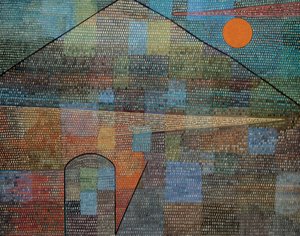 To Parnassus - Paul Klee
A central figure of the 20th century Swiss painters, Paul Klee (1879–1940) redefined the boundaries of modern art through a unique synthesis of Expressionism and Cubism. Born in Münchenbuchsee, Switzerland, his artistic journey was deeply influenced by a musical upbringing; the son of a music teacher and a singer, Klee’s early talent for the violin provided a rhythmic sensibility that would later manifest in his visual compositions. After studying at the Academy of Fine Arts in Munich under masters like Franz von Stuck, Klee underwent a profound stylistic evolution. A pivotal trip to Tunisia in 1914, where he encountered the intense, limpid light of North Africa, catalyzed his transition from traditional drawing toward a sophisticated, symbolic abstraction.
His 1932 masterpiece, To Parnassus, serves as a testament to this transformative period. The work exemplifies his ability to blend geometric abstraction with a mosaic-like precision. Through a vibrant palette of warm oranges and deep purples, Klee utilizes bold outlines and layered shapes to create a sense of spiritual ascent. The composition, featuring celestial circles and architectural portals, invites a reflective contemplation of the relationship between the physical and the metaphysical, marking him as a visionary of the Swiss modern era.
Ferdinand Hodler
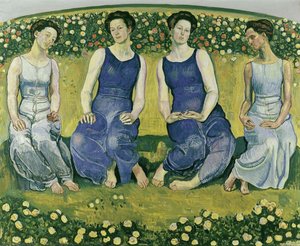 Holy Hour - Ferdinand Hodler
Ferdinand Hodler stands as a monumental figure among 20th century Swiss painters, a master whose work bridged the gap between late Symbolism and a uniquely modern visual language. Born in Bern in 1853, his early life was marked by the profound loss of his father and brothers to tuberculosis, a tragedy that infused his later explorations of mortality with a quiet, persistent melancholy. After beginning his career as a decorative painter, Hodler moved to Geneva in 1871, where he transitioned from meticulous landscape realism toward a more profound, subjective engagement with the rhythms of existence.
He is most celebrated for his theory of parallelism, a compositional method where figures and natural forms are arranged in rhythmic, interconnected patterns to reflect the underlying structure of the world. His 1913 masterpiece, Holy Hour, exemplifies this approach. The painting depicts three women in a verdant garden, arranged with a deliberate symmetry that evokes religious iconography. Through this rhythmic arrangement, Hodler elevates a serene moment of friendship into a sacred, dreamlike tableau, cementing his legacy as a vital force in Swiss art history.
Félix Vallotton
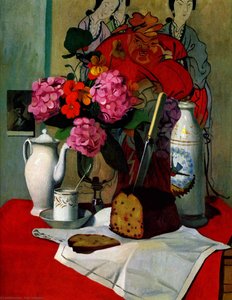 Still life in Chinese painting - Félix Vallotton
Born in Lausanne, Switzerland, in 1865, Félix Vallotton represents a vital link in the evolution of Swiss art into the modern era. His journey began when he left the stability of his Swiss upbringing to pursue formal training in Paris, enrolling at the Académie Julian in 1882. Under the guidance of masters like Jules Joseph Lefebvre, he developed a rigorous technical discipline that would define his unique aesthetic. Though he became a prominent figure within the Nabis group—often referred to by his peers as le Nabi étranger due to his Swiss origins—Vallotton maintained a distinct identity that set him apart from his French contemporaries.
His legacy is cemented by his mastery of both striking woodcuts and evocative oil paintings, bridging the gap between decorative precision and psychological depth. In his 1925 work, Still life in Chinese painting, we see the culmination of his sophisticated command over composition. This piece beautifully juxtaposes the tactile reality of European domesticity—soft pink roses and glassware—with enigmatic, theatrical figures that suggest a broader cultural dialogue. Through this ability to blend the intimate with the exotic, Vallotton remains a cornerstone of the 20th century Swiss painters' tradition.
Antonio Laccabue
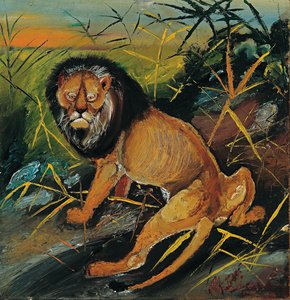 Lion - Antonio Laccabue
Born in Zurich in 1899, Antonio Laccabue stands as a profound figure among 20th century Swiss painters, representing the raw, expressive power of the Naïve art movement. His work is instantly recognizable through its intense, vivid color palettes and a singular focus on the primal essence of the natural world. Laccabue’s canvases often feature animals and landscapes rendered with a psychological depth that transcends simple folk art, characterized by a unique blend of realism and spirited spontaneity.
In his 1935 work, Lion, one can observe his masterful command of oil, using the medium to build tactile textures that make the surrounding foliage feel alive. The piece captures a moment of profound stillness, where the interplay of light and shadow lends a sculptural weight to the subject. His artistic journey, shaped by significant personal hardships and refined under the guidance of Renato Marino Mazzacurati, allowed him to transform raw emotion into powerful imagery. From the intense gaze of his wildlife portraits to his expressive landscapes, Laccabue’s legacy remains a testament to the ability of art to capture the untamed soul of nature.
Charles Ricketts
 The Danaides - Charles Ricketts
Born in Geneva to a French mother and an English father, Charles Ricketts represents a unique bridge between Swiss origins and the vibrant English art scene of the early 20th century. His presence in this group is defined by his birth in Switzerland and a career that flourished during the first three decades of the 1900s, a period where his eclectic vision helped shape modern design. His work is a profound intersection of Symbolism and Renaissance elegance, often imbued with a spiritual, dramatic intensity.
A master of many disciplines, Ricketts was as celebrated for his theatrical costume designs as he was for his exquisite book illustrations. This versatility is captured in his evocative painting, The Danaides. In this composition, one can sense the heavy, dramatic weight of classical mythology, rendered with a tonal depth that speaks to the soul. His ability to translate profound narratives—from the tragic to the divine—into visual form makes his oeuvre a testament to the expressive potential of the early modern era. Whether through the intricate lines of a wood engraving or the sweeping gestures of a large-scale canvas, his artistic legacy remains deeply rooted in the aesthetic transitions of the 20th century."
Giovanni Giacometti
 Spring in Bergell - Giovanni Giacometti
A central figure in the evolution of Swiss modernism, Giovanni Giacometti (1868–1933) bridged the gap between traditional academic training and the burgeoning avant-garde movements of the early 20th century. His presence in this group of 20th century Swiss painters is defined by his ability to translate the sublime Alpine atmosphere into a modern visual language, moving from Impressionism toward a more structured Expressionism. After studying in Munich and later at the Académie Julian in Paris, his artistic trajectory was fundamentally altered by his encounter with Giovanni Segantini. This mentorship introduced him to Divisionism, a technique of applying broken strokes of color to capture the luminous, vibrating quality of mountain light.
His representative work, Spring in Bergell (1912), serves as a profound testament to this stylistic mastery. In this piece, Giacometti captures a spirited procession of riders traversing a sun-drenched hillside, blending the rugged majesty of the Swiss Alps with a sense of pastoral joy. Through a sophisticated palette of lush greens and hazy mountain blues, he achieves a dreamlike depth that honors the structural grandeur of his homeland while embracing the ephemeral beauty of the changing seasons.
Claudia Andujar
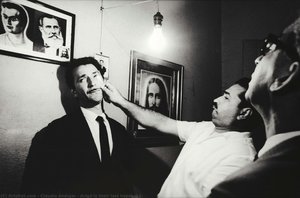 Arigó is their last hope (#13) - Claudia Andujar
Born in Neuchâtel in 1931, Claudia Andujar stands as a profound figure among 20th century Swiss painters and visual artists, bridging the gap between European origins and the deep spiritual landscapes of South America. Her work is defined by a lifelong commitment to documenting the human condition, a drive shaped by her family's flight from pre-war Europe and the tragic loss of her father. This early exposure to vulnerability transformed her into a powerful witness for marginalized communities.
After studying humanities in New York, Andujar moved to Brazil in 1956, where her artistic trajectory shifted toward the Yanomami people. Rather than acting as a detached observer, she engaged in a decades-long collaboration, using experimental photographic techniques to capture their cosmology and rituals. Her representative work, Arigó is their last hope (#13), exemplifies this approach. Captured in 1967, this stark black-and-white photograph utilizes dramatic, directional lighting and a tight, intimate composition to explore themes of faith, healing, and the psychological tension of indigenous survival during a period of political upheaval in Brazil.
- Subject Matter: A visceral encounter between figures, symbolizing a desperate plea for connection and survival.
- Technique: Experimental use of film and grain to achieve a profound tonal range and raw emotional authenticity.
Alberto Giacometti
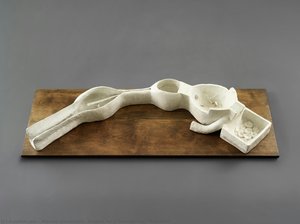 Project for a Passageway (Maquette) - Alberto Giacometti
Born in 1901 in the Swiss alpine landscapes of Borgonovo, Alberto Giacometti remains one of the most profound figures of 20th century Swiss painters and sculptors. His artistic lineage was deeply rooted in the creative atmosphere of his family; his father, Giovanni Giacometti, was a respected Post-Impressionist painter, and his brother Diego was a renowned sculptor. This immersion in Swiss artistic tradition, combined with his formative years at the Geneva School of Fine Arts and his later move to Paris, allowed him to evolve from early Cubist explorations into a singular, hauntingly modern voice.
A viewer can recognize Giacometti’s work by its intense focus on the tension between form and the surrounding void. His aesthetic is defined by a deliberate roughness and a reduction of detail that emphasizes the essence of his subjects. In his 1931 work, “Project for a Passageway (Maquette),” we see this mastery of texture through a roughly hewn plaster figure. This piece reflects his fascination with Surrealism and anthropological symbolism, transforming a sculptural model into a psychological threshold. His work captures the very spirit of existentialism, using tactile, weathered surfaces to explore the profound isolation and the transformative nature of the human condition.
Sophie Taeuber-Arp
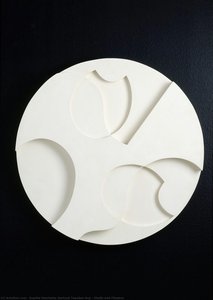
In her 1938 masterpiece Shells and Flowers, Sophie Taeuber-Arp achieves a sublime equilibrium between organic life and rigorous geometric precision. This work exemplifies her ability to translate the complexities of nature into a language of minimalist form and radial design. As a central figure among 20th century Swiss painters, Taeuber-Arp’s legacy is defined by her multidisciplinary mastery, spanning painting, sculpture, and textile design. Her artistic journey, which began in her native Davos, led her to the heart of the European avant-garde, where she became a vital force in the Dada movement.
Her aesthetic is characterized by a unique fusion of Constructivism and Concrete Art, often utilizing a palette that emphasizes clarity and structural harmony. Unlike many of her contemporaries who embraced the chaos of Dada, Taeuber-Arp infused the movement with a sense of disciplined abstraction and rhythmic order. Her technical foundation, rooted in the principles of the Bauhaus, allowed her to dissolve the boundaries between fine art and functional design. Through her innovative use of paper cut art and geometric abstraction, she remains a monumental architect of modernism, bridging the gap between the spontaneous energy of the human spirit and the uncompromising logic of form.
Karl Schmid
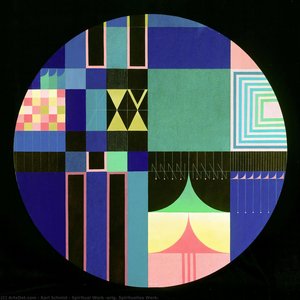 Spiritual Work (orig. Spirituelles Werk) - Karl Schmid
Born in Zurich in 1914, Karl Schmid stands as a quintessential figure among 20th century Swiss painters due to his ability to synthesize the disciplined precision of craftsmanship with the expressive freedom of modernism. His journey was one of profound resilience, shaped by an early apprenticeship in cabinetmaking and later enriched by intellectual dialogues with giants like Oskar Kokoschka during his time in the sanatoriums of Davos. This unique intersection of the tactile, structural world of woodcarving and the fluid realms of expressionism allowed him to bridge the gap between art and science throughout his long career.
His representative work, Spiritual Work (orig. Spirituelles Werk), created in 1986, exemplifies this mastery of structural logic. In this piece, Schmid moves toward a mystical geometric abstraction, utilizing a rhythmic arrangement of shapes that pulse against a dark, muted background. A brilliant yellow core radiates warmth, surrounded by swirling orange flames that dance with a patterned energy. The composition, which features two small birds as silent witnesses to the celestial light, reflects a lifetime spent exploring the tension between organic life and the rigid, disciplined geometry of form.
Conclusion
The 20th century was a transformative era for Swiss art, a period where the boundaries between abstraction, surrealism, and profound humanism were constantly redrawn. From the rhythmic, lyrical geometries of Paul Klee to the haunting, existential silhouettes of Alberto Giacometti, these artists moved beyond mere representation to capture the very essence of the modern spirit. Whether through the intense color palettes of Félix Vallotton or the structural elegance of Sophie Taeuber-Arp, this group of masters redefined how we perceive form, space, and emotion in a rapidly changing world.
At Mus3ums.com, we invite you to bring this legacy of Swiss innovation into your own living space. Our master artists specialize in creating museum-quality, hand-painted oil reproductions that preserve the tactile soul and visible brushstrokes of these iconic works. Whether you are looking to honor the delicate textures of an Impressionist landscape or the bold impasto of a modern masterpiece, you can explore our full collection to find the perfect piece for your home or gallery.


