Introduction
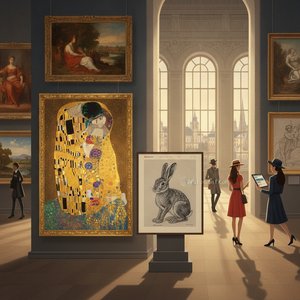
The decade of the 1910s in Vienna and the surrounding Austrian territories marked a profound psychological and aesthetic rupture that forever altered the course of modernism. As the twilight of the Austro-Hungarian Empire approached, a singular tension emerged between the opulent, decorative splendor of the late Secessionist movement and a raw, visceral exploration of the human psyche. This era was defined by a departure from the external world toward the internal landscape, where the boundaries between the physical form and the subconscious began to dissolve.
At the heart of this transformation were figures who sought to strip away the veneer of bourgeois respectability. The works of this period oscillate between the shimmering, gold-leafed symbolism of Gustav Klimt and the jagged, tormented lines of Egon Schiele, capturing a society caught between imperial grandeur and the existential anxiety of a changing world. This was a time when art became a vessel for the unspoken, influenced by the burgeoning field of psychoanalysis and a desire to express the complexities of desire, mortality, and the fractured self.
Today, these masterpieces remain vital because they speak to the enduring complexity of the human condition. The expressive intensity and radical compositions developed during this decade continue to resonate in contemporary visual language, offering a profound meditation on identity and emotion. The following selection highlights ten significant works from this transformative era, tracing the evolution of Austrian expressionism and the profound shifts in perspective that defined a generation of masters.
Portrait of Baroness Elisabeth Bachofen-Echt - Gustav Klimt
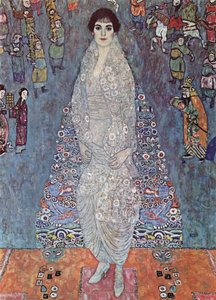 Portrait of Baroness Elisabeth Bachofen-Echt - Gustav Klimt
Gustav Klimt's 1916 Portrait of Baroness Elisabeth Bachofen-Echt stands as a profound testament to the evolution of Austrian art during the 1910s. As a central figure of the Viennese Secession, Klimt utilizes this commission to explore the intersection of individual identity and the decorative sublime. The work is a masterful example of his mature style, where the sitter is not merely a subject of social status, but an ethereal presence enveloped in a luminous, mosaic-like atmosphere.
The composition is defined by a deliberate flattening of perspective, a hallmark of the Art Nouveau movement that rejects traditional spatial depth in favor of ornamental richness. Klimt employs a sophisticated layering of oil paint, punctuated by subtle accents that evoke his celebrated "Golden Phase." The Baroness is presented with a sense of refined serenity, her form emerging from a background of intricate, organic patterns. Through the use of delicate glazes and a palette of rosy browns and soft tones, Klimt captures a reflective, introspective grace, transforming a formal portrait into a symbolic exploration of beauty and quiet dignity.
Lady with Fan - Gustav Klimt
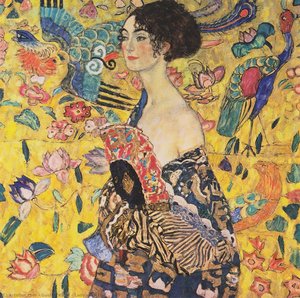 Lady with Fan - Gustav Klimt
Completed between 1917 and 1918, Lady with Fan serves as a poignant culmination of Gustav Klimt’s artistic journey, representing one of the final masterpieces of his career. As a quintessential work from the 1910s, it encapsulates the transition from the decorative opulence of the Vienna Secession toward a more expressive, modern sensibility. The portrait features a woman in profile, her serene expression framed by a dense, vibrant explosion of stylized floral patterns and avian motifs, including peacocks.
The composition exemplifies the synthesis of Art Nouveau decadence and the principles of Japonism. Klimt utilizes a flattened perspective and bold, gestural outlines that echo the aesthetics of ukiyo-e woodblock prints, yet he imbues the canvas with a uniquely Austrian sense of psychological depth. Through thick impasto application and a complex layering of organic and geometric forms, the work moves away from his famous "Golden Phase" toward a more textured, energetic style. The interplay of yellow and blue hues, combined with the symbolic presence of flowers and birds, creates an atmosphere of both sensuality and mystery, marking a definitive moment in the evolution of early 20th-century European art.
The Virgin - Gustav Klimt
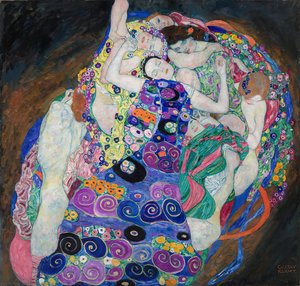 The Virgin - Gustav Klimt
Created in 1913, Gustav Klimt's The Virgin stands as a profound testament to the Austrian avant-garde of the 1910s, a decade defined by the tension between decorative elegance and deep psychological exploration. This oil on canvas exemplifies the artist's mastery of Art Nouveau and Symbolism, moving beyond mere ornamentation to touch upon the essence of human connection. The composition is a rhythmic, circular arrangement of figures, where women are entwined in a protective, nurturing embrace. This spiral formation creates a sense of organic unity, evoking themes of motherhood, fertility, and the sacredness of life.
Klimt’s technique in this period is characterized by a sophisticated interplay of flowing, biomorphic lines and intricate, mosaic-like patterns. The work utilizes a rich, saturated palette and a flattened perspective, prioritizing a decorative, almost otherworldly atmosphere over traditional spatial realism. Through layered colors and a tactile, impastoed application of paint, Klimt transforms the subject matter into a luminous, symbolic vision. The piece captures the era's fascination with the female form, presenting it not just as a figure, but as a vessel for profound emotional and spiritual energy.
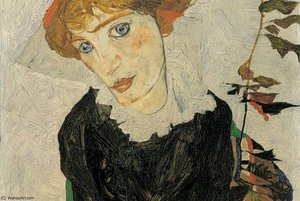
Portrait of Wally - Egon Schiele
The viewer is immediately arrested by the intense, direct gaze of the subject, a psychological confrontation that defines the raw power of this 1912 masterpiece. Painted during a transformative period for Austrian art, this work serves as a quintessential example of the 1910s, capturing the shift from traditional representation toward the visceral emotionality of Expressionism. The portrait features Walburga “Wally” Neuzil, a frequent muse whose presence in Schiele’s life deeply informed his exploration of vulnerability and desire.
Schiele’s technique is marked by a nervous, agitated line work and a highly textural application of oil paint. Rather than seeking idealized beauty, the artist employs a daring, unnaturalistic palette of greens, yellows, and muted browns to convey an internal state of melancholy and introspection. The composition is tight, focusing on the upper torso and head, where the flattened perspective and thick impasto brushstrokes create a mosaic-like surface. By distorting proportions and emphasizing the tactile quality of the paint, Schiele moves beyond mere likeness to capture the profound anxieties of the human condition, a hallmark of the Austrian avant-garde in the early 20th century.
Death and the Maiden - Egon Schiele
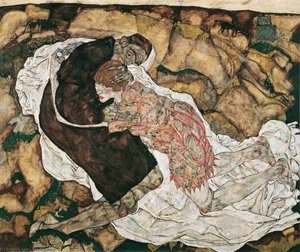 Death and the Maiden - Egon Schiele
Created in 1915, Egon Schiele's Death and the Maiden serves as a profound testament to the psychological intensity defining Austrian Expressionism during the 1910s. This work captures a moment of profound vulnerability, depicting an intimate, almost desperate embrace between two figures. The composition is characterized by a sense of claustrophobia and unease, utilizing jagged, angular lines and a deliberately skewed perspective to convey a state of internal turmoil.
The visual language of the piece relies heavily on a dramatic contrast of color and texture. Schiele employs a palette of unsettling, muted tones—dominated by putty and earthy hues—which clash against the more vibrant, though somber, elements of the figures. The application of paint is intensely tactile; thick impasto layers create a rough, uneven surface that mirrors the agitated emotional state of the subjects. Through this distorted representation of reality, Schiele moves beyond mere portraiture to explore the raw, melancholic essence of the human condition, a hallmark of the avant-garde movements emerging from Austria during this transformative decade.
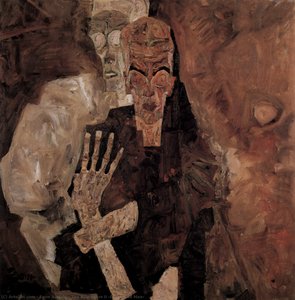
The Self-Seers II (Death and Man) - Egon Schiele
A profound cornerstone of the 1910s Austrian avant-garde, The Self-Seers II (Death and Man) serves as a visceral meditation on mortality and the fractured psyche. Painted in 1911, Egon Schiele’s work exemplifies the shift toward Expressionism that defined the era, moving away from classical beauty toward a raw, unsettling honesty. The composition is claustrophobic and intensely psychological, featuring a gaunt, mask-like figure confronted by a skeletal hand emerging from the darkness—a haunting symbol of inescapable fate.
Schiele’s technical execution is central to the work's emotional weight. He employs a heavy impasto technique, where thick, gestural brushstrokes of oil paint create a tactile, almost chaotic surface. The palette is somber and melancholic, dominated by earthy browns, ochres, and whites that evoke a sense of decay and existential dread. By eschewing traditional perspective in favor of amorphous, swirling shapes and flat, diffused lighting, Schiele captures the nervous energy and societal anxieties of Vienna during this transformative decade. The result is a masterpiece of dramatic intensity, where the very texture of the paint mirrors the psychological distress of the human condition.
Dolomite Landscape - Oskar Kokoschka
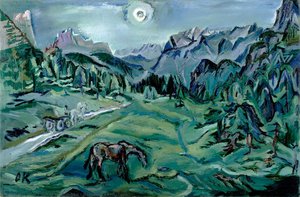 Dolomite Landscape - Oskar Kokoschka
Painted in 1913, Dolomite Landscape stands as a profound testament to the expressive fervor defining Austrian art during the 1910s. Oskar Kokoschka, a central figure of the Viennese avant-garde, moves beyond mere topographical recording to capture a psychological encounter with the sublime. This work exemplifies the shift toward Expressionism, where the landscape becomes a vessel for inner emotion rather than a mirror of external reality.
The composition is dominated by a dramatic, moonlit sky where a large, circular moon casts an intense, almost artificial glow across a mountainous valley. Kokoschka utilizes a vibrant, unnatural palette—notably deep phthalo greens—to create a dreamlike, surreal atmosphere. In the meadow, a group of horses serves as a focal point, their forms simplified and abstracted to prioritize emotional impact. The artist’s signature technique is evident in the thick impasto and nervous, bold brushstrokes that lend the canvas a tactile, energetic quality. Through flattened perspective and distorted lines, Kokoschka transforms the Dolomites into a melancholic, visionary realm, reflecting the profound spiritual and psychological tensions of the era.
Farm Garden with Crucifix - Gustav Klimt
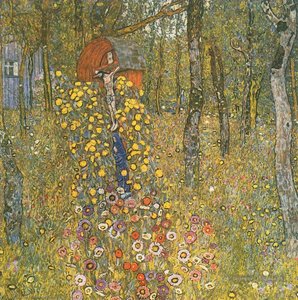 Farm Garden with Crucifix - Gustav Klimt
Created in 1911, Farm Garden with Crucifix stands as a profound testament to Gustav Klimt’s mastery during the height of the Austrian modernist movement. As a central figure of the Vienna Secession, Klimt’s work from this decade often navigates the delicate intersection of the physical and the metaphysical. This piece, a quintessential example of Austrian art from the 1910s, captures a moment of quietude where the lush, organic vitality of nature meets a sense of spiritual introspection.
The composition is a dense, impressionistic tapestry of color, characterized by short, broken brushstrokes that build a luminous, textured surface. Klimt employs a vibrant palette of yellows and greens to render a floral meadow, creating a shimmering effect that feels both immediate and dreamlike. The presence of the crucifix introduces a layer of religious symbolism, grounding the ephemeral beauty of the garden in a deeper, more contemplative reality. Through his signature use of expressive, layered oil paint, Klimt transforms a simple landscape into a mystical encounter, where the boundaries between the earthly garden and the divine become beautifully blurred.
Bride of the Wind - Oskar Kokoschka
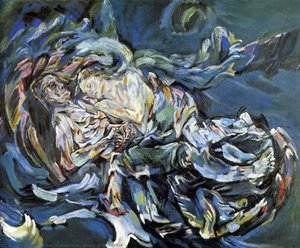 Bride of the Wind - Oskar Kokoschka
Oskar Kokoschka’s 1914 masterpiece, Bride of the Wind, stands as a profound testament to the psychological intensity defining Austrian art during the 1910s. This large-scale oil painting moves beyond mere representation, utilizing the visceral language of Expressionism to capture a state of profound emotional upheaval. The composition is dominated by a central female figure, whose form is nearly subsumed by a swirling, chaotic landscape of turbulent drapery and amorphous shapes.
The artist employs a highly gestural technique, characterized by thick, impasto-like brushstrokes that create a tactile, restless energy across the canvas. Kokoschka’s palette—a dramatic interplay of melancholic blues, whites, and ochre tones—enhances the sense of a storm-tossed existence. Rather than focusing on spatial accuracy, the work prioritizes the internal landscape of the soul, using distorted perspectives and fractured lines to evoke themes of passion, vulnerability, and the struggle to maintain stability amidst chaos. It is a work that captures the very essence of the era's unrest, translating personal and historical turbulence into a powerful, rhythmic visual experience.
Pierrot lunaire, op. 21 - Night - Arnold Schoenberg
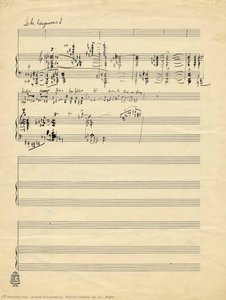 Pierrot lunaire, op. 21 - Night - Arnold Schoenberg
Arnold Schoenberg’s Pierrot lunaire, op. 21 – Night, composed in 1912, serves as a profound sonic manifestation of the Austrian avant-garde's departure from tradition. As a central figure of the Second Viennese School, Schoenberg utilized this period to dismantle established tonal harmonies, moving toward the radical expressionism that defined the decade. This specific movement, "Night," captures the psychological fragmentation and existential anxiety prevalent in early 20th-century Austrian intellectual life.
The work is structured around the enigmatic, melancholic figure of Pierrot, a character from French folklore reimagined as a vessel for profound despair. Through the use of a passacaglia form, Schoenberg employs a repetitive bass ostinato to create a hypnotic, unsettling tension that mirrors a descent into a dreamlike, nocturnal phantasmagoria. The composition reflects the era's shift toward subjective, raw emotionality, where the boundaries between reality and the subconscious begin to dissolve. By abandoning conventional melodic structures, Schoenberg’s work from this decade remains a monumental pillar of modernism, capturing the ethereal and often fractured essence of the human psyche through a revolutionary musical language."
Conclusion
The Austrian avant-garde of the 1910s represents a profound shift in the visual language of modernity, moving from the decorative opulence of the Secession to the raw, psychological intensity of Expressionism. Whether through the golden, symbolic landscapes of Gustav Klimt, the visceral, anatomical explorations of Egon Schiele, or the emotive distortions of Oskar Kokoschka, these works collectively captured the tension and transformation of a world on the brink of profound change. Each piece serves as a testament to the era's ability to bridge the gap between classical tradition and the turbulent complexities of the human psyche.
For those seeking to bring this transformative era into a private space, Mus3ums.com offers the opportunity to own these masterpieces through our bespoke services. We specialize in museum-quality, hand-painted oil reproductions that honor the specific textures and brushwork of these Austrian masters. From the intricate layering of gold leaf to the expressive impasto of the Expressionists, our artists recreate these iconic works on 100% cotton canvas to ensure an authentic, tactile experience. We invite you to explore our full collection and bring the profound legacy of the 1910s into your home through our exquisite, hand-crafted artistry.