


Introduction
The 20th century in the Czech lands was a period of profound aesthetic transformation, marked by a rapid shift from traditionalist academicism toward the radical frontiers of modernism. As the geopolitical landscape of Central Europe underwent seismic shifts, a generation of artists emerged, navigating the tensions between national identity and the international avant-garde. These painters were united by a restless intellectualism, often bridging the gap between the decorative elegance of Art Nouveau and the fractured, analytical depths of Cubism, Surrealism, and Abstract Expressionism.
From the intricate, symbolic lines of Alphonse Mucha to the pioneering abstraction of František Kupka, the movement was characterized by a unique synthesis of spiritualism and formal experimentation. This era saw artists grappling with the complexities of the human psyche and the changing nature of reality, resulting in a body of work that is as intellectually rigorous as it is visually diverse. The cultural crucible of Prague and the surrounding regions provided a fertile ground where disparate movements—from the structural explorations of Bohumil Kubišta to the dreamlike, often unsettling imagery of Alfred Kubin—could coexist and influence one another.
Today, these artists remain vital to the study of modern art history, representing a crucial link in the evolution of European abstraction and figurative expression. Their ability to translate the anxieties and aspirations of a century in flux into enduring visual languages continues to resonate with contemporary scholars and researchers. The following selection examines ten pivotal figures who defined this era, tracing the trajectory of Czech art from its decorative roots through its most profound modernist revolutions.
Alphonse Mucha
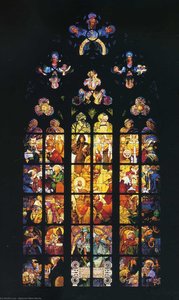
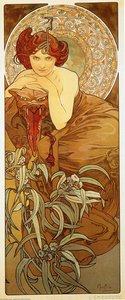
Alphonse Mucha stands as a monumental figure among 20th century Czech painters, bridging the gap between traditional Moravian roots and the avant-garde movements of Paris. Although his career flourished in France, his identity remained deeply tied to his Czech heritage, a connection he expressed through monumental works like the Slav Epic and his contributions to the visual identity of the newly independent Czechoslovakia. His signature Art Nouveau style, defined by organic forms and flowing, rhythmic lines, transformed the aesthetic landscape of the early 1900s.
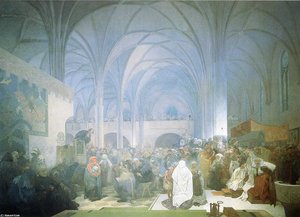
In his 1917 work, Czech Heart, we observe a departure from the decorative, idealized women of his famous posters for Sarah Bernhardt. This piece demonstrates his evolution toward a more emotive and painterly approach. The composition features a woman in a white gown and a floral headpiece, leaning protectively over a young boy in a gesture of profound intimacy. Moving away from the vibrant palettes of his youth, Czech Heart utilizes a restrained, somber palette of pale blues, greys, and whites, creating an atmospheric and ethereal quality that highlights his mastery of light and emotion.
František Kupka
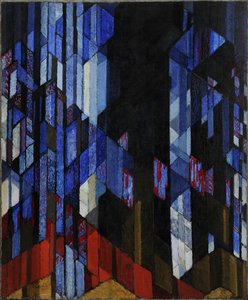 The Cathedral - František Kupka
A central figure in the evolution of modernism, František Kupka represents the profound shift of 20th century Czech painters toward abstraction and spiritual depth. Born in Opočno in 1871, his journey from the Academy of Fine Arts in Prague to the studios of Paris allowed him to transcend traditional representation. His early academic training in Prague and Vienna eventually gave way to a fascination with theosophy and Eastern philosophy, driving him to seek the unseen rhythms of the universe through color and light.
His 1913 masterpiece, “The Cathedral,” serves as a vital testament to this evolution. In this work, Kupka moves beyond mere architectural depiction to explore the intersection of the earthly and the divine. Through a sophisticated application of geometric abstraction and fractured planes, he captures a sense of spiritual ascent. The composition utilizes a rhythmic interplay of light and form, where the verticality of the structure meets an expansive, twilight atmosphere. By employing a mastery of color and texture, Kupka transforms a physical space into a meditative experience, establishing himself as a pioneer of Orphism and a vital voice in the history of Czech modern art.
Bohumil Kubišta
 Pierrot - Bohumil Kubišta
A central figure of the Czech avant-garde, Bohumil Kubišta (1884–1918) represents the intellectual rigor of 20th century Czech painters. His work serves as a vital bridge between the emotional intensity of Expressionism and the structural discipline of Cubism, a synthesis often referred to as Cubo-Expressionism. Having studied at the Academy of Fine Arts in Prague and the Reale Istituto di Belle Arti in Florence, Kubišta moved beyond mere representation to explore the metaphysical through geometric precision.
A visitor can recognize a Kubišta original by its profound psychological tension and rhythmic fragmentation. His canvases are characterized by sharp, angular edges and faceted planes that break subjects into crystalline segments, often set against somber, atmospheric backgrounds. In his 1911 work, Pierrot, this technique is masterfully applied. The figure is isolated within a void of deep blues and teals, where muted flesh tones clash against saturated, warm accents to create a sense of internal struggle. Through this interplay of light and fractured form, Kubišta captures the very essence of the modern human condition, transforming recognizable archetypes into profound, spiritual explorations of the soul.
Alfred Kubin
 Dolmen, c. 1900-1902 - Alfred Kubin
The artwork Dolmen, c. 1900-1902 serves as a profound testament to the psychological depth of Alfred Kubin. Created during the turn of the century, this drawing utilizes Indian ink, wash, and spray paint to construct a landscape of existential weight. The composition centers on a megalithic tombstone set within a rugged terrain, where a man’s contorted features and the presence of scattered birds evoke a sense of profound, melancholic tension. The palette is dominated by espresso tones, greys, and blacks, creating an atmospheric density that defines the textures of weathered stone and shifting shadows.
Born in Leitmeritz, Bohemia, Kubin is a vital figure in this group of 20th century painters from the Czech Republic, as his formative years and early life were deeply rooted in this region. A master of Symbolism and Expressionism, his work navigates the darkest corridors of the subconscious. His technique, influenced by the tonal subtleties of light and shadow, prioritizes the exploration of dreams and the grotesque over mere representation. Through his intricate pen and ink drawings and lithographs, Kubin transformed the inner landscapes of fear and grief into a hauntingly beautiful visual language.
Jan Saudek (Czech, B. 1935)
 #35 (Life) - Jan Saudek (Czech, B. 1935)
Born in Prague in 1935, Jan Saudek’s artistic consciousness was forged in the crucible of the 20th century. His early years were marked by the profound trauma of Nazi occupation and the loss of relatives to the Theresienstadt concentration camp, an experience of displacement that infused his later work with a haunting, melancholic beauty. This deep-seated sensitivity to human fragility defines his place among the significant 20th century painters and visual artists from the Czech Republic, as he transitioned from a technical apprenticeship in printing to a masterful exploration of surrealist intimacy.
Saudek’s aesthetic often draws upon the decorative elegance of Alfons Mucha, utilizing intricate patterns and idealized forms to navigate the tension between desire and despair. In his evocative work #35 (Life) (1986), this preoccupation with human connection reaches a poignant crescendo. Through a tight, intimate perspective, the image captures a father cradling his child, where the soft textures of skin and the dominance of the figures create a sense of profound closeness. The composition serves as a meditation on the cyclical nature of existence, reflecting the societal values and the emotional complexities of the late 1900s through a lens of romanticized, yet fragile, beauty.
Antonín Hudeček
 Psyche - Antonín Hudeček
Antonín Hudeček (1872–1941) stands as a pivotal figure in the transition of Czech landscape painting into the 20th century. His inclusion in this group is defined by his mastery of atmospheric light and his role in evolving the regional tradition from strict academicism toward a more sensory, plein air approach. Trained at the Academy of Fine Arts in Prague under Maximilian Pirner and Václav Brožík, Hudeček’s early focus on the human form eventually gave way to a profound devotion to the natural world, heavily influenced by the mařákovci movement and the landscape colonies of Okoř.
His representative work, Psyche (1901), serves as a masterful bridge between his academic training and the Symbolist tendencies of the early 20th century. In this oil on canvas, Hudeček utilizes a vertical composition to place a solitary nude figure within a dense, misty woodland. The painting is a study in Tonalism, employing a palette of muted greens and earthy browns to create a sense of ethereal stillness. Through soft, blended brushwork and a sophisticated command of light and shadow, he captures a fleeting, atmospheric moment that elevates the landscape from mere topography to a vessel of mood and mystery.
Pavel Baňka
 I Was Too Shy To Speak - Pavel Baňka
In his evocative 1989 work, I Was Too Shy To Speak, Pavel Baňka utilizes the medium of photography to explore the profound complexities of human connection and subjectivity. The piece features a couple connected by whimsical, tangled beams of light that emerge from their heads, creating a striking contrast between kinetic energy and the stillness of their detached expressions. This interplay of light and shadow serves as a visual metaphor for the barriers to intimacy and the internal struggles of communication.
Born in Prague in 1941, Baňka is a pivotal figure among 20th century Czech painters and visual artists, having emerged from the vibrant underground beatnik scene of the 1960s. His artistic trajectory is defined by a transition from technical studies at the Czech Technical University to a dedicated commitment to photography in the late 1970s. As a co-founder of the Action Group of Free Photography in 1989 and the Prague House of Photography in 1990, his work helped navigate the shifting political landscapes of the era. His aesthetic often utilizes a palette of soft, emotive tones, such as rosy browns, to capture the ephemeral nature of time and memory.
Norbert Troller
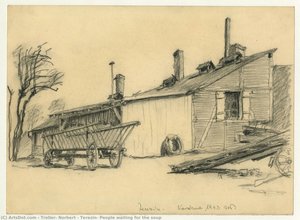 Terezin: People waiting for the soup - Norbert Troller
Norbert Troller (1896–1984) stands as a profound voice among 20th century Czech painters, utilizing his dual identity as an architect and an artist to document the most harrowing chapters of human history. Born in Brno, his artistic trajectory was shaped by rigorous training at the Brno Technical University and the Academy of Fine Arts in Vienna. His inclusion in the canon of Czech modernism is defined by his ability to translate the structural precision of architecture into a poignant, visual testimony of survival during the Second World War.
In his representative work, "Terezin: People waiting for the soup" (1943), Troller captures a moment of quiet, somber endurance within the Theresienstadt concentration camp. The piece is a masterclass in understated storytelling, where the architectural clarity of a house and barn provides a jarring, stable framework for the fragile human figures gathered near a truck. Through his delicate, monochromatic lines, the mundane act of waiting for sustenance is elevated to a symbol of resilience. The work avoids melodrama, instead relying on the stark, structural integrity of his sketches to convey the heavy, historical weight of a life lived under the shadow of persecution.
Ferdinand František Engelmüller
 Cemetery with Cypress Trees - Ferdinand František Engelmüller
Ferdinand František Engelmüller (1867–1924) stands as a significant figure among 20th century Czech painters, bridging the transition from late 19th-century traditions into the modern era. His work is characterized by a profound commitment to the Impressionist and Post-Impressionist movements, focusing on the atmospheric nuances of the Bohemian landscape. A co-founder of the Mánes Association, Engelmüller possessed a technical mastery that allowed him to capture the specific light of the Elbe riverbanks and the dense, shaded recesses of the Šumava forests.
A viewer can recognize his hand through a distinctive approach to light and texture. He utilized thick, painterly brushstrokes to give physical weight to the atmosphere, often creating a palpable sense of movement in clouds and water. His representative work, Cemetery with Cypress Trees (1918), exemplifies this dramatic execution. In this piece, vertical cypress trunks are cast into deep shadow, creating a striking silhouette against a turbulent, backlit sky. The composition relies on a somber, high-contrast palette of deep greens and dark blues, punctuated by the soft reflections of lily pads on a dark pond. Through his meticulous observation of nature, Engelmüller transformed the rugged terrain of the Bohemian-Moravian Highlands into emotive, structured landscapes.
Lubo Kristek
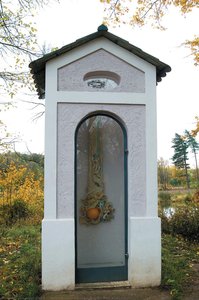 The Birth and Simultaneously Damnation of the Sphere - Lubo Kristek
Born in Brno in 1943, Lubo Kristek represents a vital, multidisciplinary evolution within the lineage of 20th century Czech painters and sculptors. His practice emerged during the transformative 1960s, a period of intense experimentation that saw him move beyond traditional boundaries to embrace conceptualism, surrealism, and performance art. Following his relocation to West Germany in 1968, Kristek’s work became increasingly preoccupied with the intersection of human vulnerability, medical ethics, and the natural world, often utilizing assemblage to bridge the gap between art and life.
A significant contribution to his legacy is the 1978 work, The Birth and Simultaneously Damnation of the Sphere. This ceramic sculpture, situated within the historical landscape of John’s Castle, utilizes the sphere as a potent symbol of both perfection and existential uncertainty. Through meticulous ceramic molding, Kristek achieves a polished, ethereal white surface that interacts dynamically with light and shadow. His theoretical development of "holographic perception" further distinguishes him as a thinker who sought to orchestrate immersive experiences, ensuring his place as a provocative figure in the post-war European avant-garde.
Conclusion
The 20th-century Czech school represents a profound intersection of avant-garde experimentation and deep-seated national identity. From the lyrical, decorative elegance of Alphonse Mucha to the pioneering abstraction of František Kupka, these artists navigated the complexities of a changing world through diverse lenses—ranging from the surrealist shadows of Alfred Kubin to the intense, emotive portraiture of Jan Saudek. Whether through the geometric rigor of Cubism or the expressive textures of modernism, each painter contributed a unique visual language to the Central European canon, ensuring that the legacy of Czech art remains both intellectually profound and aesthetically diverse.
For those seeking to integrate these historical movements into a contemporary setting, our full collection offers a gateway to these masters. We invite you to experience the tactile depth and vibrant history of these works through our museum-quality, hand-painted oil reproductions, meticulously crafted to preserve the soul and brushwork of the original masterpieces.


