
The Fiddler, National Gallery of Art at WasMarc Chagall · 1913
 Oil On Canvas
- WallArt
- Cubism
 1913
1913- Modern
Marc Chagall (1887 – 1985)
Poznejte klidnou krásu obrazu „Ležící básník“ Marca Chagalla – ikonického díla z roku 1915 kombinujícího kubismus a symbolismus. Objevte jeho tajemství a emoční hloubku!
A Portrait of Vitebsk and the Soul
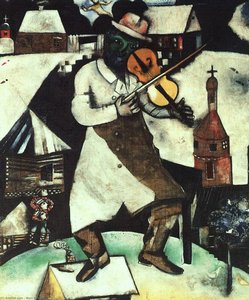
Marc Chagall’s “The Fiddler,” painted in 1913 during his formative years in Paris, isn't merely a depiction of a musician; it’s a vibrant distillation of memory, folklore, and the artist’s deeply rooted connection to his Belarusian homeland. Born Moishe Shagal in Liozna, Belarus, Chagall carried with him the rich tapestry of his Jewish upbringing – a blend of Orthodox traditions, Hasidic mysticism, and the bustling energy of a small provincial town. Vitebsk, his birthplace, became an enduring motif throughout his career, appearing repeatedly as a fantastical landscape populated by flying figures, whimsical animals, and a profound sense of nostalgia. “The Fiddler” is arguably one of the most potent expressions of this longing for home, capturing not just a scene but an entire emotional universe.
Cubist Roots, Dreamlike Visions
Stylistically, “The Fiddle” resides within the nascent stages of Cubism, though it transcends a strict adherence to the movement’s geometric deconstruction. Chagall employs flattened planes and fragmented forms – particularly evident in the architecture of the village and the figure of the fiddler himself – yet these elements are infused with an intensely personal and symbolic language. The composition is dominated by bold contrasts of color: deep blues, greens, and purples create a sense of nocturnal mystery, while bursts of yellow and red highlight key figures and details. This deliberate use of color isn’t simply decorative; it serves to heighten the emotional impact and imbue the scene with an almost hallucinatory quality.
- Technique: Oil on canvas – Chagall's signature impasto technique adds texture and depth, particularly noticeable in the fiddler’s coat.
- Composition: A dynamic arrangement featuring a towering figure of the fiddler set against a simplified village landscape.
- Color Palette: Dominated by cool blues and greens contrasted with warm yellows and reds, creating a sense of drama and mystery.
Symbolism and Narrative
The painting is rich in symbolic meaning. The oversized fiddler immediately commands attention, suggesting both power and vulnerability. He’s not simply playing music; he's embodying the spirit of the village, a conduit between the earthly realm and something beyond. The snow-covered landscape evokes a sense of isolation and perhaps even hardship, while the church steeple rising in the background represents faith and tradition – key elements of Chagall’s Jewish heritage. The presence of other figures, though less defined, hints at a community gathered around this central figure, suggesting themes of shared experience and communal life. The painting can be interpreted as a meditation on memory, longing, and the enduring power of folklore.
A Window into Chagall’s Soul
“The Fiddler” is more than just a beautiful image; it's a profound expression of Marc Chagall’s inner world. It reflects his deep connection to his roots, his fascination with Jewish mysticism, and his ability to transform personal memories into universal symbols. Reproductions of this iconic work offer a remarkable opportunity to bring this dreamlike vision into your home, allowing you to experience the emotional depth and artistic brilliance of one of the 20th century’s most beloved artists. Consider commissioning a hand-painted reproduction from Mus3ums.com – a faithful recreation that captures not only the visual details but also the very essence of Chagall's vision.
Informace o díle
- Název díla: The Fiddler, National Gallery of Art at Was
- Umělec: Marc Chagall
- Rok výroby: 1913
- Formát: Portrait
- Stav autorských práv: Pod ochranou autorského práva
- Pohyb: Cubism
- Technika a materiál: Oil On Canvas
- Období tvorby: Early Period
- Barevná paleta: Neutrals
- Klíčová slova: folklore, snow, color
Rychlé informace
- Notable elements: Surreal scene, fiddler
- Year: 1913
- Influences:
- Russian folklore
- Jewish culture
- Dimensions: 188 x 158 cm
- Subject or theme: Village life, music
- Medium: Oil on canvas
Otázky a odpovědi
Jakou barvu v kompozici díla „The Fiddler, National Gallery of Art at Was“ od Marc Chagall dominuje?
Hlavní barvou díla „The Fiddler, National Gallery of Art at Was“ od Marc Chagall je Rosy Brown (#a3af8c).
Jakou celkovou náladu vyzařuje dílo „The Fiddler, National Gallery of Art at Was“ od Marc Chagall?
„The Fiddler, National Gallery of Art at Was“ má Romantic atmosféru.
Jaký je formát díla „The Fiddler, National Gallery of Art at Was"?
„The Fiddler, National Gallery of Art at Was“ od Marc Chagall je Portrait kompozice. Před výběrem velikosti tisku je vhodné si zkontrolovat její poměry stran.