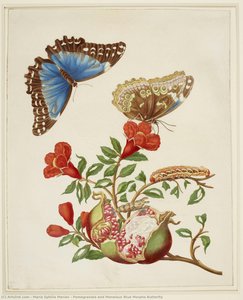
Pomegranate and Menelaus Blue Morpho ButterflyMaria Sybilla Merian · 1703
 Acrylic On Canvas
- WallArt
- Baroque Botanical Illustration
 1703
1703 37.0 x 30.0 cm
 Královská sbírka
Maria Sybilla Merian (1647 – 1717)
Maria Sibylla Merianová (1647-1717) byla průkopnická přírodopisná ilustrátorka a entomoložka, známá svými detailními obrazy hmyzu a rostlin z Surinamu, která zásadně ovlivnila obojí umění i vědu.
Královská sbírka (London, United Kingdom)
Prozkoumejte staletí britské historie & umění v Královské sbírce! Objevte mistrovská díla od Leonarda da Vinciho, Michelangela a dalších ve 13 královských rezidencích.
A Window Into Suriname’s Insect World: Maria Sibylla Merian's ‘Pomegranate and Menelaus Blue Morpho Butterfly’
Maria Sibylla Merian’s “Pomegranate and Menelaus Blue Morpho Butterfly” isn’t merely a botanical illustration; it’s a testament to scientific curiosity, artistic vision, and the burgeoning fascination with the natural world during the Enlightenment. Executed in 1702-03 as plate nine from her groundbreaking *Metamorphosis Insectorum Surinamensium*, this exquisite watercolor captures a moment of profound beauty—and intellectual discovery—that continues to resonate centuries later. The painting depicts a branch laden with pomegranate blossoms, against which rests the iridescent sapphire wing of a Menelaus blue morpho butterfly (*Morpho menelaus*) and its larval stage – a caterpillar adorned with striking bands of yellow and black. Merian’s meticulous observation of insect life cycles was revolutionary for her time, challenging prevailing beliefs about spontaneous generation and advocating for empirical study as the path to understanding God's creation. This wasn’t simply about documenting insects; it was about revealing their intricate transformations—a microcosm mirroring the larger processes shaping the natural world. Merian’s technique is characterized by a masterful blend of watercolor and bodycolor, applied over lightly etched vellum with gum arabic and silver paint. The etching process ensured precise outlines, allowing Merian to capture the delicate details of both the butterfly and its caterpillar—a testament to her dedication to accuracy. Furthermore, she employed a clever method known as ‘counterproofing,’ transferring a reversed image onto vellum before applying color by hand. This technique maximized artistic expression while maintaining scientific rigor, resulting in a stunning visual record that transcends mere representation. The historical context surrounding *Metamorphosis* is crucial to appreciating the painting’s significance. Merian undertook an arduous expedition to Suriname—then a Dutch colony—accompanied by her daughter Dorothea, driven by an unwavering desire to study Surinamese insects firsthand. This journey represented a bold step beyond the confines of European laboratories and observatories, immersing Merian in an environment teeming with exotic flora and fauna. The resulting book wasn’t just a scientific treatise; it was also a powerful statement about human intellect's capacity for wonder and discovery—a celebration of the natural world viewed through the lens of reason and observation. Beyond its technical brilliance and historical importance, “Pomegranate and Menelaus Blue Morpho Butterfly” possesses an undeniable emotional impact. The vibrant colors—particularly the luminous blue of the butterfly’s wings—evoke a sense of awe and wonder, transporting the viewer to the lush landscapes of Suriname. Simultaneously, the depiction of metamorphosis symbolizes transformation, resilience, and the cyclical nature of life itself—themes that continue to inspire artists and thinkers today. This painting stands as an enduring emblem of scientific inquiry coupled with artistic beauty—a timeless masterpiece capturing a pivotal moment in the history of natural science and visual art.- Provenance: Dr Richard Mead (1673–1754); his sale (London, Abraham Langford, 13–16 January 1755, lot 66), where purchased by an unknown collector; sold 15 June 1768 (London, Paterson and Eve, lot 572), where purchased by Sir John Hill via Wilson; George III by c.1810
- Medium: Watercolor, Bodycolor, Vellum, Gum Arabic, Silver Paint
- Dimensions: 37.16 x 30.2 cm (vellum sheet)
- Repository Number: RCIN 921162
O tomto díle
- Název díla: Pomegranate and Menelaus Blue Morpho Butterfly
- Autor: Maria Sybilla Merian
- Rok výroby: 1703
- Původní rozměry: 37.0 x 30.0 cm
- Formát: Portrait
- Stav autorských práv: Právo veřejné domény
- Kde je možné jej vidět: Královská sbírka
- Technika a materiál: Acrylic On Canvas
- Technika: WallArt
- Hlavní barva: Putty
Rychlé informace
- Notable elements: Butterfly metamorphosis
- Artistic style: Botanical Illustration
- Title: Pomegranate and Menelaus Blue Morpho Butterfly
- Influences: Scientific Observation
- Location: British Royal Collection
Často kladené dotazy
Jakou celkovou náladu vyzařuje „Pomegranate and Menelaus Blue Morpho Butterfly“ od Maria Sybilla Merian?
Dílo „Pomegranate and Menelaus Blue Morpho Butterfly“ od Maria Sybilla Merian je v náladě popsáno jako Serene. Tato klasifikace může pomoci při zařazení díla do konkrétního prostředí.
Nachází se dílo "Pomegranate and Menelaus Blue Morpho Butterfly" v zemi svého autora?
Ne – dílo se nachází v zahraničí. Dílo „Pomegranate and Menelaus Blue Morpho Butterfly“ je uloženo v zemi United Kingdom, zatímco Maria Sybilla Merian se narodil(a) v zemi Německo.
Jaký je poměr stran díla „Pomegranate and Menelaus Blue Morpho Butterfly“ od Maria Sybilla Merian a jaké jsou jeho rozměry?
Dílo „Pomegranate and Menelaus Blue Morpho Butterfly“ od Maria Sybilla Merian je v formátu Portrait o rozměrech 37 x 30 cm.