
The History of Opéra national de Paris
The origins of the Opéra national de Paris date back to 1669. Louis XIV founded the institution as the Académie d'Opéra. This establishment was placed under the leadership of Jean-Baptiste Lully. Following this period, the institution was officially renamed the Académie Royale de Musique. Over time, the name was simplified, and the company became known simply as the Opéra.
The institution has undergone several transformations in its structure and nomenclature. It began as a royal academy and evolved through various administrative shifts. The company has maintained its presence in Paris through several different venues, including the Palais Garnier and the Opéra Bastille. These locations have hosted the company's productions for generations, maintaining the continuity of the French operatic and balletic tradition.
The Architecture of the Rotonde de l’Empereur
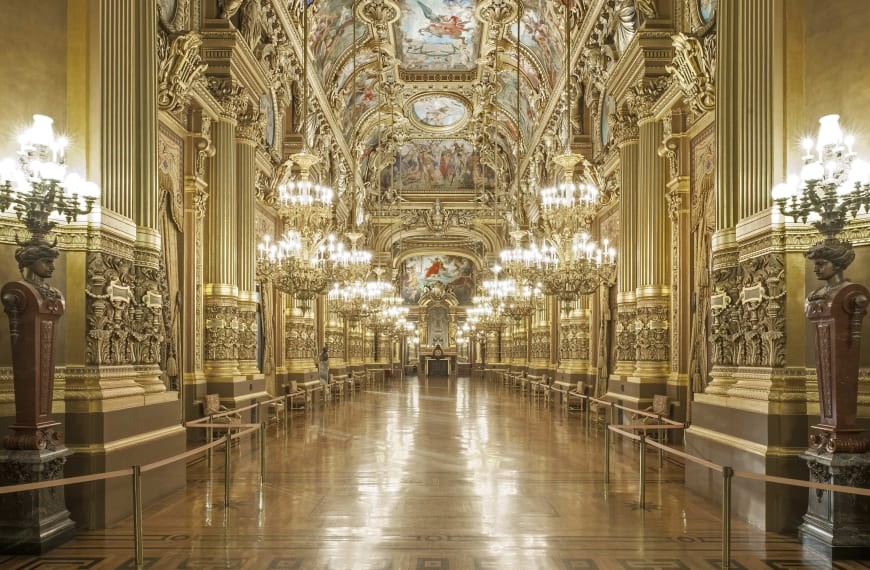
The Rotonde de l’Empereur was originally designed as an exclusive entrance for Emperor Napoleon III. This architectural space is characterized by its soaring ceilings, which are adorned with intricate plasterwork. Ornate moldings catch and reflect the light throughout the interior. A grand staircase provides the primary ascent into the Rotonde, leading visitors through the structural layers of the building.
The lighting within the space is carefully orchestrated. It is intended to highlight both the architectural details and the artifacts housed within the museum. This intentional use of light emphasizes the textures of the moldings and the scale of the ceiling. At the top of the stairs, a bronze sculpture by Jacques Gestalder depicts the dancer Alexandre Kalioujny mid-leap during Michel Fokine’s Les danses polovtsiennes. This work serves as a permanent fixture within the architectural setting.
The Bibliothèque-Musée de l’Opéra Collection
The archive comprises over 600,000 documents. This collection includes original musical scores penned by major figures of the repertoire, such as Verdi, Massenet, and Debussy. Alongside these scores, meticulously preserved librettos provide a record of the narratives that have occupied the stage. These textual materials are held alongside a vast array of visual records, including paintings and drawings that depict specific scenes from celebrated productions.
The physical presence of the performance is preserved through a variety of material objects. The museum holds costumes rendered in silk, velvet, and lace, which reflect the evolving aesthetics of different eras. Beyond textiles, the collection features stage designs, including detailed scale models that illustrate the imaginative visions of designers like René Bougnol and Eugène Ferrier. These models offer a precise view of the process used to create immersive theatrical worlds.
Masterpieces of the Museum Collection
The collection contains significant visual and musical artifacts that document the history of French performance. Marc Chagall’s Ceiling of Paris Opera House is a notable work within the space, characterized by its use of gold, red, and brown tones. In another depiction of social life, Jean-Georges Béraud's ‘An Elegant Couple’ captures the specific elegance of Parisian opera society. These works provide a visual record of the atmosphere and the people who inhabited the opera houses.
The archives hold original musical scores that offer a direct link to the creative process of major composers. These include the works of Verdi, Massenet, and Debussy. Alongside these musical documents, the museum preserves physical representations of movement and stagecraft. A bronze sculpture by Jacques Gestalder depicts the dancer Alexandre Kalioujny mid-leap, capturing a specific moment of athletic grace.
- Marc Chagall, Ceiling of Paris Opera House
- Jean-Georges Béraud, ‘An Elegant Couple’
- Jacques Gestalder, sculpture of Alexandre Kalioujny
Exhibitions and Research at the Museum
The Bibliothèque-Musée de l’Opéra National de Paris functions as a center for research and education. The institution supports ongoing scholarship by providing access to its archives. Regular lectures, workshops, and guided tours are offered to facilitate this study. These programs allow for a closer examination of the technical and creative processes behind operatic and balletic history.
Exhibitions routinely explore specific facets of the evolution of opera and ballet. Recent retrospectives have focused on the lives and legacies of composers such as Verdi and Debussy. These displays often examine how stylistic transformations in costume design reflect changing roles for performers or shifting fashion trends across different eras. Such exhibitions may also investigate the influence of Russian choreography on French ballet.
The museum's research capabilities extend to the study of various theatrical elements. Scholars can examine the development of stage design through the study of detailed scale models. The collection also provides material for investigating the history of musical composition through original scores and librettos. These resources support a continuous dialogue regarding the history of performing arts.


