
Introduction
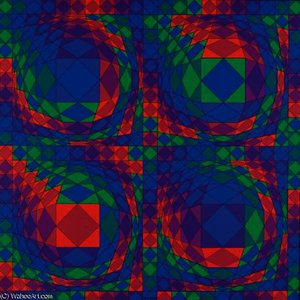
In the mid-20th century, two movements emerged that challenged the traditional stillness of art: Op Art and Kinetic Art. Op Art, a term used in the American press in 1964, focuses on the use of high-contrast patterns and geometric shapes to create the illusion of movement on a static surface. Kinetic Art, which has roots dating back to the early 20th century, involves works that move through physical means such as motors, wind, or the movement of the viewer. These two movements are often compared or shown side by side, most notably at the Galerie Denise René in Paris during the 1955 exhibition Le Mouvement. Because both movements prioritize perception, science, and the active role of the viewer over personal emotional expression, they are frequently confused by students and collectors alike.
This article will clarify the distinction between these two styles. By examining the mechanics of visual perception versus actual physical motion, readers will learn to identify whether a work is performing a "visual glitch" for the eye or a literal dance in space.
| Op Art | Kinetic Art | |
|---|---|---|
| Dates | c. 1950s-1960s | c. 1919-1920 |
| Where | Paris and New York | Paris |
| Key painters | Victor Vasarely, Bridget Riley, Richard Anuszkiewicz | Alexander Calder, Jean Tinguely, Jesús Rafael Soto |
| Palette and light | High-contrast patterns and complementary colors | Light, wind, and motors |
| Typical subjects | Geometric abstraction, lines, and grids | Machines, mobiles, and moving structures |
| Technique | Precise paint application with hard edges | Metal, wire, motors, and scrap |
| One key work | Fission (1963) by Bridget Riley | Calder's Circus (1931) by Alexander Calder |
The Visual Illusion of Op Art
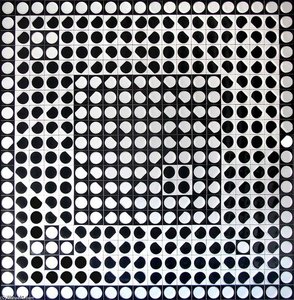
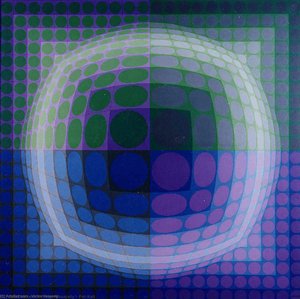 Pal-Ket - Victor Vasarely
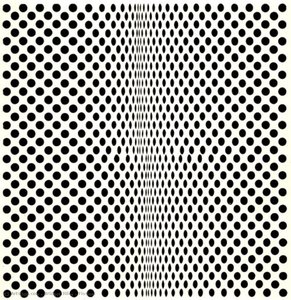 Fission - Bridget Riley
 Quartered Red Cadmium - Richard Anuszkiewicz
Op Art, short for optical art, is a movement that focuses on the mechanics of human perception. Rather than using art to express deep emotions or political truths, Op Art uses high-contrast patterns and precise geometric configurations to trigger a physiological response in the viewer. This movement gained significant public attention in the 1960s, following exhibitions such as The Responsive Eye at the Museum of Modern Art in New York in 1965. The goal of the Op Artist is to create a visual experience that feels dynamic, even though the artwork itself remains perfectly still.
The sensation of movement in Op Art is a calculated deception. By utilizing mathematical precision and the principles of the human eye—such as after-images and moiré—artists can make a flat surface appear to pulse, swell, or vibrate. This is achieved through several specific techniques:
- Contrast and Repetition: Using starkly different colors or values to create flickering light effects.
- Geometric Distortion: Using lines and grids that appear to bend or recede to create an illusion of depth.
- Retinal Fatigue: Using repetitive patterns to cause the eye to perceive motion where none exists.
Several key artists defined this era through their technical precision. Victor Vasarely, a Hungarian-born artist based in France, explored these concepts through grids and lines. His work Zebra (1937) and his later Vega series demonstrate surfaces that seem to swell and recede. In London, Bridget Riley used precise black-and-white patterns to create undulating stripes. Her work Movement in Squares (1961) and Fall (1963) can cause a sense of dizziness in the viewer. Additionally, the American artist Richard Anuszkiewicz utilized complementary colors to create vibration, as seen in Injured by Green (1963).
The Physical Motion of Kinetic Art
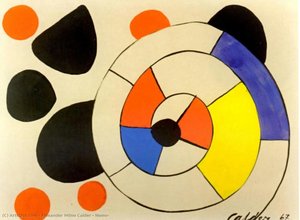
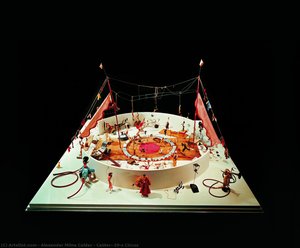 Calder's Circus - Alexander Calder
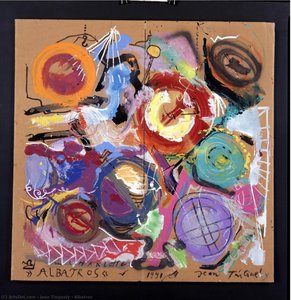 Albatros - Jean Tinguely
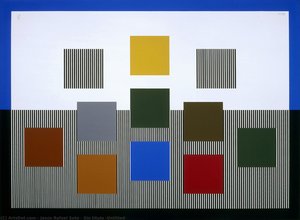 Sin título (Untitled) - Jesús Rafael Soto
While Op Art relies on the eye to create movement, Kinetic Art involves actual, physical motion. This movement can be caused by mechanical devices, natural forces like wind, or the physical movement of the spectator. Because the work changes as it moves, no two moments of the experience are identical.
The history of this movement includes several distinct approaches to motion:
- Mechanical and Motorized Motion: Artists often acted as engineers, using metal, wire, and motors. A significant example is the Swiss artist Jean Tinguely (1925–1991), who built complex machines from scrap metal. His work Albatros (undated), held at the Bechtler Museum of Modern Art, exemplifies his interest in the intersection of machine and sculpture. Tinguely was also known for his
Comparing Illusion and Reality in Motion
The distinction between Op Art and Kinetic Art can be understood through a simple practical test in a gallery setting. If a viewer stands still and the artwork appears to shimmer, pulse, or warp, but the physical object remains stationary, the work is Op Art. In this movement, movement exists only within the eye and the brain as a physiological response to pattern. Conversely, if the artwork actually turns, swings, or rattles—driven by wind, motors, or the physical passage of the spectator—it is Kinetic Art.
While both movements emerged as close cousins in the 1950s and 1960s, their technical approaches differ significantly:
- Op Art relies on the illusion of motion on a static surface. Artists use high-contrast patterns, mathematical precision, and the repetition of shapes to trigger retinal fatigue or moiré effects. For example, Fission (1963) by Bridget Riley, held at the Museum of Modern Art (MoMA), uses repeating circular dots on a white background to create a sense of dynamic perception without any physical movement.
- Kinetic Art involves actual, physical motion. These artists often function like engineers, utilizing metal, wire, and motors. Alexander Calder (1898–1973) achieved great popularity with his hanging mobiles, such as Lobster Trap and Fish Tail (1939), which move gently in the air. Other artists, like Jean Tinguely (1925–1991), created complex machines, such as Homage to New York (1960), which were designed to move and even destroy themselves.
Ultimately, Op Art is a calculated deception of the retina, whereas Kinetic Art is a literal engagement with physical space and time.
Conclusion
To distinguish these two movements while visiting a museum, a viewer only needs to observe whether the artwork is physically changing. If the piece is a static canvas or sculpture that appears to shimmer, pulse, or warp due to high-contrast patterns and geometric shapes, it is Op Art. This movement relies on a physiological reaction in the eye to create an illusion of motion. If the artwork actually turns, swings, or rattles—whether driven by a motor, the wind, or the physical movement of the spectator—it is Kinetic Art.
Despite this fundamental difference between illusion and reality, the two movements share significant common ground. Both Op Art and Kinetic Art emerged as close cousins in the 1950s and 1960s. They both turned away from personal expression and the traditional gestural brushstroke, choosing instead to embrace science, technology, and mathematics. Ultimately, both movements sought to make art more democratic and immediately accessible to the public by engaging the viewer's perception directly.
We invite you to explore these mesmerizing works on our website.
Frequently asked questions
What is the difference between Op Art and Kinetic Art?
The essential difference is simple. Op Art produces the illusion of movement on a surface that never moves. Kinetic Art moves for real. If a work seems to shimmer or warp while nothing is physically moving, it is Op Art. If something actually turns, swings, or rattles, it is Kinetic Art.
Who are the famous Op Art painters?
Victor Vasarely, a Hungarian-born artist based in France, is a pioneer of the movement. Other notable artists include Bridget Riley, known for her precise black-and-white canvases, and Richard Anuszkiewicz, a pupil of Josef Albers who used complementary colors to create vibration.
What are some famous Kinetic Art works?
Alexander Calder created hanging mobiles, such as Lobster Trap and Fish Tail. Jean Tinguely built machines like Homage to New York, which destroyed itself. Jesús Rafael Soto created works like Penetrables, which use the movement of the spectator's body to trigger optical effects.
When did Op Art become popular?
Op Art was named in the American press in 1964. It reached a wide public through the exhibition The Responsive Eye at the Museum of Modern Art in New York in 1965. The movement emerged in the mid-20th century as an evolution of geometric abstraction.
Famous painters of Op Art
- 1906 – 1997Victor Vasarely
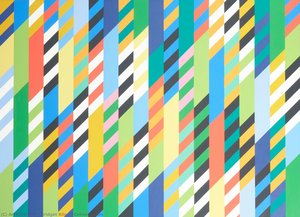
- 1931 –Bridget Riley
- 1930 – 2020Richard Anuszkiewicz


Famous artworks of Op Art
- Victor Vasarely · 1974Pal-Ket
- Victor Vasarely · 1986Kaglo II
- Bridget Riley · 1963Fission
- Bridget RileyConversation
- Richard Anuszkiewicz · 1977Quartered Red Cadmium
- Richard Anuszkiewicz · 1973Winter-Summer Reds

Famous painters of Kinetic Art
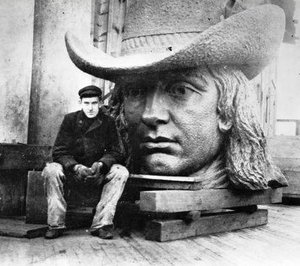
- 1898 – 1976Alexander Calder
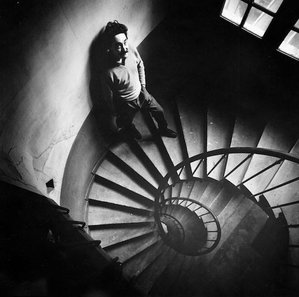
- 1925 – 1991Jean Tinguely
- 1923 – 2005Jesús Rafael Soto

Famous artworks of Kinetic Art
- Alexander Calder · 1931Calder's Circus
- Alexander CalderNemo
- Jean TinguelyAlbatros
- Jean TinguelyL
- Jesús Rafael Soto · 1990Sin título (Untitled)