

Introduction
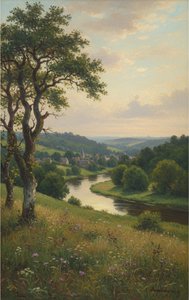
In the heart of the Forest of Fontainebleau, a quiet revolution unfolded during the mid-19th century, forever altering the trajectory of European art. These French Barbizon painters abandoned the rigid constraints of the studio and the artificiality of academic history painting to seek truth in the unfiltered landscape. By stepping directly into nature, they sought to capture the fleeting effects of light, the heavy texture of damp earth, and the profound stillness of the woodland, establishing a direct, emotional connection between the observer and the natural world.
This movement served as the vital bridge between Romanticism and Impressionism. Rather than idealizing scenery, artists like Théodore Rousseau and Charles-François Daubigny embraced a more naturalistic approach, focusing on the subtle nuances of atmosphere and the raw, unadorned beauty of the French countryside. Their commitment to en plein air—painting outdoors—paved the way for the radical experiments of the next generation, shifting the focus from what the eye knows to what the eye actually perceives.
Today, the legacy of the Barbizon School remains deeply resonant. Their works offer a timeless meditation on the harmony between humanity and the environment, capturing a sense of tranquility and organic detail that continues to enchant modern sensibilities. To understand the evolution of landscape art, one must look to the masters who first dared to find the sublime in a simple grove of trees or a misty riverbank. The following profiles explore the essential figures of this movement, tracing the diverse styles and profound contributions of the painters who redefined the art of seeing."
Théodore Rousseau
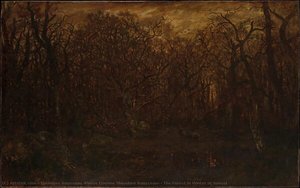 The Forest in Winter at Sunset - Théodore Rousseau
Théodore Rousseau stands as a cornerstone of the French Barbizon School, a movement that irrevocably altered the course of landscape painting by championing an uncompromising devotion to realism. Born in Paris in 1812, Rousseau’s artistic journey was deeply rooted in a meticulous observation of the natural world. Rather than merely documenting visual appearances, he sought to capture the spiritual significance and the feeling of awe inspired by untamed beauty. His work reflects a profound tension between tradition and passion, as he navigated the often-hostile Parisian artistic circles to emerge as a leading figure in the development of a new, naturalistic vision.
His technique was shaped by the essence of rural life and the atmospheric power of dramatic landscapes, moving away from the idealized and polished representations favored by Romanticism. This commitment to the raw, unvarnished truth of nature is epitomized in his monumental work, The Forest in Winter at Sunset. In this piece, Rousseau demonstrates his mastery of light and texture, capturing the skeletal architecture of winter trees against an ethereal, dying glow. By prioritizing the emotional resonance of the forest over academic artifice, Rousseau solidified his status as a master of the Barbizon movement.
Charles-François Daubigny
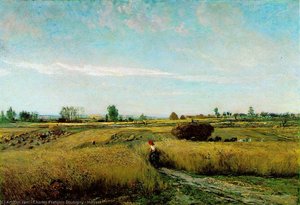
Born in Paris in 1817, Charles-François Daubigny was immersed in the world of art from childhood, influenced by his painter father and miniaturist uncle. After studying under masters such as Jean-Victor Bertin and Paul Delaroche, he eventually moved away from the rigid, polished academicism of his training to seek a more direct connection with the natural world. This transition made him a pivotal figure in the Barbizon School, as he abandoned idealized studio compositions in favor of observing the landscape with quiet, honest observation.
His commitment to the movement was defined by a desire to capture the authentic essence of nature, a pursuit that laid the essential groundwork for the later Impressionist movement. In his 1851 masterpiece, Harvest, Daubigny exemplifies this shift toward naturalism. The work presents a serene rural landscape where light and atmosphere take precedence over formal structure. Through the depiction of swaying grasses and a solitary figure under a bright sky, he captures the tranquil soul of the countryside, cementing his legacy as a pioneer who brought the spirit of the forest and the river to the forefront of French art."
Constant Troyon
 Cows in the Field - Constant Troyon
Constant Troyon stands as a pivotal figure of the Barbizon School, bridging the gap between traditional landscape painting and a profound naturalism. While his early training at the Sèvres porcelain manufactory gifted him a meticulous eye for detail, it was his departure from the studio to capture the raw essence of the countryside that truly defined his legacy. His work is characterized by a shift from purely topographical landscapes toward intimate, soulful depictions of animals within their organic environments, a hallmark of the movement's pursuit of authenticity.
A transformative journey to the Netherlands in 1846 allowed Troyon to absorb the influence of Dutch masters like Paulus Potter and Rembrandt, a stylistic evolution that became his signature. This is masterfully realized in his 1852 work, Cows in the Field. In this pastoral tableau, Troyon moves beyond mere livestock depiction to create a serene atmosphere of rural tranquility. Through his expert handling of light and color, he captures the dynamic, natural state of his subjects against a backdrop of rolling hills, cementing his reputation as a master of the animalier genre within the French naturalism movement.
Jules Dupré
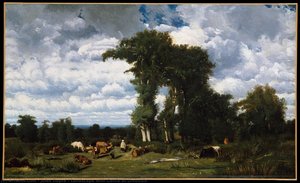 Landscape with Cattle at Limousin - Jules Dupré
In Landscape with Cattle at Limousin, the viewer is immediately confronted with the atmospheric tension that defined the career of Jules Dupré. This 1837 work serves as a profound testament to his ability to capture the fleeting energy of the French countryside, where a sense of impending drama hangs in the air. Unlike the tranquil, lyrical landscapes of some of his contemporaries, Dupré’s vision was one of movement and elemental force.
As a cornerstone of the Barbizon School, Dupré moved away from the rigid constraints of the studio to embrace the raw, unvarnished reality of nature. His work is characterized by a dramatic, almost melancholic intensity, focusing on stormy skies, the shifting light of twilight, and the restless power of the elements. His technical mastery is evident in his energetic brushwork and the use of thick impasto, which lends a palpable texture to foliage and earth. Influenced by the dynamism of English landscape traditions, Dupré utilized a rich palette of deep greens and earthy tones to explore the interplay of light and shadow. Through his intense observation of the natural world, he transformed the rural landscape into a stage for profound emotional resonance.
Narcisse Virgilio Díaz
 Road in the Wood - Narcisse Virgilio Díaz
Narcisse Virgilio Díaz de la Peña stands as a pivotal figure within the Barbizon School, a movement defined by its departure from rigid academicism in favor of direct engagement with the natural world. His transition from the decorative arts of Sèvres to the rugged landscapes of the Fontainebleau forest allowed him to capture the raw, atmospheric essence of the French countryside. His work is characterized by a profound sensitivity to light and a Romantic sensibility that helped pave the way for the Impressionist revolution.
In his evocative masterpiece, Road in the Wood (1850), Díaz demonstrates the core tenets of the Barbizon movement through a masterful command of chiaroscuro. Rather than seeking the polished perfection of studio-bound history painting, he focuses on the quiet, unvarnished reality of a woodland path. The dappled light filtering through a dense canopy creates an ethereal, breathing atmosphere, illuminating mossy ground and the figures traveling through the trees. This ability to transform a simple, everyday scene into a profound meditation on nature's tranquility is what solidified his reputation as a master of the landscape.
Charles Jacque
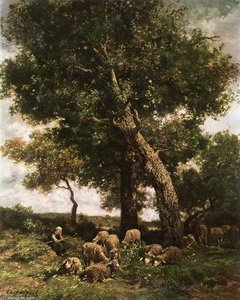 On the Pasture - Charles Jacque
Charles-Émile Jacque’s journey to the heart of the Barbizon School was as unconventional as the landscapes he would eventually immortalize. Before becoming a master of pastoral scenes, he spent seven years in the French army, where he developed a meticulous eye for detail through the precise craft of map engraving. This disciplined observation became his greatest asset when he eventually joined the artistic revolution in the village of Barbizon, seeking refuge from the urban pressures of Paris alongside contemporaries like Jean-François Millet.
Jacque’s work is defined by a profound connection to the rhythms of rural existence, focusing on the quiet dignity of livestock and the serenity of the countryside. His 1860 masterpiece, On the Pasture, serves as a quintessential example of this vision. In this tranquil oil on canvas, he captures a sun-drenched moment where sheep graze peacefully near a solitary figure, offering a meditative antidote to the industrialization of the 19th century. By prioritizing direct observation of nature over rigid academic conventions, Jacque solidified his place among the French Barbizon painters, transforming the simple life of shepherds and animals into high art.
Henri Harpignies
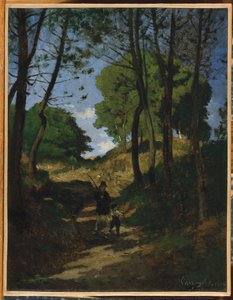 Fir Trees in Les Trembleaux, near Marlotte (Sapins aux Trembleaux à Marlotte) - Henri Harpignies
Henri Harpignies stands as a distinguished figure within the Barbizon School, a movement defined by its departure from studio artifice in favor of the direct, unmediated observation of nature. While his early training under Jean Achard provided him with a foundation in rigorous draughtsmanship, it was his immersion in the landscapes of France and his subsequent travels to Italy that refined his poetic sensibility. Unlike the more dramatic Romantics, Harpignies’ work is characterized by a profound sense of tranquility and a masterful command of atmospheric light.
A viewer can instantly recognize a Harpignies landscape through his ability to capture the subtle nuances of the forest. His brushwork avoids the heavy impasto of some contemporaries, opting instead for a refined technique that emphasizes the harmony of the countryside. In his evocative work, Fir Trees in Les Trembleaux, near Marlotte (1854), he demonstrates this expertise by utilizing light and shadow to create a hushed, sanctuary-like atmosphere. His compositions often feature winding paths and dense woodland, inviting the observer into a meditative state. Through his focus on the serene beauty of the natural world, Harpignies successfully bridged the gap between classical landscape traditions and the burgeoning realism of the mid-19th century."
Felix Ziem
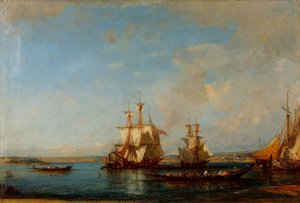 Caiques and Sailboats at the Bosphorus - Felix Ziem
In the breathtaking masterpiece Caiques and Sailboats at the Bosphorus, Félix Ziem invites the viewer into a world where water and sky dissolve through a mesmerizing dance of light. This evocative scene captures the rhythmic maritime life of the Bosphorus, utilizing a painterly touch that transcends mere documentation. Through expert perspective, Ziem creates an immense sense of depth, drawing the eye from immediate ripples toward the hazy, ethereal silhouettes of distant mosques on the horizon.
Ziem’s artistry is defined by a profound relationship with light and atmosphere. While his roots lie in the French Barbizon School—sharing the movement's commitment to capturing nature's essence—he expanded these traditions by infusing them with the exotic, sun-drenched allure of Orientalism. His work often moves away from rigid academic lines in favor of a fluid, atmospheric approach, a technique that heavily influenced the later Impressionists. His palette is celebrated for its luminous intensity, particularly his masterful use of blues that even inspired Vincent van Gogh. Whether depicting the shimmering canals of Venice or the vibrant straits of Istanbul, Ziem’s canvases remain a testament to the alchemy of color and the ephemeral beauty of the natural world.
Paul Guigou
 Self-portrait - Paul Guigou
Paul Camille Guigou (1834–1871) stands as a vital link between the naturalism of the Barbizon School and the burgeoning energy of Impressionism. While many of his contemporaries focused on the forests of northern France, Guigou brought the movement's core philosophy—the direct, unmediated observation of nature—to the sun-drenched landscapes of Provence. His work is characterized by a profound atmospheric sensitivity, capturing the intense light, heat, and moisture of the Mediterranean through a sophisticated use of tonal harmonies and textured earth tones.
A viewer can recognize Guigou’s hand through his transition from academic precision toward a more visceral, expressive language. His mature canvases often feature thick, visible brushstrokes that lend a tactile reality to scenes of wheat fields, rivers, and local washerwomen. This technique, which emphasizes the physical presence of the landscape, is exemplified in his Self-portrait (1869). In this intimate work, Guigou moves away from the expansive vistas of his youth to explore a more psychological terrain, using directional light to carve his features from a soft, atmospheric background. His ability to translate the rugged beauty of the French countryside into such emotive, textured compositions ensures his place among the most poignant landscape painters of the nineteenth century."
Jules Coignet
 View of Bozen with a Painter - Jules Coignet
In View of Bozen with a Painter (1837), Jules Coignet captures a profound moment of artistic observation. A solitary figure, seated upon a rocky outcropping in a teal-blue smock and straw-yellow hat, faces a craggy, moss-green mountain that dominates the horizon. Below, a tranquil valley unfolds with meadows of sage green and a cluster of tan buildings nestled beside an ice-blue body of water. The sky transitions through a delicate gradient of lemon yellow, peach, and muted blue, creating a sense of atmospheric depth.
Coignet’s work serves as a vital link within the Barbizon School movement, bridging the gap between Neoclassical tradition and the burgeoning realism of the mid-19th century. While he trained under Jean-Victor Bertin, Coignet moved away from the rigid, idealized landscapes of his mentor to embrace a more direct, observational method. By prioritizing topographical accuracy and the immediate effects of light and atmosphere, he became a pioneer of plein air techniques. His commitment to capturing nature as it truly appeared—rather than through a mythological lens—aligns him perfectly with the Barbizon ethos of finding poetic truth in the natural world.
Conclusion
The legacy of the Barbizon School lies in its profound shift toward the authentic, capturing the raw essence of the French landscape through the eyes of masters like Rousseau and Daubigny. From the atmospheric forest scenes of Dupré to the meticulous detail of Jacque, these artists collectively dismantled the rigid constraints of academic studio painting, paving the way for the Impressionist revolution. Each painter contributed a unique perspective on nature, whether through the dramatic light of Díaz or the serene, structural compositions of Harpignies, creating a visual language that celebrates the quiet majesty of the natural world.
For those looking to bring this timeless connection to nature into their own living spaces, Mus3ums.com offers a way to honor these masters. Our full collection allows you to explore a wide array of French artistry, from the rustic charm of the Barbizon movement to the vibrant energy of later eras. We invite you to transform your home or office by living with these historic landscapes through our museum-quality, hand-painted oil reproductions, each meticulously crafted to capture the soul and texture of the original masterpieces.