
Introduction
The 1960s in the United States marked a seismic shift in the visual language of the modern world, as the boundaries between high art and popular culture began to dissolve. This decade saw a departure from the intense, emotional gestures of Abstract Expressionism toward a new aesthetic that embraced the mechanical, the mass-produced, and the everyday. It was a period of profound cultural transformation, where the vibrant energy of consumerism, the precision of comic book printing, and the starkness of minimalism collided to redefine what a canvas could represent.
As the nation navigated rapid social changes and a burgeoning media landscape, artists sought to reflect the pulse of a new era. Some turned toward the repetitive iconography of celebrity and advertising, while others explored the raw textures of found objects or the geometric purity of color fields. This era was not merely a stylistic evolution but a philosophical interrogation of the image itself, questioning the role of the artist in an increasingly mechanized society.
Today, these works remain vital, serving as the visual DNA of contemporary art. They continue to influence how we perceive branding, celebrity, and the intersection of art and life. By examining the following ten masterpieces, we trace the evolution of a movement that challenged the very definition of creativity, moving from the gestural to the graphic, and from the singular to the serial.
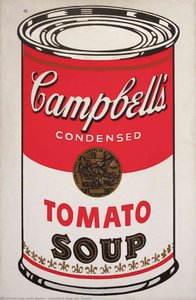
Campbell's soup cans - Andy Warhol
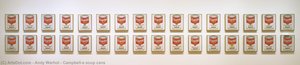
Created in 1962, this seminal work serves as a definitive pillar of the 1960s American art scene, marking a radical departure from traditional fine art. Andy Warhol’s Campbell's soup cans utilize a repetitive grid of thirty-two cans, each representing a different flavor from the original product line. By presenting these mundane, mass-produced objects through a frontal, symmetrical lens, Warhol elevated everyday consumer culture to the status of high art, challenging long-held notions of artistic originality and the sanctity of the unique masterpiece.
The piece exemplifies the bold aesthetic of Pop Art through its use of silkscreen printing, a mechanical technique that mirrored the industrial processes of the era. This method allowed for flat color fields and clean, precise lines, effectively blurring the distinction between handmade craftsmanship and the impersonal nature of mass production. The striking palette of vibrant reds and whites creates a rhythmic, visual order that reflects the ubiquity of consumerism in mid-century America. Through this repetition, Warhol transformed a simple grocery item into a profound commentary on the democratization of imagery and the visual language of the modern age.
The problem we all live with - Norman Rockwell
 The problem we all live with - Norman Rockwell
In this profound work from 1964, Norman Rockwell pivots from his signature idealized Americana toward a stark, somber social commentary that defines the turbulent American history of the 1960s. The composition centers on six-year-old Ruby Bridges, who is depicted walking with quiet purpose toward the William Frantz Elementary School in New Orleans. She is flanked by the towering, protective presence of U.S. marshals, creating a visual tension between her small, vulnerable frame and the gravity of the desegregation movement.
The palette is notably restrained, utilizing a muted, almost monochromatic range of putty and somber tones that heighten the dramatic weight of the scene. This shift in Rockwell's narrative realism moves away from vibrant storytelling into a more visceral, emotional territory. By focusing on the individual experience of a child navigating a landscape of racial friction, the painting translates complex legal shifts into a singular, human confrontation. The work remains a powerful testament to the era's social upheaval, capturing a moment of profound courage amidst a backdrop of systemic hostility.
Marilyn Diptych - Andy Warhol
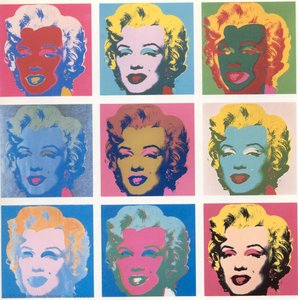
Created in 1962, Andy Warhol's Marilyn Diptych stands as a monumental pillar of American art from the 1960s, capturing the era's fascination with celebrity and mass media. Produced in the wake of Marilyn Monroe’s tragic death, this work transcends traditional portraiture to become a profound meditation on mortality and the commodification of fame. Warhol utilizes the silkscreen printing process—a technique synonymous with the industrial production of the decade—to repeat Monroe's likeness, sourced from a publicity still for the film Niagara.
The composition is a striking study in dichotomy. On the left, a grid of nine portraits explodes with vibrant, artificial hues of hot pink, turquoise, and yellow, representing the manufactured glamour of a pop icon. In contrast, the right side fades into monochromatic, ghostly tones, evoking a sense of decay and the ephemeral nature of life. By minimizing the visible hand of the artist through mechanical repetition, Warhol highlights how the media transforms human beings into consumable products. This tension between the saturated, energetic colors and the fading, melancholic shadows defines the visual language of the 1960s Pop Art movement.
Whaam! - Roy Lichtenstein
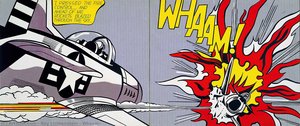 Whaam! - Roy Lichtenstein
Roy Lichtenstein’s 1963 masterpiece, Whaam!, serves as an explosive distillation of war, media, and the comic book aesthetics that defined the 1960s in the United States. This large-scale work is not merely a depiction of aerial combat; it is a powerful commentary on the detached, stylized representation of violence prevalent in mid-20th century American culture. By appropriating imagery from lowbrow comic books, Lichtenstein elevated the graphic language of mass media into the realm of fine art.
The work is instantly recognizable for its meticulous recreation of commercial printing techniques, most notably the Ben-Day dot system. These tiny, precisely placed dots create areas of solid color, giving the canvas a distinctive, flattened, printed appearance. The composition is dominated by a fighter plane positioned diagonally, unleashing a fiery attack that is rendered with a carefully constructed artifice. Through bold black outlines, simplified geometric forms, and onomatopoeic text, Lichtenstein captures a sense of dramatic action. Created during the Cold War era, the piece reflects the era's anxieties, presenting a distanced, almost clinical view of conflict that challenges the viewer to consider how media shapes our perception of reality."
Drowning girl - Roy Lichtenstein
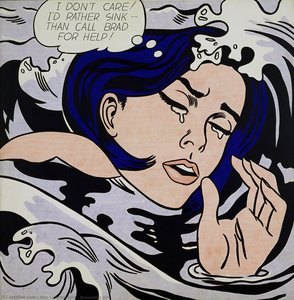 Drowning girl - Roy Lichtenstein
Created in 1963, Drowning Girl stands as a quintessential masterpiece of the Pop Art movement, perfectly embodying the aesthetic shifts occurring in the United States during the 1960s. Roy Lichtenstein utilizes this work to elevate the melodramatic tropes of comic book panels into the realm of fine art. The composition centers on a distressed woman submerged in turbulent water, her expression capturing a moment of intense emotional turmoil and isolation.
Lichtenstein’s signature technique is on full display here through the meticulous application of Ben-Day dots, a printing method used to simulate halftone shading. This choice, combined with thick, bold outlines and a flattened perspective, creates a graphic intensity that challenges traditional notions of depth and realism. The color palette is striking, utilizing high-contrast hues and heavy black lines to define the swirling patterns of the water and the woman's features. By incorporating elements like speech and thought bubbles, Lichtenstein transforms a fleeting moment of romantic despair into a monumental, iconic image that defines the visual language of the decade.
Black Fire I - Barnett Newman
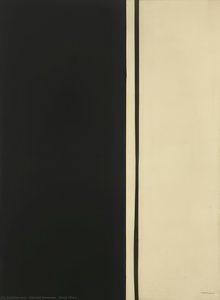 Black Fire I - Barnett Newman
Barnett Newman’s Black Fire I (1963) stands as a monumental achievement of the 1960s, representing a pivotal moment in the evolution of American Color Field painting. This large-scale work exemplifies the decade's shift toward profound abstraction, moving away from the gestural chaos of earlier Abstract Expressionism toward a more meditative, reductive language. The composition is defined by a stark, vertical division: a deep, monolithic black field on the left meets a soft, pale beige on the right. This tension is mediated by a dark vertical line, a signature element often referred to as a "zip," which serves to organize the space and assert a sense of human presence within the void.
The execution of the piece demonstrates Newman's mastery over tonal purity. While the beige section appears relatively smooth, the black area possesses a subtle, textured quality, suggesting a deliberate application of paint that prioritizes visual impact over mere decoration. By stripping away all representational subject matter, Newman created a work that focuses entirely on the sublime interaction of color and form, a hallmark of the high-modernist aesthetic that defined the American art scene during this era.
Estate - Robert Rauschenberg
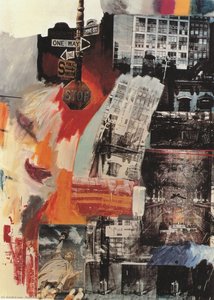 Estate - Robert Rauschenberg
Robert Rauschenberg’s Estate (1963) serves as a profound testament to the experimental spirit of American art in the 1960s, a decade defined by the blurring of boundaries between high art and everyday reality. As a seminal work from his celebrated Combines era, this piece exemplifies the Neo-Dadaist impulse to merge the tactile world of found objects with the expressive freedom of painting. The composition is a dense, chaotic collage of urban fragments, where recognizable street signs like “STOP” and “One Way” intersect with amorphous, gestural forms to evoke a sense of metropolitan disorientation.
The technique is characterized by a tension between order and instability. Rauschenberg employs a layered, mixed-media approach, utilizing loose, rapid brushstrokes and heavy impasto to create a sense of urgency and movement. The palette is dominated by an intense, dramatic core of reds, oranges, and grays, which suggests the heat and ash of an urban landscape, punctuated by cooler blues and whites. By juxtaposing sharp, graphic lines with fluid, organic textures, Estate captures the fragmented energy of the modern cityscape, embodying the era's fascination with the intersection of abstraction and the visceral reality of the street.
President elect - James Rosenquist
 President elect - James Rosenquist
James Rosenquist’s 1960 work, President elect, serves as a profound bridge between the late 1950s and the explosive Pop Art movement of the 1960s. This provocative collage masterfully encapsulates the essence of mid-20th-century American society through a layered, multifaceted composition. By blending elements of realism, graphic design, and surrealism, Rosenquist invites viewers into a visual dialogue that explores the intersection of innocence, consumerism, and historical memory.
The piece is characterized by a distinctly chaotic yet intriguing aesthetic, utilizing a montage of fragmented imagery. It juxtaposes the political iconography of a portrait of John F. Kennedy with the commercial allure of vintage Chevrolet advertisements. This layering of high-stakes political imagery against the symbols of postwar prosperity and automotive culture creates a stark commentary on the American Dream. Through his signature technique of assembling disparate elements—ranging from photographic textures to handwritten notes—Rosenquist crafts a tactile, dynamic surface. The work reflects the fragmented nature of modern identity, where the individual is constantly caught between the monumental figures of history and the pervasive, often decaying, influence of consumerist ideals.
Standard station - Ed Ruscha
 Standard station - Ed Ruscha
Created in 1966, Standard station serves as a quintessential emblem of the Pop Art movement's fascination with the vernacular imagery of mid-century America. Ed Ruscha, a pivotal figure in this era, elevates a mundane roadside service point into a high-art icon, capturing the essence of consumerism and the burgeoning car culture of the 1960s. The work utilizes a highly stylized, almost graphic approach, characterized by clean lines and simplified geometric forms that bridge the gap between realism and abstraction.
The composition is dominated by the bold, red and white 'STANDARD' signage, which cuts a striking diagonal against a gradient sky transitioning from warm sunset oranges to muted blues. This use of a limited, high-contrast color palette emphasizes the structural elements of the station—its canopy, fuel pumps, and signage—with a precision reminiscent of mid-century modern design. By stripping the subject of complex texture in favor of flat, impactful color, Ruscha transforms a functional, everyday object into a nostalgic and powerful representation of the American landscape, reflecting the decade's shift toward celebrating the beauty in the mass-produced and the ordinary.
Target - Jasper Johns
 Target - Jasper Johns
Created in 1961, Target serves as a pivotal bridge into the visual language of the 1960s in the United States. As a leading figure of the Neo-Dada movement, Jasper Johns utilized this period to strip familiar motifs of their traditional meanings, transforming a simple, recognizable symbol into a profound investigation of perception. This work belongs to the 1960s era through its radical focus on the physical properties of the medium and its departure from purely representational art toward the burgeoning Pop Art and Abstract Expressionist sensibilities of the decade.
The composition is defined by a series of concentric circles that command the square canvas. Utilizing a heavy, tactile application of encaustic and oil, Johns creates a surface where the paint functions as a sculptural object. The primary colors—red, blue, and yellow—expand outward from a central point, creating a bullseye that feels both flat and deeply dimensional. Each thick, impasto stroke leaves a physical ridge, generating micro-shadows that emphasize the raw, material reality of the pigment. In this tension between the representational idea of a target and the abstract weight of the wax, the act of painting becomes a visible, permanent event.
Conclusion
The American art of the 1960s represents a seismic shift in visual language, where the boundaries between high culture and everyday life were permanently dissolved. From the vibrant, mechanical precision of Pop Art to the profound, spiritual expansiveness of Color Field painting, these works collectively redefined what a canvas could communicate. Whether through the iconic imagery of Warhol and Lichtenstein or the textured, layered complexities of Rauschenberg and Johns, this decade captured a nation in transition, blending commercial aesthetics with deep existential inquiry. Each piece in this selection contributes a unique chapter to that narrative, moving from the graphic boldness of the street to the quiet, monumental presence of abstract expressionism's evolution.
For those looking to bring this transformative era into their own environment, Mus3ums.com offers the opportunity to own these historical milestones. We specialize in museum-quality, hand-painted oil reproductions that capture the authentic texture, brushwork, and soul of these masterpieces. You can explore our full collection to find the perfect piece and invite the revolutionary spirit of the 1960s into your home through our bespoke, artist-crafted works.


