
Introduction
The dawn of the twentieth century in Vienna and the surrounding Austrian territories marked a profound psychological and aesthetic shift that forever altered the course of modernism. This era was defined by a restless tension between the opulent, decorative traditions of the past and a burgeoning desire to explore the raw, often unsettling depths of the human subconscious. As the intellectual landscape of Europe shifted, Austrian creators began to dismantle classical perspectives, favoring instead a language of intense emotion, symbolic complexity, and structural experimentation.
At the heart of this movement was a radical departure from academic realism. Artists and thinkers of the 1900s sought to capture the invisible—the anxieties of a changing world, the eroticism of the human form, and the intricate patterns of the natural and spiritual realms. This period saw the rise of the Secession movement, which challenged the conservative institutions of the time and paved the way for Expressionism and Symbolism. The works produced during this decade are not merely visual objects; they are manifestations of a cultural metamorphosis that sought to harmonize art with the complexities of modern life.
Today, these masterpieces remain vital because they continue to speak to the universal human condition. The bold lines of Egon Schiele and the shimmering, gold-leafed textures of Gustav Klimt offer a profound dialogue between the physical body and the eternal soul. Their influence persists in contemporary visual culture, serving as a bridge between the traditional craftsmanship of the nineteenth century and the fragmented, emotive power of the modern age. The following selection highlights ten significant works that encapsulate this transformative decade, offering a glimpse into the visionary spirit of Austrian art at the turn of the century.
The kiss - Gustav Klimt
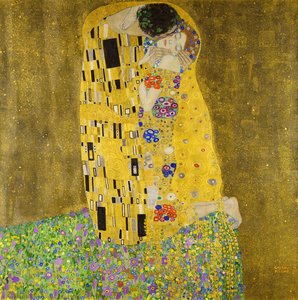 The kiss - Gustav Klimt
Created in 1908, this masterpiece epitomizes the opulent aesthetic of the Austrian 1900s. The work depicts a couple locked in a profound, intimate embrace, enveloped within a shimmering, heavy cloak that seems to emanate light from within the canvas. This luminous effect is achieved through the masterful application of gold leaf layered over oil paint, a technique that creates a dense, mosaic-like surface reminiscent of Byzantine art. The composition prioritizes emotional and spiritual union over realistic spatial depth, utilizing a flattened perspective that emphasizes the decorative richness of the scene.
The palette and patterning serve as a study in symbolic contrast, a hallmark of the Secessionist spirit of the era. The man’s attire is defined by dark, geometric shapes—rectangles and squares that suggest a sense of strength—while the woman’s garment is adorned with soft, organic floral motifs symbolizing fertility and life. These elements converge at the center of the embrace, where the gold leaf binds the figures into a singular, radiant entity. The background, a dense field of gold punctuated by jewel-toned circles and rectangles, reinforces the sense of a private, transcendent world removed from reality.
Portrait of Adele Bloch-Bauer I - Gustav Klimt
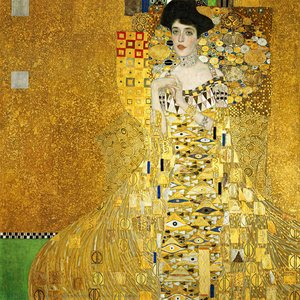 Portrait of Adele Bloch-Bauer I - Gustav Klimt
The eye is immediately arrested by a shimmering, celestial radiance that seems to emanate from within the canvas itself. In this 1907 masterpiece, the subject is enveloped in a dense, opulent landscape of gold leaf and intricate geometric tessellations. This luminous, mosaic-like surface creates a tactile depth, where curvilinear Art Nouveau patterns collide with rigid squares and circles, blurring the line between a portrait and a sacred icon. The central female figure, Adele Bloch-Bauer I, possesses an enigmatic expression, her features partially obscured by the overwhelming luxury of her golden gown and the swirling, decorative motifs that surround her.
As a quintessential product of the 1900s, this work serves as a definitive expression of the Viennese Secession movement. It captures the era's radical departure from traditional realism, favoring instead a highly stylized, symbolic language. By merging the physical presence of the sitter with an abstract, decorative plane, the painting embodies the early 20th-century obsession with the intersection of modern identity and ornamental splendor. The use of gold and the flattened perspective transform the portrait into a timeless vision of feminine grace and high-society prestige.
Judith - Gustav Klimt
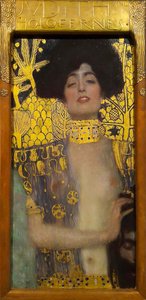 Judith - Gustav Klimt
Created in 1901, Judith stands as a definitive masterpiece of the 1900s, capturing the essence of the Austrian avant-garde during a transformative decade. Gustav Klimt, a central figure of the Vienna Secession, utilizes this work to explore the intersection of sensuality and strength. The painting depicts a reclining female figure, often identified as the biblical Judith, whose presence is both commanding and mysterious. This piece is a quintessential example of the Art Nouveau movement, characterized by its mesmerizing use of curvilinear, organic lines and complex, layered patterns.
Klimt’s signature technique is on full display through the heavy application of gold leaf and intricate mosaic-like ornamentation that envelops the subject. This creates a shimmering, tactile surface that prioritizes decorative splendor over traditional spatial depth. By blending naturalistic rendering with Byzantine-inspired abstraction, Klimt achieves a dreamlike, mystical atmosphere. The interplay of bronze tones and luminous textures transforms the figure into a symbol of female power and divinity, marking a pivotal moment in the evolution of Austrian Symbolism at the turn of the century.
The Three Ages of Woman - Gustav Klimt
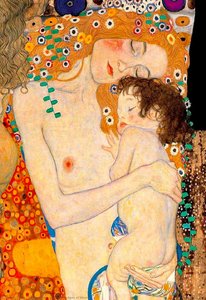 The Three Ages of Woman - Gustav Klimt
Created in 1905, The Three Ages of Woman stands as a profound testament to Gustav Klimt's mastery during the height of the Vienna Secession. This work is a quintessential example of Austrian art from the 1900s, bridging the gap between Symbolism and Post-Impressionism through its ethereal and highly stylized composition. The painting captures a moment of intense intimacy, focusing on the tender, protective embrace between a mother and her child.
Klimt’s signature aesthetic is on full display through the use of curvilinear, organic lines and a luminous palette of warm oranges, reds, and yellows. The composition is characterized by:
- Decorative Opulence: Intricate, mosaic-like patterns and gold leaf accents that envelop the figures in a shimmering, dreamlike glow.
- Symbolic Depth: The use of floral motifs and nudity to represent the cycles of life, growth, and the vulnerability of the human condition.
- Textured Surface: A rich, layered application of oil paint that creates a sense of sculptural depth and tactile richness.
By emphasizing the spiritual significance of the maternal bond, Klimt transforms a private, domestic scene into a universal meditation on existence.
Death and Life - Gustav Klimt
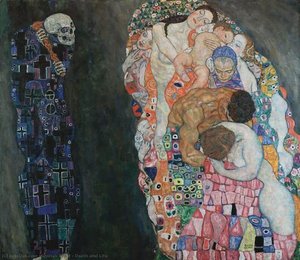 Death and Life - Gustav Klimt
Upon first encounter, the viewer is met with a dense, kaleidoscopic composition where the boundaries between human forms and decorative patterns dissolve. A spectral, skull-faced figure draped in dark, mosaic-like garments stands in stark opposition to a vibrant, swirling mass of nude figures. This central group, characterized by intimate embraces and organic curves, radiates warmth through a palette of reds, yellows, and pinks, contrasting sharply with the cold, geometric rigidity of the figure representing mortality. The use of shimmering textures and intricate, Byzantine-inspired patterns creates a dreamlike, flattened perspective that emphasizes symbolic depth over realistic space.
As a quintessential work from 1908, this piece exemplifies the height of the Austrian Secessionist movement during the first decade of the 1900s. It captures the era's fascination with Symbolism, blending Art Nouveau elegance with a profound existential inquiry. By juxtaposing the cyclical nature of fertility and connection against the inevitability of death, the work serves as a definitive expression of the psychological and aesthetic tensions defining Austrian art at the turn of the century.
The Tree of Life - Gustav Klimt
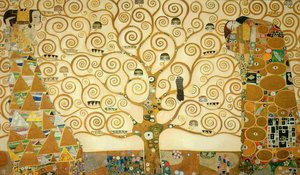 The Tree of Life - Gustav Klimt
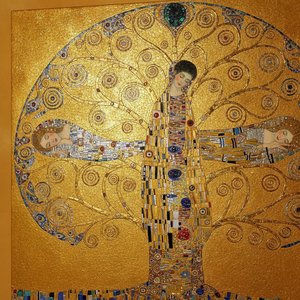
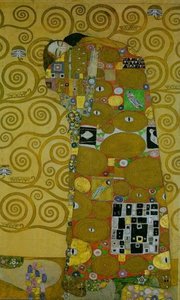
Created in 1909, The Tree of Life stands as a definitive masterpiece of the Austrian 1900s, embodying the height of the Vienna Secession and the Art Nouveau movement. This work exemplifies the era's shift toward decorative symbolism and the rejection of traditional representational depth in favor of a flattened, mosaic-like perspective.
Klimt’s technique in this piece is characterized by an opulent application of gold leaf, a hallmark of his celebrated "Golden Phase." This material, layered with meticulous oil paints, creates a shimmering, tactile surface that catches the light to produce a dynamic, otherworldly glow. The palette is dominated by warm, luminous tones and a creamy putty background, which serves to highlight the intricate, curvilinear patterns of the central motif. The tree itself, rendered in swirling, organic spirals, acts as a powerful archetype for growth and the cyclical nature of existence. Through the integration of stylized figures and architectural elements within the branches, Klimt explores the profound interconnectedness between human civilization and the spiritual realm, a recurring theme in Austrian Symbolism during this transformative decade.
At Midnight - First written copy - Gustav Mahler (Text: Friedrich Rückert)
 At Midnight - First written copy - Gustav Mahler (Text: Friedrich Rückert)
This 1902 autograph manuscript, featuring the text of Friedrich Rückert, serves as a profound artifact of the Austrian musical landscape during the first decade of the 1900s. As a facsimile of Gustav Mahler’s first written copy of "At Midnight," the work captures the transition from late Romanticism into the existential complexities of the early 20th century. The visual presentation is defined by a monochromatic, putty-toned palette, where the aged, textured paper provides a stark, nostalgic backdrop for the urgent, handwritten musical notation.
The technique is one of intimate, manual inscription; the scattered notes and various revisions visible on the sheet reveal the composer's meticulous process of transformation. This piece embodies the era's preoccupation with the liminal—the threshold between darkness and dawn. Through its melancholic and contemplative tone, the manuscript reflects the spiritual yearning and emotional depth characteristic of Mahler’s symphonic and orchestral works. It is a study in the tension between profound solitude and the search for clarity, representing a pivotal moment where musical notation becomes a deeply personal, historical testament.
Portrait of Leopold Czihaczek, Standing - Egon Schiele
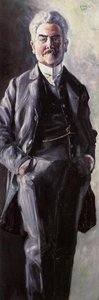 Portrait of Leopold Czihaczek, Standing - Egon Schiele
Created in 1907, this work is a quintessential example of the radical shifts occurring in Austrian art during the 1900s. As a cornerstone of the Expressionist movement, the portrait moves beyond mere likeness to explore the psychological depths of the human condition. The subject, Leopold Czihaczek, is rendered with a nervous, electric energy that defines the era's departure from traditional realism.
Schiele’s technique is characterized by a masterful use of angular, jagged lines that delineate the figure with a sense of internal tension. The composition is vertically oriented, emphasizing the subject's standing posture with hands clasped behind his back, a pose that suggests a formal reserve masking an underlying restlessness. The color palette is notably somber, dominated by muted tones of dark blue, gray, and black, which cultivate a melancholic and introspective atmosphere. Through visible, textured brushstrokes and a deliberate distortion of proportions, the artist achieves a visceral intensity. This stylistic choice reflects the broader artistic zeitgeist of the decade, where the focus shifted from the external world to the raw, unshielded emotions of the individual soul.
Peace on Earth, op. 13 - Arnold Schoenberg
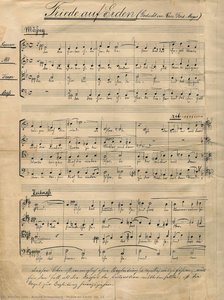 Peace on Earth, op. 13 - Arnold Schoenberg
The eye is immediately drawn to the delicate, sepia-toned patina of this original musical score, where the German title "Friede auf Erden" stands as a testament to a profound era of composition. The black and white photograph captures the intricate arrangement of orchestral notes, their rhythmic patterns appearing almost like visual textures against the aged, creased paper. This artifact serves as a tangible connection to the creative spirit of the early twentieth century, evoking a sense of nostalgia through its faded, historical character.
As a work composed in 1907, this piece is a quintessential representative of Austrian artworks of the 1900s. It captures Arnold Schoenberg, a central figure of the second Viennese school, at a pivotal moment in his evolution toward modern musical thought. The score, which draws from Conrad Ferdinand Meyer’s poetry, reflects the intense cultural and competitive atmosphere of the period, specifically linked to the 1st Styrian Music Festival. Through its exploration of the duality between historical conflict and the hope for justice, the work embodies the complex, transformative energy that defined the Austrian avant-garde during this decade.
Man with Blue Headband and Hand on Cheek - Egon Schiele
 Man with Blue Headband and Hand on Cheek - Egon Schiele
The viewer is immediately struck by the sharp, nervous energy of the lines that define this solitary figure. In this 1909 work, the eye follows the angular contours of a man’s face, where a hand is pressed against a cheek in a gesture of profound introspection or perhaps quiet concealment. The subject’s features are elongated and slightly distorted, creating a sense of vulnerability that is amplified by the muted, somber palette of beige, brown, and a striking touch of blue from the headband. The composition is strikingly vertical, emphasizing a stillness that feels both formal and emotionally charged.
This piece is a quintessential representative of Austrian art from the 1900s, specifically capturing the shift toward early Expressionism. By rejecting naturalistic proportions in favor of psychological truth, the work mirrors the era's preoccupation with the inner life. The use of graphite or charcoal allows for a raw, textured application, where hatching and cross-hatching create tonal depth without relying on traditional perspective. It is a masterful study in how line and shadow can convey the heavy, melancholic weight of the human condition.
Conclusion
The artistic landscape of the early 20th century in Austria was defined by a profound tension between the decorative elegance of the Secessionist movement and the raw, psychological intensity of emerging Expressionism. From the shimmering, gold-leafed textures of Klimt to the visceral, anatomical explorations of Schiele, these works represent a pivotal moment where traditional aesthetics dissolved into modern complexity. Whether through the rhythmic lyricism of musical compositions or the bold, emotive strokes of visual masterpieces, this decade captured a world in transition, leaving behind a legacy of profound emotional depth and stylistic revolution.
At Mus3ums.com, we invite you to bring this transformative era into your own living space. Our master artists specialize in creating museum-quality, hand-painted oil reproductions that capture the unique impasto and soul of these Austrian icons. You can explore the breadth of this era by browsing our full collection and find a piece that resonates with your personal aesthetic, allowing the spirit of the 1900s to live on within your home.