

Introduction
The 1850s in the United Kingdom marked a profound era of visual rebellion and intense emotionality, defined by a departure from the rigid constraints of academic tradition. This decade saw the rise of the Pre-Raphaelite Brotherhood, a group of young, radical artists who sought to return to the sincerity, bright colors, and intricate detail found in Italian art before the influence of Raphael. While these painters were revolutionizing the canvas with their hyper-realistic textures and complex symbolism, other artists were exploring the sublime power of landscape and the dramatic, apocalyptic scale of historical narratives.
Culturally, this period was a crossroads of industrial expansion and a romantic longing for a medieval, spiritual past. The tension between the burgeoning modern world and a nostalgic yearning for chivalry and myth provided the fuel for some of the most evocative imagery in British art history. Whether through the luminous, jewel-toned depictions of tragic legends or the sweeping, atmospheric vistas of the natural world, the works of this decade captured a nation in the midst of a profound identity shift.
Today, these paintings remain vital for their psychological depth and their mastery of light and composition. They offer a window into a period of intense intellectual debate regarding truth, nature, and the role of the artist in a changing society. The following selection highlights ten significant works from this transformative decade, featuring the meticulous craftsmanship of masters such as John Everett Millais, Dante Gabriel Rossetti, and John Martin, showcasing the diverse and brilliant landscape of British creativity during the 1850s."
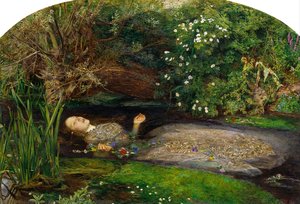
Ophelia - John Everett Millais
Painted in 1851, Ophelia stands as a definitive masterpiece of the 1850s, marking a pivotal moment in the career of John Everett Millais. As a founding member of the Pre-Raphaelite Brotherhood, Millais utilized this work to champion a radical return to the meticulous detail and luminous color found in art prior to Raphael. This specific piece belongs to the 1850s group of British works due to its profound engagement with the era's fascination with Shakespearean tragedy and the movement's commitment to naturalism.
The composition depicts a young woman reclining in a shallow, shimmering stream, her figure surrounded by an intricate tapestry of lush vegetation and symbolic flora. Millais achieved this astonishing level of realism by painting en plein air along the Hogsmill River, capturing the damp textures of moss and the delicate, translucent quality of water. The painting’s palette is dominated by deep, phthalo greens, creating a serene yet melancholic atmosphere. Through extensive layering of glazes, Millais achieved a tactile depth that elevates the scene from a mere literary illustration to a sublime meditation on the intersection of human sorrow and the enduring beauty of the natural world."
A Huguenot, on St. Bartholomew's Day Refusing to Shield Himself from Danger by Wearing the Roman Catholic Badge - John Everett Millais
 A Huguenot, on St. Bartholomew's Day Refusing to Shield Himself from Danger by Wearing the Roman Catholic Badge - John Everett Millais
Created in 1852, this profound work stands as a cornerstone of the Pre-Raphaelite movement and a defining example of British art from the 1850s. In this masterpiece, John Everett Millais captures a moment of intense spiritual conviction and romantic tragedy. The scene depicts a Huguenot man and his lover caught in the violent religious upheavals of St. Bartholomew's Day. As they embrace, the man’s resolute refusal to wear a Roman Catholic badge—even to save his life—transforms a private goodbye into a powerful statement of faith.
Millais, a founding member of the Pre-Raphaelite Brotherhood, utilizes the movement's signature commitment to "truth to nature" through extraordinary, meticulous detail. Every element, from the rich, deep purples of the man's attire to the weathered textures of the background brickwork, is rendered with luminous precision. The composition focuses on the emotional intimacy of their joined hands and the poignant expressions of sorrow and steadfastness on their faces. Through masterful lighting and a dramatic tonal range, Millais elevates this historical narrative into a timeless study of devotion and sacrifice.
The Fairy Feller - Richard Dadd
 The Fairy Feller - Richard Dadd
Created in 1855, The Fairy Feller stands as a quintessential example of the intricate, supernatural vision that emerged from the United Kingdom during the 1850s. Richard Dadd, a painter known for his obsessive attention to detail and hauntingly beautiful fairy realms, presents a dense, claustrophobic tableau that captures the Victorian fascination with folklore and the ethereal. This work belongs to the 1850s group through its profound engagement with the era's romanticism and its departure from the rigid realism of the period toward a more psychological, mythological landscape.
The composition is a lush, woodland reverie, teeming with sprites and figures dressed in varied period costumes. Dadd’s meticulous technique allows the viewer to sense the texture of mossy ground and the ripe sweetness of scattered fruits, including apples and bananas, which serve as potent symbols of abundance and temptation. Light filters through an unseen canopy, casting a mysterious glow over the lively gathering. It is a masterpiece of narrative richness, where every inch of the canvas is activated by a sense of movement and secret ritual, inviting the observer into a sun-dappled, enchanted world.
The Great Day of His Wrath - John Martin
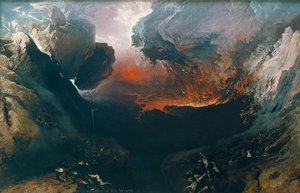 The Great Day of His Wrath - John Martin
Created in 1851, The Great Day of His Wrath stands as a quintessential example of British Romanticism from the 1850s. John Martin, a master of the sublime, utilizes this oil on canvas to depict a cosmic cataclysm, capturing the terrifying intersection of divine judgment and natural devastation. The work is defined by its immense scale and theatrical lighting, where incandescent bursts of fire clash against deep, cavernous shadows to create a sense of overwhelming chaos.
Martin’s composition relies on a dramatic juxtaposition of scale. Amidst the swirling clouds and fracturing mountains, minuscule human figures and a solitary angel are scattered throughout the landscape, emphasizing the fragility of existence against the infinite power of the divine. This focus on the monumental and the terrifyingly vast is a hallmark of the era's artistic sensibilities. Through his expert use of perspective and light, Martin transforms a biblical vision into a visceral experience of awe, making him a pivotal figure in the landscape traditions of the United Kingdom during this decade.
The Scapegoat - William Holman Hunt
 The Scapegoat - William Holman Hunt
Painted between 1854 and 1856, The Scapegoat stands as a profound testament to the Pre-Raphaelite movement's commitment to intense naturalism and symbolic depth. As a quintessential work from the 1850s, it exemplifies the era's fascination with meticulous detail and the spiritual weight of biblical narratives. William Holman Hunt draws his subject from the Book of Leviticus, transforming a pastoral scene into a heavy, iconographical prefiguration of Christ's redemptive suffering.
The composition centers on a forlorn, shaggy-haired goat positioned within a harsh, arid landscape. A red ribbon tied around its horns marks its ritualistic role, while a nearby skeleton emphasizes the grim reality of the wilderness. Hunt employs a dramatic palette, pitting the dark, asphalte-like textures of the rocky shoreline against a brooding sky. A distant, luminous light breaks through the gloom, meeting a subtle rainbow that offers a quiet, hopeful counterpoint to the surrounding desolation. Through this careful arrangement of light and shadow, the artist elevates a moment of isolation into a powerful meditation on sacrifice and solitude.
The Destruction of Sodom And Gomorrah - John Martin
 The Destruction of Sodom And Gomorrah - John Martin
John Martin’s 1852 masterpiece, The Destruction of Sodom and Gomorrah, stands as a profound example of the dramatic Romanticism that defined British art during the 1850s. This oil on canvas captures a cataclysmic biblical event through a lens of overwhelming scale and theatricality. The composition is dominated by a swirling vortex of fiery clouds and molten light, creating a celestial furnace that erupts in brilliant yellows, oranges, and reds. These intense hues contrast sharply against a palette of deep blacks, shadowy blues, and espresso tones, emphasizing the cosmic scale of the catastrophe.
The technique utilizes highly directional lighting to carve the landscape into jagged silhouettes, where a single bolt of lightning pierces the heavy, dark clouds. Within this panoramic expanse, the human presence is rendered as fragile and minute against the architecture of ruin. We witness the immediate terror of Lot and his daughters in the foreground, while Lot’s wife appears as a solitary figure in the middle distance, caught in the moment of her transformation. Through turbulent, fluid brushstrokes that mimic smoke and fire, Martin achieves a sublime study of movement and stillness, embodying the era's fascination with divine wrath and the power of nature.
Chatterton - Henry Wallis
 Chatterton - Henry Wallis
Henry Wallis’s 1856 masterpiece, Chatterton, stands as a definitive work of the 1850s, capturing the profound melancholy and dramatic intensity characteristic of the Pre-Raphaelite movement. This oil on canvas depicts the tragic end of the 17-year-old English Romantic poet, Thomas Chatterton, who took his own life in 1770. Wallis portrays the young man in a state of death, lying pale and vulnerable upon a bed within a cramped garret. The composition is masterfully balanced, utilizing a window to allow natural light to spill into the room, illuminating the figure against the distant, silhouetted skyline of London, where the form of St Paul's Cathedral is visible.
The scene is rich with symbolic, quiet detail: a chair sits in the background, a vase rests near the center, and potted plants occupy the corners, grounding the tragic subject in a domestic, yet somber, reality. Through his use of chiaroscuro and meticulous attention to the aftermath of the poet's arsenic ingestion, Wallis creates a poignant meditation on youth and unfulfilled ambition. This work remains a powerful testament to the emotional depth and narrative complexity found in British art of this decade.
The Hireling Shepherd - William Holman Hunt
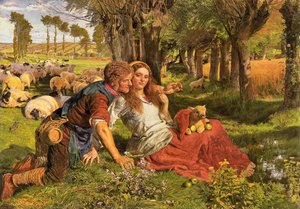 The Hireling Shepherd - William Holman Hunt
Created in 1851, The Hireling Shepherd stands as a definitive masterpiece of the Pre-Raphaelite movement, a group that revolutionized British art in the 1850s by rejecting academic conventions in favor of intense naturalism. William Holman Hunt, a founding member of the Brotherhood, utilizes this work to showcase the meticulous detail and vivid symbolism that defined the decade's aesthetic. The painting presents a lush, pastoral scene where a young shepherd and a maiden are lost in a moment of romantic intrigue, seemingly neglecting their flock to examine a death's-head hawkmoth.
Hunt’s technique is characterized by a brilliant, luminous color palette and a commitment to botanical and zoological accuracy. The composition is carefully balanced, layering organic forms—from the textured foliage to the grazing sheep—to create a sense of idyllic beauty. However, beneath the serene, romanticized surface of this rural landscape lies a complex narrative of temptation and neglected duty. Through his use of thin glazes to build depth and light, Hunt captures a world that is both a celebration of nature's abundance and a profound study of human character, marking a pivotal moment in mid-19th-century British painting.
The Lady of Shalott (Moxon Tennyson) - Dante Gabriel Rossetti
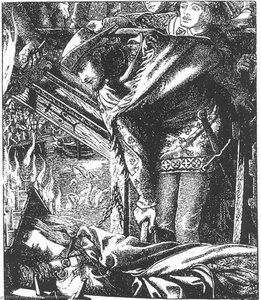 The Lady of Shalott (Moxon Tennyson) - Dante Gabriel Rossetti
Created in 1857, this profound work exemplifies the intense spiritual and narrative focus that defined British art during the 1850s. As a leading figure of the Pre-Raphaelite movement, Dante Gabriel Rossetti draws inspiration from the evocative poetry of Alfred, Lord Tennyson, translating literary tragedy into a visual masterpiece of shadow and symbolism. The piece captures a moment of devastating melancholy, centered on a woman lying prostrate amidst a scene of chaos and despair.
The artist utilizes a stark black and white palette, relying on intricate engraving techniques to build depth. Through dense cross-hatching and varying line densities, Rossetti sculpts form and texture, making the heavy atmosphere feel almost palpable. The composition is layered with symbolic elements: a man standing in a gesture of profound concern or accusation, and a drifting boat accompanied by swans, which serve as quiet reminders of mortality. By eschewing traditional academic perspective in favor of overlapping figures and complex, organic textures, Rossetti creates an immersive, claustrophobic environment that captures the very essence of the Pre-Raphaelite spirit through its meticulous realism and tragic, romantic intensity.
Mary Magdalene at the Door of Simon the Pharisee - Dante Gabriel Rossetti
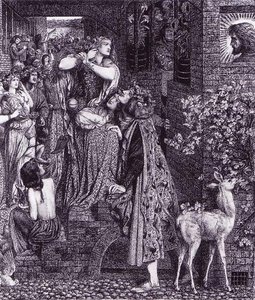 Mary Magdalene at the Door of Simon the Pharisee - Dante Gabriel Rossetti
Created in 1858, Mary Magdalene at the Door of Simon the Pharisee stands as a profound testament to the early visionary period of Dante Gabriel Rossetti. As a leading figure of the Pre-Raphaelite movement, Rossetti’s work during this decade moved away from rigid academic traditions, favoring instead a deep, symbolic emotionalism. This evocative black and white drawing captures a moment of spiritual intersection, rendered with a melancholic grace that defines the Romantic spirit of the 1850s.
The composition is rich with layered meaning and unexpected natural elements. Rossetti depicts Mary Magdalene cradling an infant, her presence a study in tenderness amidst a gathering of onlookers. The inclusion of two deer—one near the center and another to the right—introduces a unique tension between sacred biblical narrative and the untamed natural world. Through meticulous linework and a masterful play of light and shadow, Rossetti achieves an ethereal, dreamlike quality. This piece exemplifies the shift in British art toward a more soulful, textured approach to storytelling, where every figure and animal serves to heighten the profound, quiet intensity of the scene.
Conclusion
The mid-19th century in the United Kingdom served as a transformative era where the meticulous detail of the Pre-Raphaelites met the dramatic, sweeping visions of Romanticism. From the intense, symbolic narratives of Millais and Rossetti to the atmospheric landscapes and epic compositions of Martin and Dadd, these works collectively defined a decade of profound emotional depth and technical precision. Each piece within this group contributes a unique layer to the Victorian aesthetic, whether through the vibrant, naturalistic colors of the early Pre-Raphaelite movement or the haunting, melancholic beauty found in the era's most iconic portraits. To explore more masterpieces from this pivotal decade, you can browse our full collection.
At Mus3ums.com, we invite you to bring this era of British excellence into your own space. Our master artists specialize in creating museum-quality, hand-painted oil reproductions that capture the authentic texture, brushwork, and soul of these 1850s treasures, allowing you to live with history every day.


