Introduction
The 1820s in the United Kingdom marked a transformative era where the landscape became a stage for profound emotional and spiritual expression. As the nation navigated the complexities of the Industrial Revolution, artists sought refuge and sublime inspiration in the untamed beauty of nature and the dramatic interplay of light and shadow. This decade saw a departure from rigid classical structures toward a more visceral, atmospheric approach to painting, capturing the fleeting essence of weather, tide, and light.
During this period, the British school of art reached a pinnacle of technical mastery and poetic depth. The works of masters like J. M. W. Turner and John Constable redefined how humanity perceived the natural world, moving from mere topographical documentation to a deeply felt, almost elemental experience of the environment. While Turner explored the chaotic power of the sea and atmosphere, Constable found a quiet, rhythmic soul in the pastoral English countryside. This tension between the sublime and the tranquil defines the visual language of the decade.
These artworks remain vital today because they capture the very dawn of the modern perception of nature. They represent a pivotal moment when art began to prioritize the internal feeling of the observer as much as the external subject. The brushwork of this era—ranging from delicate, luminous washes to thick, textured applications—continues to influence how we interpret the relationship between humanity and the elements.
The following selection showcases ten significant works from this remarkable decade, highlighting the diverse perspectives of artists born in the United Kingdom who shaped the course of art history through their unique visions of light, land, and legacy.
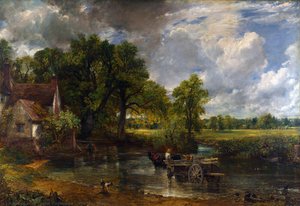
The Hay Wain - John Constable
 The Hay Wain - John Constable
John Constable’s 1821 masterpiece, The Hay Wain, stands as a quintessential vision of the English countryside and a defining work within the landscape traditions of the 1820s. This large-scale Romantic painting captures a tranquil yet dynamic scene along the River Stour, where a cart is pulled through shallow waters near a modest cottage. As a pivotal figure in British Romanticism, Constable moved away from idealized, staged landscapes to embrace the authentic, shifting light and atmospheric nuances of his native Suffolk.
The composition is characterized by a masterful handling of texture and light. Using expressive, loose brushstrokes and a rich impasto technique, the artist renders the turbulent sky and dramatic cloud formations with profound emotional intensity. The interplay of light and shadow creates a sense of depth, utilizing atmospheric perspective to lead the eye from the detailed foliage and water in the foreground to the soft, distant horizon. By focusing on the sublime power of nature and the quiet dignity of rural life, Constable transformed a simple pastoral moment into a profound meditation on the relationship between humanity and the natural world.
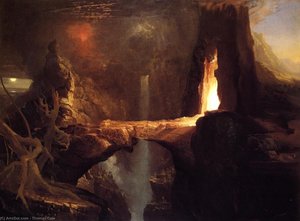
Expulsion. Moon and Firelight - Thomas Cole
 Expulsion. Moon and Firelight - Thomas Cole
Upon first glance, the eye is immediately drawn to the violent, luminous intersection of water and light. A towering waterfall plunges over a jagged precipice, its cascading spray illuminated by an intense, almost otherworldly glow that cuts through the surrounding darkness. This central radiance, reminiscent of firelight, creates a stark chiaroscuro effect against the deep, somber tones of the rocky terrain. The composition is defined by dynamic, angular lines—the swirling clouds, the rushing water, and the rugged stone formations—all of which contribute to a profound sense of movement and unrest. Small figures positioned in the foreground serve to emphasize the overwhelming scale of the landscape, evoking the quintessential Romantic concept of the sublime.
As an Anglo-American artist, Thomas Cole’s work from this period is a vital part of the British artistic legacy of the 1820s. This piece, painted in 1828, exemplifies the era's fascination with the dramatic interplay of light and shadow. It captures the transition of Romanticism as it moved from European traditions to the untamed wilderness of the New World, making it a cornerstone of the artistic movements emerging from the United Kingdom during this decade.
The Hay-Wain (detail) - John Constable
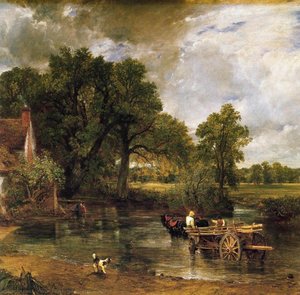 The Hay-Wain (detail) - John Constable
Completed in 1821, this detail from John Constable's seminal work serves as a profound testament to the Romantic movement's fascination with the natural world. As a cornerstone of British art from the 1820s, the piece captures a lively, pastoral moment on the River Stour within the idyllic Dedham Vale. The composition focuses on the rhythmic activity of rural life, centered around a large, wheeled boat being pulled by a horse through the water.
Constable’s mastery is evident in his ability to translate the shifting light and atmosphere of the English countryside into a textured, emotional experience. The scene is populated with subtle signs of life: smaller boats navigating the river, figures gathered at the water's edge, and even a dog wandering the shore. Through his signature use of impasto and a keen observation of the interplay between water and sky, Constable moves beyond mere topographical recording. He transforms a simple agricultural scene into a poetic vision of the Stour Valley, immortalizing the fleeting, tranquil essence of the British landscape during this transformative decade.
Chichester Canal - J. M. W. Turner
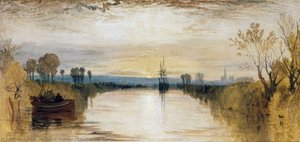 Chichester Canal - J. M. W. Turner
J. M. W. Turner’s 1828 masterpiece, Chichester Canal, serves as a profound testament to the British Romantic movement during the 1820s. This work captures a serene moment along the waterway, where the landscape is defined not by rigid lines, but by the ethereal interplay of light and atmosphere. Turner utilizes a masterful technique of translucent washes and loose, expressive brushstrokes to render the water, transforming the canal into a shimmering surface of reflections. The palette is dominated by soft putty tones, cool blues, and greens, punctuated by warmer ochres that suggest the gentle warmth of a sunny day.
The composition features numerous small vessels navigating the canal, their forms dissolving into the hazy, luminous air. This deliberate blurring of edges reflects the decade's shift toward capturing the sublime essence of nature rather than mere topographical detail. By prioritizing the atmospheric mood over precise anatomical accuracy, Turner exemplifies the era's preoccupation with the emotional resonance of the English landscape, turning a simple scene of maritime transit into a meditative study of light and tranquility.
The Lovers' Whirlwind, Francesca da Rimini and Paolo Malatesta - William Blake
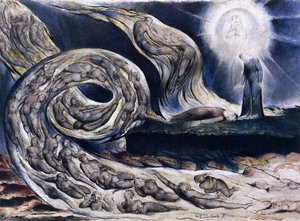 The Lovers' Whirlwind, Francesca da Rimini and Paolo Malatesta - William Blake
The eye is immediately drawn into a turbulent vortex of emotion, where the central figures of Francesca da Rimini and Paolo Malatesta are locked in a forceful, passionate embrace. This monumental work, created between 1824 and 1827, captures a moment of intense psychological drama, as the lovers are swept up in a maelstrom of swirling angels and spectral forms. The composition is defined by a sense of chaotic motion, with the man positioned above the woman amidst a storm of limbs and drapery that suggests both ecstasy and destruction. The dramatic use of light and shadow heightens the visceral tension, pulling the viewer into the heart of their doomed romance.
As a quintessential product of the 1820s, this painting exemplifies the height of the Romantic movement in the United Kingdom. Through his visionary approach, the artist moves beyond mere storytelling to explore the sublime power of human passion and spiritual turmoil. This work belongs to this specific decade of British art history due to its profound departure from classical restraint, favoring instead the raw, expressive energy and mystical symbolism that defined the era's most radical creative voices.
The Ancient of Days - William Blake
 The Ancient of Days - William Blake
The eye is immediately drawn to a luminous, celestial orb that serves as a radiant backdrop for a muscular, primordial figure. This is Urizen, a character from a private mythology, appearing to emerge from a glowing halo that pierces through deep, atmospheric shadows. His long, flowing white hair and beard stream with a kinetic energy, suggesting a cosmic wind, while his crouched posture creates a sense of profound tension. With a steady hand, he reaches downward to guide a pair of compasses over a dark, swirling void, an act symbolizing the imposition of divine order upon chaos. The palette is dominated by warm, earthy tones—ochre, burnt sienna, and deep browns—which provide a grounded contrast to the ethereal, cloud-like textures and the sharp, angular lines of the compass arms.
Created in 1827, this work exemplifies the visionary mysticism of the British Romantic movement. Through a masterful application of watercolor, ink, and gouache, the artist achieves a delicate balance between sculptural anatomical precision and broad, atmospheric washes. This piece stands as a testament to the profound spiritual and symbolic depth characteristic of United Kingdom artworks of the 1820s.
Rome: The Colosseum - J. M. W. Turner
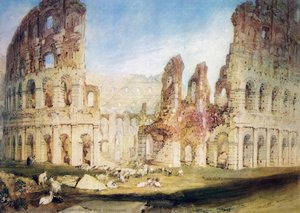 Rome: The Colosseum - J. M. W. Turner
In this evocative watercolor from 1820, J. M. W. Turner captures the Colosseum not as a static monument, but as a living part of a shifting, atmospheric landscape. This work exemplifies the British Romantic movement of the 1820s, where artists moved away from rigid topographical precision to embrace the emotional and sublime qualities of a scene. Turner’s approach focuses on the interplay of light and shadow, using expressive, loose brushstrokes to suggest the massive arches and columns of the Roman structure.
The composition is characterized by a serene yet dramatic atmosphere. In the foreground, sheep graze peacefully near a solitary figure, grounding the monumental scale of the ancient ruins in a moment of quietude. The palette, dominated by putty tones, blues, and ochres, is punctuated by brilliant shafts of light that break through a turbulent sky. Through this technique, Turner transforms the Colosseum into a vessel for light, emphasizing the ephemeral nature of time and the enduring presence of history within the natural world.
Falls of the Kaaterskill - Thomas Cole
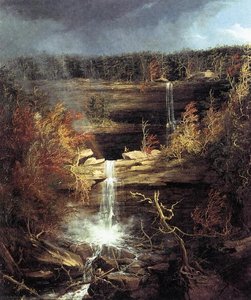 Falls of the Kaaterskill - Thomas Cole
Created in 1826, Falls of the Kaaterskill stands as a foundational masterpiece of the Hudson River School. Although Thomas Cole is celebrated as an Anglo-American pioneer, this work is a vital part of the 1820s artistic dialogue shared with the United Kingdom, as his dramatic approach to the sublime was deeply influenced by the Romantic traditions emerging from the British Isles. In this composition, Cole captures the profound transcendence of the American wilderness, using the rugged cliffs and cascading water to evoke a sense of awe.
The painting is a sophisticated study in light and shadow, where the mist from the falls blurs the boundary between the earthly and the divine. Cole’s technical mastery is evident in the interplay of textures—the smoothness of the water contrasting against jagged, moss-covered stones. By layering tones to create immense depth, he draws the viewer from the tactile details of the foreground toward the ethereal, receding waterfalls in the distance. This atmospheric command of oil painting transforms a natural landscape into a living, breathing entity of serene and captivating beauty.
Portrait of Emperor Alexander I - George Dawe
 Portrait of Emperor Alexander I - George Dawe
Executed in 1824, this commanding full-length portrait by George Dawe stands as a premier example of British Neoclassical portraiture from the 1820s. As a master of the genre, Dawe captures Emperor Alexander I not merely as a sovereign, but as a formidable military leader. The composition is defined by a powerful verticality, with the Emperor standing in a moment of formal repose against a vast, atmospheric landscape that evokes the expansive reach of his imperial territory.
The visual language of authority is articulated through meticulous detail. The subject is draped in a dark, structured military uniform, accented by the sharp brilliance of gold epaulettes and precise red piping. Light catches the metallic sheen of his decorations and the polished surface of his tall black leather boots, creating a striking contrast against the muted, hazy sky of the background. In his hand, he holds a plumed bicorne hat, adding a subtle grace to his rigid, dignified posture. Now housed in the State Hermitage Museum, this work exemplifies the era's ability to blend individual character with the monumental weight of history.
Venice the Piazza San Marco - Richard Parkes Bonington
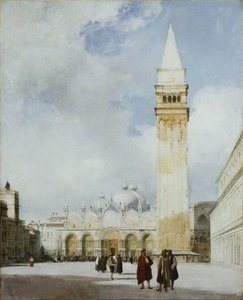 Venice the Piazza San Marco - Richard Parkes Bonington
Upon viewing Venice the Piazza San Marco, the eye is immediately drawn to the hazy, luminous atmosphere of the square, where the Basilica di San Marco and the slender Campanile rise through a soft, overcast light. Richard Parkes Bonington captures a moment of profound tranquility, using a low-angle perspective to emphasize the monumental scale of the Venetian architecture against a pale, watercolor sky. The composition is defined by a delicate interplay of light and shadow, where the dampness of the lagoon seems to permeate the very air, rendered through masterful wet-on-wet techniques that allow pigments to bleed seamlessly into one another.
This work is a quintessential example of British artworks of the 1820s, representing the height of the Romantic movement. As a British painter who masterfully blended English sensibilities with French stylistic influences, Bonington’s approach here anticipates impressionistic qualities through his loose, expressive brushwork. The piece exemplifies the decade's fascination with atmospheric perspective and the emotional resonance of light, capturing the fleeting, ephemeral beauty of the Italian landscape through a distinctly British lens of Romanticism.
Conclusion
The masterpieces of this decade represent a transformative era in British art, capturing a profound shift from the structured landscapes of the early century toward the atmospheric, emotive power of Romanticism. Through the sweeping skies of Turner, the intimate, textured studies of Constable, and the visionary, spiritual realms of Blake, these works collectively defined a national aesthetic that balanced naturalistic observation with intense human feeling. Whether through the dramatic light of a maritime scene or the quiet dignity of a portrait, these artists established a visual language that continues to resonate across generations.
For those looking to bring this era of artistic brilliance into their own spaces, Mus3ums.com offers a way to experience these classics through museum-quality, hand-painted oil reproductions. Our master artists meticulously recreate the visible brushstrokes and rich tonal depth of these 1820s treasures on 100% cotton canvas, ensuring each piece serves as a lasting testament to the beauty of the Romantic movement. You can explore the breadth of this era by browsing our full collection and find the perfect masterpiece to elevate your home or collection.