
Introduction
The 1830s in the United Kingdom represented a transformative era where the dramatic intensity of Romanticism began to merge with the meticulous precision of a rapidly industrializing society. This decade captured a nation in flux, caught between the untamed, sublime power of nature and the structured elegance of Victorian sensibilities. The artworks of this period are united by a profound preoccupation with light, atmosphere, and the emotional resonance of the landscape, often utilizing sweeping brushwork to evoke the sublime or delicate textures to capture the fleeting nuances of the natural world.
During this time, British art moved beyond mere representation, seeking instead to translate the spiritual and psychological impact of the environment. From the luminous, swirling skies of J. M. W. Turner to the grounded, pastoral compositions that defined the era's connection to the land, these pieces reflect a culture grappling with the sublime beauty of the countryside and the encroaching shadows of the Industrial Revolution. The mastery of color and the sophisticated handling of light during these years set a standard for European painting, influencing how subsequent generations perceived the relationship between humanity and the horizon.
Today, these works remain vital as they serve as visual chronicles of a pivotal moment in history. They offer more than just aesthetic pleasure; they provide a window into the soul of a century that redefined the modern world. The emotional depth found in these canvases continues to resonate, offering a sense of timelessness that transcends their original historical context. As we move through this selection, we encounter ten significant works that exemplify the technical brilliance and the evocative spirit of British art during this remarkable decade.
Candaules, King of Lydia, Shews his Wife by Stealth to Gyges, One of his Ministers, as She Goes to Bed - William Etty
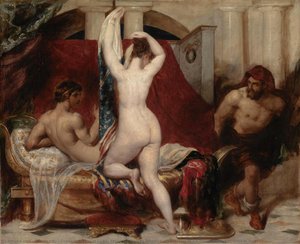 Candaules, King of Lydia, Shews his Wife by Stealth to Gyges, One of his Ministers, as She Goes to Bed - William Etty
In this evocative masterpiece from 1830, William Etty invites the viewer into a moment of profound moral transgression and voyeuristic tension. The work captures a pivotal scene from Greek legend, where the hubris of King Candaules leads to a breach of intimacy that would forever alter his kingdom. The composition centers on the luminous figure of the Queen, caught in a vulnerable state of undress upon her bed. As she prepares for sleep, unaware of the treachery unfolding, the eye is drawn to the shadows where the King and his minister, Gyges, linger in the periphery.
The painting serves as a breathtaking study of the human form, a hallmark of Etty’s reputation as a pioneer of the British nude. His technique is characterized by a rich, painterly application of color that breathes life into the flesh tones of the central figure. The soft, pearlescent glow of the Queen's skin contrasts sharply with the darker, more somber tones of the surrounding chamber. Through fluid brushwork and a sophisticated understanding of anatomy, Etty achieves a tactile quality that makes this dramatic scene feel almost palpable, cementing its place among the most significant British works of the 1830s.
View of Florence from San Miniato - Thomas Cole
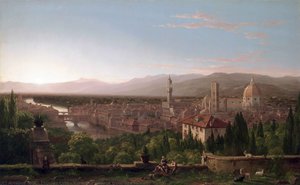 View of Florence from San Miniato - Thomas Cole
Thomas Cole's 1837 masterpiece, View of Florence from San Miniato, serves as a profound testament to the Romantic sensibilities prevalent in British-influenced art during the 1830s. As a founder of the Hudson River School, Cole brings an Anglo-American perspective to the Italian landscape, blending meticulous topographical detail with the sublime emotional intensity characteristic of the era. This panoramic oil on canvas captures the Florentine skyline from an elevated vantage point, where the iconic silhouette of the Duomo dominates the horizon.
The composition is a sophisticated study in perspective and light. In the foreground, a stone wall populated by figures engaged in quiet leisure—a man reading, a woman with a child, and a dog—provides a human scale to the vastness of the scene. Cole utilizes a wide-angle perspective to establish immense depth, leading the eye from the textured greenery of the hillside toward the distant, hazy mountains. The lighting, reminiscent of a tranquil late afternoon, bathes the city in soft, diffused tones, creating a nostalgic atmosphere that emphasizes the historical grandeur and architectural heritage of the landscape.
Study for Dream of Arcadia - Thomas Cole
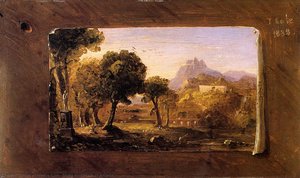 Study for Dream of Arcadia - Thomas Cole
Created in 1838, Study for Dream of Arcadia stands as a profound testament to the Romantic sensibilities that defined the 1830s. As an Anglo-American artist, Thomas Cole bridges the gap between European tradition and the burgeoning American landscape movement, making this work a vital representative of the era's artistic shifts. This oil-on-panel composition captures a serene, classical vista, where the sublime meets the pastoral.
The painting utilizes a sophisticated atmospheric perspective, employing a soft, diffused light that creates a hazy, nostalgic quality across the horizon. Cole’s mastery of the impasto technique is evident in the rich, layered textures of the foreground, where muted greens and earthy ochres lead the eye toward a distant, mountainous landscape. Within this vista, the ruins of an ancient city or temple perched atop the peaks evoke themes of antiquity and the inevitable passage of time. Through a balanced horizontal composition and a palette of clay and warm browns, Cole invites a reflective contemplation of nature's grandeur and the quiet beauty of a lost, idyllic world.
The Burning of the Houses of Parliament - J. M. W. Turner
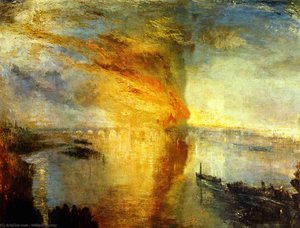 The Burning of the Houses of Parliament - J. M. W. Turner
J. M. W. Turner’s 1835 masterpiece, The Burning of the Houses of Parliament, stands as a definitive example of British Romanticism from the 1830s. This oil painting captures the catastrophic fire of 1834, a moment of profound transformation in British history. Rather than a mere journalistic record, Turner treats the event as a sublime spectacle, where the destruction of a political icon becomes a study of elemental power.
The composition is defined by a dramatic interplay of light and shadow, utilizing a vibrant palette of fiery oranges, deep reds, and glowing yellows that pierce through turbulent, smoky grays. Turner’s signature technique involves thick, expressive brushwork and an impasto-like application of paint, which lends a tactile, visceral energy to the billowing clouds and dancing flames. By prioritizing emotional resonance and atmospheric depth over rigid precision, Turner captures the awe and terror inherent in the scene. This work exemplifies the decade's preoccupation with the sublime, merging historical reality with the raw, untamable forces of nature to create a scene of unparalleled intensity.
The Grand Canal, Venice - J. M. W. Turner
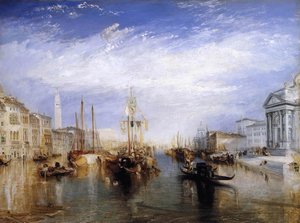 The Grand Canal, Venice - J. M. W. Turner
Completed in 1835, The Grand Canal, Venice serves as a quintessential example of the British Romantic movement during the 1830s. In this work, J. M. W. Turner moves beyond mere topographical recording to capture the very essence of Venetian atmosphere. His approach is characterized by a profound obsession with light and the ephemeral qualities of water, transforming the cityscape into a subjective, emotional experience rather than a static architectural study.
Turner’s technique is defined by loose, expressive brushstrokes and a masterful command of color that creates a sense of constant movement. The canvas is alive with the energy of numerous boats navigating the shimmering waterways, set against a backdrop of intricate architecture. His palette utilizes rich, vibrant tones to depict the play of light upon the canal, often employing thick impasto to give the water a tactile, swirling quality. This emphasis on the sublime and the atmospheric is a hallmark of British art from this decade, where artists sought to convey the raw, emotive power of a location through a dance of light, shadow, and color.
Old Sarum - John Constable
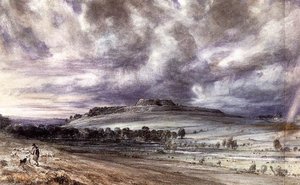 Old Sarum - John Constable
In this 1834 watercolor, John Constable captures a profound meditation on the passage of time, a quintessential theme for British landscape art of the 1830s. The work presents a panoramic view of the ancient ruins atop a massive, verdant hill, where the skeletal remains of Sarum Cathedral stand in silent dialogue with the enduring majesty of the natural world. This juxtaposition of decaying stone against the vibrant, living pulse of the grassy slopes exemplifies the Romantic movement's fascination with the sublime.
Constable’s mastery of the "fleeting moment" is evident in the restless, swirling sky. Rendered in shades of slate, pearl, and charcoal, the moisture-laden clouds suggest an impending summer storm, casting a diffused, atmospheric light across the landscape. Through expressive brushstrokes and a muted palette of earthy greens and ochres, the artist creates a sense of immense scale and depth. The presence of small figures and a dog on a winding path provides a human scale to the vastness, emphasizing the tranquil yet dramatic relationship between man and the English countryside.
Salisbury Cathedral From the Meadows - John Constable
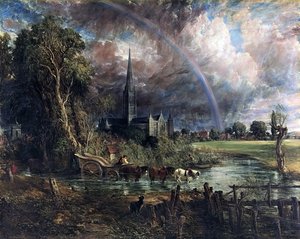 Salisbury Cathedral From the Meadows - John Constable
Salisbury Cathedral From the Meadows stands as a profound emotional testament to the spirit of Romanticism. Painted in 1831, this monumental oil-on-canvas captures a moment where the terrestrial and the divine converge, marking a significant contribution to the British artworks of the 1830s. John Constable, a master of the English landscape, orchestrates a scene that breathes with the vitality of the natural world, utilizing his signature textured impasto to capture the shifting light of the countryside.
The composition features the majestic spire of the cathedral rising triumphantly against an atmospheric sky, where a dramatic rainbow arcs overhead, suggesting hope and renewal. In the foreground, a horse-drawn carriage and scattered figures navigate the lush, verdant meadows intersected by the meandering Avon River. Through the skillful application of atmospheric perspective, Constable allows the colors of the landscape to soften, drawing the observer into a tranquil, picturesque vision of rural England. The interplay of light and shadow—from the golden luminosity hitting the river to the moody, overcast purples of the sky—creates an immense sense of depth and sublime beauty.
Profile Bust of George Washington - Robert Ball Hughes
 Profile Bust of George Washington - Robert Ball Hughes
Created in 1835, the Profile Bust of George Washington stands as a testament to the Neoclassical mastery of Robert Ball Hughes, a prominent British-American sculptor. This relief sculpture, a significant work from the 1830s, captures the likeness of the American founding father with a profound sense of dignity and permanence. Hughes utilizes a sophisticated interplay of light and shadow to carve out the contours of the face, lending a breathtaking three-dimensional depth to the subject's serene yet commanding countenance.
The technical execution reveals an artist intimately acquainted with the nuances of form. While the visual impression evokes the smooth, cool surface of polished marble, the piece possesses a tactile richness that highlights Hughes's expertise in capturing anatomical subtleties. Every line is intentional, from the sharp definition of the jawline to the soft, sweeping curves of the hair. Encased within an ornate, dark-colored frame, the bust functions as a window into the past, embodying the formal portraiture and sculptural elegance that defined the artistic output of the United Kingdom during this decade.
Sir Walter Scott, 1771 - 1832. Novelist and poet - John Watson Gordon
 Sir Walter Scott, 1771 - 1832. Novelist and poet - John Watson Gordon
In this formal oil on canvas portrait, the viewer is immediately met with the dignified presence of the celebrated novelist and poet Sir Walter Scott. Rendered by John Watson Gordon in 1830, the composition captures the subject in a three-quarter length pose, seated with hands resting upon a walking stick. The lighting is masterfully directional, casting soft shadows that define the contours of his face and provide a profound sense of three-dimensionality. Scott is dressed in a dark green coat over a yellowish waistcoat, a color palette that emphasizes the intellectual gravity of the sitter. To his right, the inclusion of his dog, Bran, adds a layer of personal narrative, while the background hints at the Eildons landscape.
This work is a quintessential example of British art from the 1830s, commissioned specifically for the 'Magnum Opus' edition of the Waverley Novels. Executed during a single sitting in 1830, Gordon’s portrait serves as a vital historical document of the era, bridging the gap between classical realism and the intimate character studies favored by 19th-century British portraiture.
Una and the Lion Five Pound Coin - Royal Mint, George William De Saulles
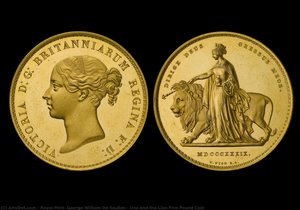 Una and the Lion Five Pound Coin - Royal Mint, George William De Saulles
This exquisite five-pound gold piece, produced by the Royal Mint in 1839, serves as a profound metallurgical testament to the artistic and political landscape of the United Kingdom in the 1830s. Designed by the renowned medallist George William De Saulles, the coin captures a pivotal transition in British history: the dawn of Queen Victoria's reign. Through meticulous engraving, De Saulles transforms precious metal into a narrative of allegory and sovereignty.
The obverse features a sharp, regal profile of the monarch, encircled by the Latin inscription BRITANNIA DEI GRA REG FID DEF IND IMP. The reverse, however, elevates the medium to the realm of epic poetry. It depicts the character of Lady Una from Edmund Spenser's The Faerie Queene, shown in a moment of serene connection as she reaches toward a lion. This imagery is deeply symbolic; the lion represents England, acting as a guardian to the sovereign. Accompanied by the spiritual invocation DIRIGE DEUS GRESSUS MEOS—"May God direct my steps"—the piece reflects the era's blend of imperial strength and divine mandate, showcasing the high level of craftsmanship achieved by British engravers during this decade.
Conclusion
The artistic output of the 1830s from the United Kingdom represents a profound intersection of Romanticism and the burgeoning realism of a changing era. From the atmospheric, light-drenched landscapes that define the legacy of masters like Turner and Constable to the dramatic, emotive storytelling found in the works of Etty and Cole, this decade captured a nation in transition. Whether through the meticulous detail of portraiture or the sweeping grandeur of maritime scenes, these artists collectively expanded the visual language of the nineteenth century, leaving behind a legacy of texture, light, and profound human emotion.
For those looking to integrate these historical narratives into a modern setting, Mus3ums.com offers a way to bring these masterpieces into your own space. Our artisans specialize in creating museum-quality, hand-painted oil reproductions that preserve the tactile soul of the original works, from the visible impasto of a landscape to the delicate tonal shifts of a portrait. We invite you to explore our full collection and discover how these timeless British treasures can transform your home through the enduring beauty of fine art.


