


Introduction
The 1880s in France represent a transformative era where the boundaries of visual perception were fundamentally redrawn. Centered in the vibrant, shifting landscapes of Paris and its surrounding countryside, this decade saw a departure from the rigid structures of academic tradition toward a profound exploration of light, color, and the fleeting moment. It was a period of intense experimentation, where artists moved beyond mere representation to capture the sensory essence of modern life, whether through the delicate, dappled sunlight of an afternoon garden or the scientific precision of color theory.
During this decade, the art world witnessed the evolution of Impressionism into more structured movements like Neo-Impressionism, as painters sought to decode the very mechanics of sight. The cultural atmosphere was one of rapid modernization, and the canvases of the time reflect this energy, capturing everything from the bustling urban boulevards to the quiet, contemplative solitude of the French coast. These works remain vital today because they established the visual language of modernity, teaching us to see the world not as static objects, but as a continuous, shimmering dance of light and atmosphere.
The following selection highlights ten significant works from this pivotal decade, featuring the mastery of artists such as Claude Monet, Pierre-Auguste Renoir, and Georges Seurat, whose contributions defined the aesthetic soul of 19th-century France.
A Sunday Afternoon on the Island of La Grande Jatte - Georges Seurat
 A Sunday Afternoon on the Island of La Grande Jatte - Georges Seurat
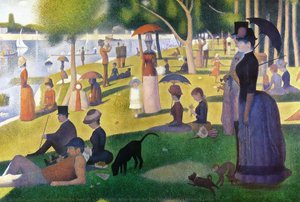
Georges Seurat’s monumental masterpiece, completed in 1886, stands as a defining achievement of the 1880s and a cornerstone of French Neo-Impressionism. This work represents a radical departure from traditional brushwork, introducing the revolutionary technique of Pointillism. Rather than blending pigments on a palette, Seurat meticulously applied tiny, distinct dots of pure color to the canvas, relying on the viewer's eye to achieve optical mixing. This scientific approach to light and color creates a luminous, shimmering quality that captures the essence of a sun-drenched afternoon.
The composition depicts a tranquil scene on the banks of the Seine at the Île de la Grande Jatte, offering a sophisticated social commentary on Parisian leisure. Through a carefully structured tableau of elegantly dressed figures, parasols, and strolling animals, Seurat captures a cross-section of society frozen in a moment of serene contemplation. The painting’s flattened perspective and rhythmic arrangement of forms evoke a sense of timeless order, making it a profound exploration of both modern life and the structural possibilities of light and atmosphere during this transformative decade.
After the Bath - Pierre-Auguste Renoir
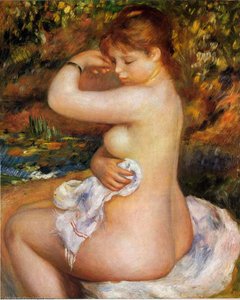 After the Bath - Pierre-Auguste Renoir
Created in 1888, After the Bath stands as a quintessential masterpiece of the Impressionist movement, perfectly capturing the decade's shift toward intimate, contemporary subjects. Renoir moves away from rigid academic traditions to explore the delicate interplay of light and the human form. The composition features a nude female figure seated in a tranquil outdoor setting, her relaxed posture and closed eyes suggesting a profound moment of quiet contemplation and vulnerability.
Renoir’s technical mastery is evident in his use of loose, broken brushstrokes that create a shimmering, tactile quality across the skin and surrounding foliage. Rather than relying on harsh outlines, he employs a soft, organic approach where colors blend seamlessly to capture the transient atmosphere of twilight or dawn. The palette is a sophisticated harmony of warm pinks and oranges against the cooler blues and greens of the water and vegetation. This work exemplifies the 1880s' artistic revolution, where the focus shifted from historical grandiosity to the sensory experience of light, color, and the peaceful beauty found in a fleeting, private moment.
A Bar at the Folies-Bergere - Édouard Manet
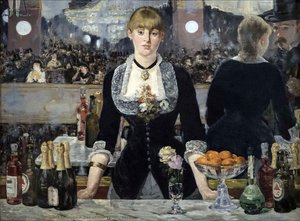 A Bar at the Folies-Bergere - Édouard Manet
Édouard Manet’s 1882 masterpiece, A Bar at the Folies-Bergere, stands as a profound meditation on Parisian modernity and the complexities of urban life. As a pivotal work from the 1880s, it captures the transition from Realism toward the full expression of Impressionism. The painting depicts a barmaid positioned behind a marble counter, her detached gaze offering a sense of melancholy amidst the vibrant energy of a bustling cabaret. This sense of isolation is heightened by the sophisticated use of a mirror behind her, which creates a visual puzzle by reflecting the lively, blurred figures of the patrons, effectively placing the viewer in the role of a spectator in the crowded venue.
Technically, the work is a triumph of light and atmosphere. Manet employs loose, broken brushstrokes to simulate the artificial glow of gaslights, prioritizing the sensory impression of the scene over strict photographic realism. The composition utilizes a flattened perspective and organic shapes—seen in the rounded bottles and glassware—to evoke the immediacy of a fleeting moment. By choosing such a contemporary, unflinching subject, Manet solidified his reputation as a revolutionary, capturing the very essence of late 19th-century social interaction.
Clifftop Walk at Pourville - Claude Monet
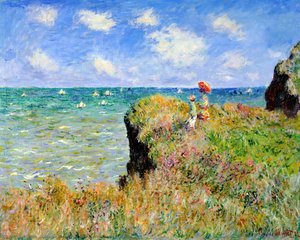 Clifftop Walk at Pourville - Claude Monet
Painted in 1882, Clifftop Walk at Pourville stands as a quintessential example of Claude Monet's Impressionist mastery during the 1880s. This work belongs to the vibrant movement of French art from this decade, a period when Monet frequently sought inspiration in the coastal landscapes of Normandy. The painting captures a serene moment on a grassy cliff overlooking the sea, where figures stroll amidst wildflowers, gazing toward the horizon where distant sailboats dot the water.
Monet’s technique is defined by loose, expressive brushstrokes and a sophisticated use of broken color to convey the transient effects of light and atmosphere. The palette is a lively harmony of celadon greens, deep blues, and warm yellows, creating a sense of immediacy and movement. By prioritizing the visual experience of light over strict realism, Monet achieves a flattened perspective that emphasizes the expansive, tranquil atmosphere of the Pourville coastline. The composition, characterized by organic shapes and a rich layering of oil paint, evokes a profound sense of leisure and a deep, contemplative connection with the natural world.
Pink Villas at Trouville - Gustave Caillebotte
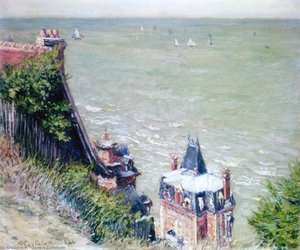 Pink Villas at Trouville - Gustave Caillebotte
Created in 1884, Pink Villas at Trouville serves as a quintessential example of French art from the 1880s, a decade where the boundaries between realism and Impressionism became beautifully blurred. Gustave Caillebotte captures the serene essence of the French coastline through a sophisticated, slightly elevated viewpoint that offers a panoramic vista of the sea and architecture. The composition is defined by a masterful use of atmospheric perspective, where the distant sailboats and the horizon fade into soft, pale tones, creating a profound sense of depth and solitude.
The technique relies on loose, expressive brushwork and the layering of thin washes to build a luminous, textured surface. Rather than focusing on meticulous detail, Caillebotte prioritizes the sensory experience of a diffused, overcast light. His palette is a harmonious blend of muted greens, soft blues, and putty tones, punctuated by the subtle warmth of the coastal structures. This emphasis on capturing fleeting light and the organic movement of waves and foliage exemplifies the innovative spirit of the era, transforming a simple maritime landscape into a contemplative study of peace and nature.
Poplars at Giverny - Claude Monet
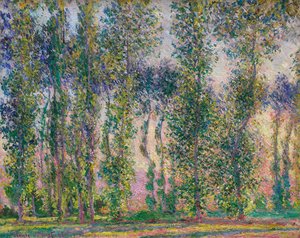 Poplars at Giverny - Claude Monet
Claude Monet's 1887 work, Poplars at Giverny, stands as a quintessential example of the Impressionist movement's evolution during the 1880s. This landscape captures a dense grove of trees bathed in the ethereal, diffused light of either dawn or dusk. Rather than focusing on precise botanical detail, Monet utilizes loose, broken brushwork to prioritize the sensory experience of atmosphere and light. The composition is defined by strong vertical strokes that represent the tree trunks, creating a sense of height and depth as they recede into a soft, horizontal background.
The color palette is a sophisticated symphony of expressive tones; muted yellow-greens on the ground contrast beautifully with the cool blues and purples found in the shadows. A subtle gradient in the sky, transitioning from pale pink to lavender, suggests a fleeting moment in time. This piece reflects Monet's deep connection to the natural world and his practice of en plein air painting, where the goal was to translate the immediate, shifting effects of sunlight onto the canvas. Through this rhythmic application of oil paint, the artist transforms a simple forest scene into a study of movement and tranquility.
Yellow Christ - Eugène Henri Paul Gauguin
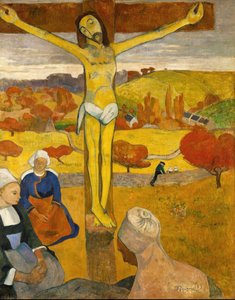 Yellow Christ - Eugène Henri Paul Gauguin
Created in 1889 during his transformative period in Pont-Aven, Brittany, Yellow Christ stands as a profound departure from the Impressionist focus on light and atmosphere. This work marks a pivotal moment in the 1880s, as Gauguin moved toward a more subjective, symbolic visual language. The painting depicts the crucifixion not through traditional piety, but through a lens of spiritual questioning and emotional distance.
The composition is defined by Gauguin’s emerging Synthetist style, characterized by flattened planes of color and bold, expressive outlines reminiscent of stained glass. The central figure of Christ is rendered with an unsettling, non-naturalistic yellowish-green skin tone, contrasting sharply against the muted landscape of rural Brittany. Surrounding the cross, figures in traditional Breton dress—including a woman, a child, and a man—are depicted with simplified, almost mask-like features. Through the use of thick impasto and a rejection of linear perspective, Gauguin replaces realistic depiction with a dreamlike, melancholic intensity. This stylistic shift, moving away from the optical realism of his contemporaries, helped pave the way for the Post-Impressionist movement and the evolution of modern art.
Breakfast (The Dining Room) - Paul Signac
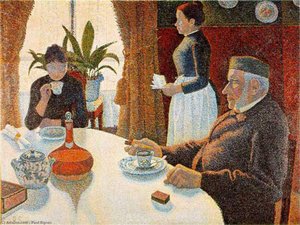 Breakfast (The Dining Room) - Paul Signac
Paul Signac’s 1887 work, Breakfast (The Dining Room), serves as a profound testament to the evolution of French art during the 1880s, marking a transition from the spontaneous gestures of Impressionism toward the disciplined precision of Neo-Impressionism. This piece captures a quiet, reflective moment of bourgeois life, where a family is attended to amidst the morning delicacies of a well-appointed dining room. The scene is anchored by a large window that floods the interior with a luminous, soft light, casting gentle shadows that define the forms of the figures and the tableware.
What distinguishes this work within the 1880s movement is Signac’s pioneering use of the Pointillist technique. Rather than blending pigments on a palette, he applied a mosaic-like application of small, distinct dots of pure color. This scientific approach to light and optics creates a shimmering, textured surface where colors appear to vibrate and blend within the viewer's eye. The palette, dominated by warm walnut tones and bright highlights on reflective surfaces, creates an atmosphere of quiet prestige and nostalgic warmth, showcasing the era's fascination with the intersection of art and optical science.
Boulevard de Clichy 1886 - Paul Signac
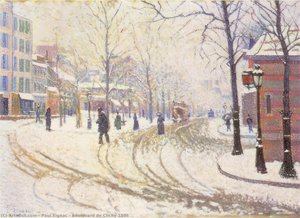 Boulevard de Clichy 1886 - Paul Signac
Paul Signac’s 1886 masterpiece, Boulevard de Clichy, serves as a profound testament to the evolution of French art during the 1880s, marking a pivotal transition toward Neo-Impressionism. This winter scene captures a serene Parisian boulevard, where the bustling energy of the city is hushed by a blanket of snow. Signac utilizes a sophisticated approach to color and light, employing a palette dominated by cool whites, blues, and grays that evoke the crisp, overcast atmosphere of a snowy day. These chilled tones are punctuated by subtle, warm accents of red and yellow within the architectural facades, creating a rhythmic contrast that breathes life into the urban landscape.
The work is particularly significant for its application of the Pointillist technique. Rather than traditional blending, Signac uses short, broken strokes and small, distinct dashes of color that coalesce in the viewer's eye to build depth and luminosity. This method allows the artist to capture the diffused, soft lighting of a winter afternoon while maintaining a sense of movement. Through this meticulous layering of pigment, Signac transforms a simple street scene into a contemplative study of light, texture, and the quiet solitude found within the heart of Paris.
The Luncheon of the Boating Party - Pierre-Auguste Renoir
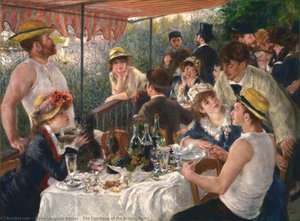 The Luncheon of the Boating Party - Pierre-Auguste Renoir
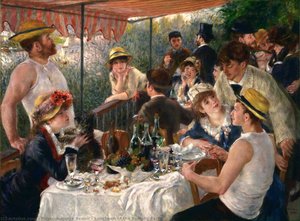
Completed in 1881, Pierre-Auguste Renoir’s The Luncheon of the Boating Party serves as a luminous testament to the social vitality of the 1880s. This masterpiece captures a sun-drenched afternoon on the banks of the Seine, specifically on the balcony of the Maison Fournaise in Chatou. The scene is a vibrant tableau of Parisian leisure, where elegantly dressed figures are gathered around a table laden with food and drink, lost in convivial conversation and carefree laughter.
Renoir’s approach exemplifies the Impressionist movement's obsession with the ephemeral. Rather than pursuing photographic precision, he employs loose, fluid brushstrokes to prioritize the interplay of light and atmosphere. Dappled sunlight filters through a striped awning, creating shimmering highlights on skin and flowing garments. The composition, while dynamic and spontaneous, reveals a sophisticated dialogue with the Old Masters; the arrangement of the banquet echoes the grand festivities of Paolo Veronese, yet Renoir reimagines the theme through a modern, optimistic lens. Through thin glazes of oil paint, he achieves a palpable sense of warmth and movement, transforming a simple social gathering into a timeless celebration of human connection and the joy of the moment.
Conclusion
The 1880s in France represented a transformative era where the boundaries of perception were constantly being redrawn. From the scientific precision of Pointillism to the emotive, swirling colors of Post-Impressionism, these works collectively captured a world in transition. Whether through the soft, atmospheric light of Monet or the structured urban perspectives of Caillebotte, the decade left an indelible mark on the history of visual language, offering a diverse spectrum of light, color, and form.
At Mus3ums.com, we invite you to bring this vibrant period into your own living space. Our master artists specialize in creating museum-quality, hand-painted oil reproductions that honor the specific textures and brushwork of these masterpieces. By choosing a custom commission, you can own a piece of this revolutionary decade, rendered on 100% cotton canvas with the depth and soul of the original works. Explore our full collection and find the perfect window into the brilliance of 19th-century French art.


