


Introduction
The decade following the Great War saw Paris transform into a vibrant crucible of creative liberation, where the rigid boundaries of the previous century dissolved into a kaleidoscope of new visual languages. In the 1920s, French art became a playground for the avant-garde, a period where the tension between tradition and radical modernity fueled a profound evolution in how color, form, and space were perceived. It was an era defined by the rhythmic energy of the machine age, the dreamlike explorations of the subconscious, and a return to structured, poetic simplicity.
This era was shaped by a unique cultural intersection, as artists like Henri Matisse, Fernand Léger, and Pierre Bonnard navigated a world recovering from conflict by reinventing the very essence of the canvas. From the geometric precision of Purism to the lush, emotive textures of Fauvism and the intimate nuances of Post-Impressionism, these works captured a society in transition. The movement was not merely a stylistic shift but a psychological one, reflecting a desire to reconstruct reality through a lens of both order and intense feeling.
Today, these masterpieces remain vital because they represent the foundational DNA of modern aesthetics. They continue to influence how we interpret light, movement, and the human form in contemporary design and fine art. The works presented here serve as a curated journey through this transformative decade, showcasing ten significant pieces that embody the spirit of a France that dared to reimagine the world through bold strokes and revolutionary perspectives.
The Mechanic - Fernand Léger
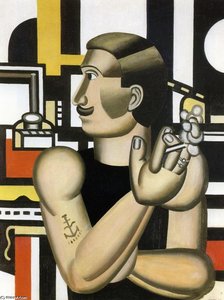 The Mechanic - Fernand Léger
Upon first glance, the eye is immediately struck by a rhythmic fragmentation of the human form, where a seated figure is deconstructed into a series of sharp, angular planes. The composition is a masterclass in geometric abstraction, utilizing a stark interplay of black and white rectangles that create a grid-like structure across the background. Punctuating this monochrome architecture are sudden, vibrant bursts of red and yellow, which draw attention to the subject's posture and the subtle details, such as an anchor symbol on the forearm and the delicate silhouette of a cigarette.
This work is a quintessential example of French art from the 1920s, capturing the era's profound fascination with the machine age and industrial modernity. By blending the analytical rigor of Cubism with the sleek, streamlined sensibilities of Art Deco, the piece reflects the decade's shift toward a new visual language. It moves away from traditional three-dimensional perspective, opting instead for a flattened, intellectualized space that celebrates the dynamism of the modern world through bold lines and mechanical precision.
Three Women - Fernand Léger
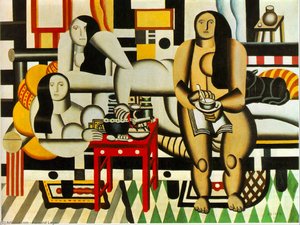 Three Women - Fernand Léger
Fernand Léger's Three Women (1921) stands as a profound testament to the radical shifts defining French art in the 1920s. This masterpiece captures the era's transition from traditional representation toward the rhythmic, mechanical energy of the machine age. The composition features three female figures arranged in a balanced triangular formation, their forms simplified into almost mannequin-like poses that explore the intersection of humanity and geometry.
The technique utilizes a sophisticated fusion of Cubism and early Modernism, characterized by flattened perspectives and fragmented, sculptural volumes. Léger employs a predominantly monochromatic palette of deep espresso, gray, and black, using precise linear drawing and careful shading to define form within a non-realistic, stylized interior. These bold, graphic lines create a sense of detachment and formal elegance, moving away from narrative storytelling to focus on the pure architecture of the image. By stripping the domestic scene of its traditional warmth, Léger captures the pulse of a new, modern reality, where the human figure becomes a component of a larger, dynamic, and highly structured visual rhythm.
le bassin aux nympheas - reflets verts - Claude Monet
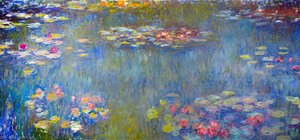 le bassin aux nympheas - reflets verts - Claude Monet
Painted in 1920, Le Bassin aux Nymphéas – Reflets Verts stands as a profound testament to the late-career mastery of Claude Monet. As a quintessential work from the 1920s, it exemplifies how French Impressionism evolved into a more immersive, almost abstract exploration of nature during this decade. The composition is dominated by a tranquil pond, where the surface becomes a canvas for the interplay of light, water, and flora.
Monet utilizes a sophisticated technique of broken color, applying small, rhythmic strokes of pure pigment that allow the eye to optically blend hues. The palette is a lush arrangement of cool blues and deep greens, punctuated by vibrant splashes of pink and yellow from the floating lilies. These organic shapes and soft, flowing lines mimic the gentle ripples of the water, creating a sense of depth through layered color rather than traditional perspective. By prioritizing the sensory impression of a fleeting moment over precise representation, this work captures the ephemeral beauty of the natural world, reflecting the serene and dreamlike atmosphere that defined much of the era's landscape painting.
Nude - Pierre Bonnard
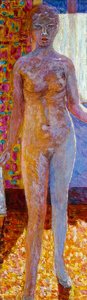 Nude - Pierre Bonnard
Pierre Bonnard’s 1920 Nude serves as a profound example of French art from the 1920s, capturing the era's shift toward deep personal introspection and the exploration of human identity in a post-war world. This vertical composition features a central female figure set against an abstract, fragmented background, where organic shapes and amorphous colors blend into a dreamlike atmosphere. The work exemplifies the transition from Post-Impressionism toward Expressionism, utilizing a palette of muted browns, ochres, and tans that evoke a melancholic and contemplative mood.
The technical execution is remarkably tactile; Bonnard employs thick impasto application, likely with a palette knife, to create a heavily textured surface. This technique, combined with loose, gestural lines and a flattened perspective, emphasizes the surface quality of the canvas over traditional depth. While the figure is rendered with anatomical focus, the surrounding environment dissolves into swirling, atmospheric strokes of cobalt, violet, and pink. Such a mastery of color and texture allows the artist to transform a simple study of the female form into a mystical exploration of vulnerability and quiet contemplation.
The Blue Room - Suzanne Valadon
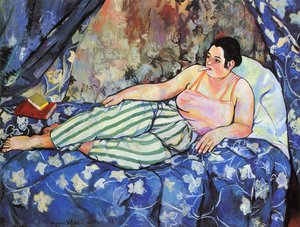 The Blue Room - Suzanne Valadon
Created in 1923, The Blue Room stands as a profound testament to the shifting social landscapes of the 1920s. As a key figure in French Post-Impressionism, Suzanne Valadon utilizes this period to move away from academic idealism, instead capturing a raw, unidealized reality. This work belongs to the 1920s French movement through its rejection of traditional constraints, favoring a modern, psychological depth that reflects the era's evolving perspectives on femininity and independence.
The composition is defined by a striking Fauvist energy, where bold, simplified forms meet a dramatic, almost chaotic interior. Valadon employs a high-contrast palette, pitting intense, cool blues against warm reds and oranges to create a sense of dynamic tension. Her technique is characterized by heavy impasto and gestural, visible brushstrokes that prioritize emotional resonance over precise anatomical detail. The subject—a reclining woman reading and smoking—subverts the traditional male gaze, replacing passive beauty with a sense of intellectual leisure and quiet rebellion. Through distorted perspective and thick, textured layers of oil, Valadon transforms a private moment into a powerful statement of modern existence.
Reflections of Clouds on the Water-Lily Pond (tryptich, center panel) - Claude Monet
 Reflections of Clouds on the Water-Lily Pond (tryptich, center panel) - Claude Monet
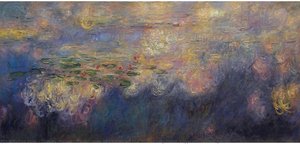
Created in 1920, Reflections of Clouds on the Water-Lily Pond (triptych, center panel) serves as a profound late-career milestone for Claude Monet, anchoring this collection of French artworks of the 1920s. This piece represents the culmination of the artist's lifelong obsession with the shifting qualities of light and atmosphere at his Giverny estate. As a cornerstone of the Impressionist landscape tradition, the work moves beyond simple representation to explore the very essence of perception.
The composition is masterfully structured as a triptych, with the center panel providing an expansive, panoramic view of the pond. Within this central space, lily pads float serenely upon the water, while the surrounding panels expand the narrative to include graceful ducks and the mesmerizing, ethereal dance of clouds reflected in the shimmering depths. Monet’s palette is a sophisticated study in blues and greens, applied with thick, visible brushstrokes that capture the luminosity of sunlight filtering through the foliage. By focusing on the interplay between the water's surface and the sky above, Monet achieves a sense of profound tranquility, turning a specific moment in time into a timeless meditation on nature.
Lemons on a Pewter Plate - Henri Matisse
 Lemons on a Pewter Plate - Henri Matisse
Created in 1926, this work exemplifies the vibrant energy of French art during the 1920s, a decade where the boundaries between object and environment began to blur into a harmonious pulse of color. Matisse utilizes a bold, Fauvist approach to transform a simple still life into a study of light and decorative rhythm. Three lemons, rendered in brilliant yellows, rest upon a cool, grey pewter plate, their skins appearing to glow from within the pigment itself. The composition is set against a pinkish-orange surface and a background of large, abstract white and reddish-brown shapes that suggest a shifting floral pattern.
The tactile quality of the piece is defined by heavy, impasto brushstrokes. Using a palette knife, Matisse creates thick, frosting-like textures and rounded grooves that build volume through color rather than traditional shading. This technique, which echoes the constructive spirit of Paul Cézanne, flattens the perspective to emphasize the emotional impact of the palette. The result is a joyful, compressed space where the warmth of the Mediterranean sun is captured through saturated, contrasting tones and organic, fluid lines.
Reading Woman with Parasol - Henri Matisse
 Reading Woman with Parasol - Henri Matisse
The viewer is immediately drawn to the serene figure of a woman seated in a moment of profound quietude, her gaze fixed intently upon an open book. Bathed in the soft, diffused light of a garden setting reminiscent of the landscapes near Nice, she is defined by a vibrant yellow shawl and a striking red necklace that anchor the composition. The scene is a masterclass in gestural brushwork, where fluid strokes of green and brown create an abstracted foliage that surrounds her, prioritizing the essence of light and atmosphere over rigid anatomical precision.
This work is a quintessential example of French art from the 1920s, marking a sophisticated evolution in Matisse's career. Moving away from the aggressive, non-naturalistic color palettes of his earlier Fauvist period, this 1921 piece demonstrates a shift toward a more harmonious and balanced approach to composition. By utilizing flattened forms and a more controlled, yet still expressive, use of saturated tones, Matisse captures the introspective spirit of the era, transforming a simple moment of leisure into a timeless study of peaceful contemplation and modern solitude.
Portrait of Madame Paul Guillaume with a large hat - André Derain
 Portrait of Madame Paul Guillaume with a large hat - André Derain
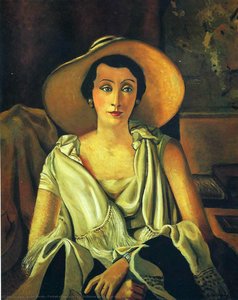
The eye is immediately drawn to the luminous, flowing white gown of the subject, which stands in striking contrast to the warm, amber-hued atmosphere of the studio. In this 1928 masterpiece, André Derain captures Madame Paul Guillaume seated amidst a cluttered, creative sanctuary of canvases and palettes. The composition is defined by a sophisticated interplay of organic curves—from the dramatic sweep of her large straw hat to the soft folds of her sleeves—and the structured, shadowed depth of the artist's workspace. There is a palpable sense of introspection in her serene, slightly melancholic gaze, which invites the viewer into a private moment of contemplation.
This work is a quintessential example of French art from the 1920s, showcasing the evolution of a prominent Fauvist into a master of nuanced, expressive realism. Derain utilizes a rich, tactile impasto technique, where visible brushstrokes create a rhythmic texture across the canvas. The palette, dominated by sun-drenched yellows and earthy tones, reflects the decade's shift toward sophisticated, atmospheric portraiture that balances bold colorism with a profound, quiet prestige.
Madame Caroline Franklin Groult - Jacques-Émile Blanche
 Madame Caroline Franklin Groult - Jacques-Émile Blanche
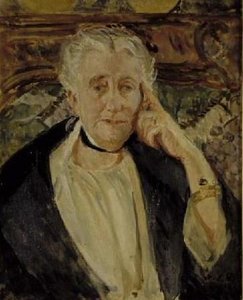
Jacques-Émile Blanche’s 1923 portrait of Madame Caroline Franklin Groult serves as a profound testament to the evolution of French portraiture during the 1920s. Moving through the aftermath of the Great War, this work captures a period of transition, blending the soft sensibilities of Impressionism with a more modern, psychological depth. Blanche utilizes a sophisticated, muted palette dominated by driftwood tones, creams, and deep blacks, which emphasizes the subject's quiet dignity and intellectual presence.
The technical execution is characterized by:
- Luminous Glazing: A masterful application of light that creates a sense of depth and inner radiance.
- Impressionistic Brushwork: Loose, textured strokes that define the contours of her white hair and the folds of her black dress.
- Contemplative Composition: The subject is depicted with her hand to her chin, her gaze directed toward a distant, unseen horizon, suggesting a moment of profound reflection.
By focusing on the sitter's thoughtful expression and the subtle interplay of light within her domestic surroundings, Blanche captures the essence of a woman navigating the shifting social and cultural landscapes of the early 20th century.
Conclusion
The vibrant energy of the 1920s in France was captured through a diverse spectrum of visionaries, from the structural dynamism of Léger and the bold color theories of Matisse to the intimate, atmospheric nuances of Bonnard. Each of these masterpieces reflects a pivotal moment in art history, where the boundaries of form, light, and emotion were constantly being redefined. Whether through the soft textures of Impressionist legacies or the sharp edges of modernism, these works collectively define an era of unparalleled creative liberation.
At Mus3ums.com, we invite you to bring this transformative period into your own living space. Our master artists specialize in creating museum-quality, hand-painted oil reproductions that capture the authentic soul, texture, and brushwork of these iconic French treasures. You can explore our full collection and choose a piece that resonates with your personal aesthetic, allowing the spirit of 1920s France to live on within your home.


