Introduction
The 1930s in Switzerland represented a profound intersection of avant-garde experimentation and a search for new visual languages amidst a shifting European landscape. During this decade, Swiss-born artists became central figures in the evolution of modernism, moving away from traditional representation toward abstraction, surrealism, and the structural rigor of the Bauhaus influence. This era was defined by a unique tension between the organic and the geometric, as creators sought to reconcile the human form with the increasingly mechanized and fragmented reality of the twentieth century.
The period saw the emergence of highly influential figures such as Paul Klee, whose lyrical, symbolic abstractions redefined the relationship between color and subconscious thought, and Alberto Giacometti, whose sculptural and painterly explorations of space and isolation began to take their iconic, attenuated forms. Alongside them, the architectural and design philosophies of Le Corbusier and the rhythmic, geometric compositions of Sophie Taeuber-Arp challenged the boundaries between fine art and functional form. These artists did not merely paint; they reimagined the very essence of space, light, and the human presence.
Today, these works remain vital because they capture the moment when art broke free from the constraints of the past to embrace the complexity of the modern psyche. Their influence persists in contemporary design, architecture, and abstract expressionism, serving as a testament to the power of intellectual and aesthetic rebellion. The following selection highlights ten significant works from this transformative decade, offering a journey through the diverse and sophisticated visions that emerged from the Swiss creative spirit."
To Parnassus - Paul Klee
 To Parnassus - Paul Klee
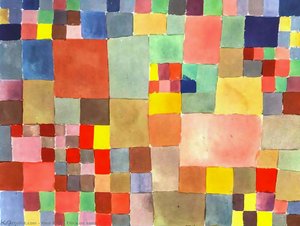
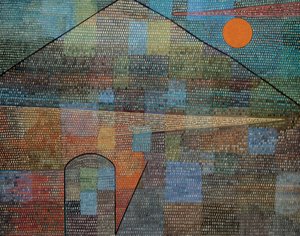
Paul Klee’s 1932 masterpiece, To Parnassus, serves as a profound exemplar of Swiss abstraction during the 1930s, capturing the era's shift toward rhythmic, symbolic landscapes. This work exemplifies the decade's fascination with the intersection of geometry and mysticism. The composition is defined by a meticulous, mosaic-like texture, where the canvas is fragmented into tiny, colorful tiles that evoke the precision of stained glass or a pixelated dreamscape.
At the heart of this stylized vista lies a luminous orange celestial body, casting a warm glow over a structured landscape of triangles and arches. These geometric forms—reminiscent of mountains or portals—suggest a spiritual ascent toward the mythological heights of Parnassus. Through a sophisticated use of color theory, Klee balances warm reds and oranges against cool purples and blues, creating a sense of depth within a flattened, layered perspective. The piece reflects the broader 1930s movement toward Abstract Expressionism, where the artist’s scientific approach to color meets a deeply contemplative, almost surrealist emotional tone, transforming a simple landscape into a complex narrative of enlightenment and transition.
Legend of the Nile - Paul Klee
 Legend of the Nile - Paul Klee
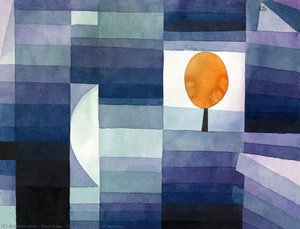
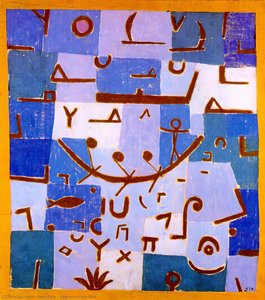
Upon first encounter, Legend of the Nile presents a vibrant, fragmented tapestry of blue and purple hues, where the eye is immediately drawn to a dense arrangement of overlapping rectangular blocks. These geometric forms create a flattened, rhythmic space populated by stylized human figures and celestial motifs like crescent moons and stars. Scattered throughout the composition are hieroglyphic-like symbols that evoke the mythic essence of ancient Egyptian spirituality, weaving a narrative of life and water through a complex, layered visual language.
Created in 1937, this work is a quintessential example of Swiss-born Paul Klee’s mature period during the 1930s. It exemplifies the era's fascination with synthesizing diverse avant-garde movements, blending the structural logic of Cubism with the emotional intensity of Expressionism. Klee’s scientific approach to color theory is on full display here, using a sophisticated palette of deep blues and warm accents to establish a sense of mystical movement. The piece stands as a profound testament to the decade's exploration of rhythmic abstraction and the intersection of ancient mythology with modern, non-representational form.
Comedians' Handbill - Paul Klee
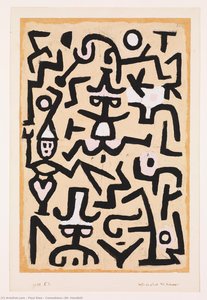 Comedians' Handbill - Paul Klee
Created in 1938, Comedians' Handbill stands as a quintessential example of the rhythmic abstraction that defined the Swiss-born Paul Klee's output during the 1930s. This gouache work, currently held at The Metropolitan Museum of Art, exemplifies the era's shift toward a sophisticated fusion of expressionism, cubism, and surrealism. Klee, a master of color theory, utilizes the opaque qualities of gouache to construct a flattened picture plane that rejects traditional perspective in favor of visual rhythm.
The composition is a playful arrangement of organic, simplified shapes that suggest performers or theatrical figures. These forms are delineated by bold, meandering black lines that create a sense of movement and interaction across a warm, cream-toned background. Subtle pink accents provide rhythmic highlights, while the overlapping shapes evoke a sense of whimsical energy and theatricality. By stripping the subject matter down to its essential, abstract essence, Klee captures a sense of amusement and playfulness, making this piece a vital representative of the avant-garde movements flourishing in the late 1930s.
La Kash-Ne - Paul Klee
 La Kash-Ne - Paul Klee
Created in 1933, La Kash-Ne serves as a profound testament to the rhythmic abstraction and symbolic language that defined the Swiss-German influence on the era's modernism. This work belongs to the 1930s group through its departure from traditional representation, favoring a deconstructed, totemic form that resonates with the somber, mystical atmosphere of the decade. The composition is built upon an interplay of large, interlocking organic and geometric shapes, suggesting a mask-like presence that exists within a flattened, non-traditional perspective.
The piece is characterized by a heavy, tactile presence, utilizing a monochromatic palette that emphasizes tonal contrast over color. The artist employs a technique of thick, impasto-like layering, where semi-gloss opaque paint and traces of graphite create a rugged, sculptural landscape of pigment. Visible brushstrokes and deliberate scrapes across the surface allow light to catch the raised edges of the medium, creating a shifting, physical relief. In this work, the subject matter is found not in a recognizable figure, but within the very texture and structural depth of the medium itself, reflecting a sophisticated, scientific approach to the architecture of form.
Botanical Theater - Paul Klee
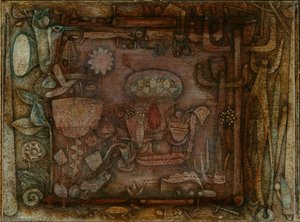 Botanical Theater - Paul Klee
In the quiet, evocative realm of Paul Klee’s Botanical Theater, painted in 1934, the boundaries between reality and imagination dissolve into a mesmerizing dance of color and line. This work exemplifies the sophisticated abstraction characteristic of Swiss-born artists during the 1930s, moving away from traditional representation toward a more rhythmic, subconscious exploration of form.
The composition is structured around a central rectangular area, evoking the intimacy of a puppet theater or a miniature diorama. Within this frame, Klee eschews traditional perspective, instead utilizing a layered arrangement of biomorphic shapes to create depth. Using a delicate combination of watercolor and gouache, he employs a palette of earthy ochres, tans, and grays, punctuated by whimsical splashes of pink, yellow, and phthalo green. These colors do not serve a realistic purpose but rather create a harmonious, ethereal atmosphere. Through this interplay of thin, delicate lines and bold geometric elements, Klee transforms a botanical theme into a surrealist performance, where organic life acts out a silent, dreamlike ballet on a stylized stage.
Hot Pursuit - Paul Klee
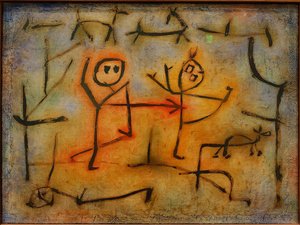 Hot Pursuit - Paul Klee
The eye is immediately drawn to a frantic, rhythmic dance of shadows and light. Thick, dark black lines slash across the canvas, defining skeletal, stick-figure entities that seem to scramble through an atmospheric haze. A glowing orange aura clings to these central figures, casting a warm, flickering light against a backdrop of muted greys, ochre, and burnt sienna. This 1939 work captures a sense of primitive energy, where the boundaries between the physical and the symbolic dissolve into a private vocabulary of signs and enigmatic forms.
As a masterpiece created in 1939, this work exemplifies the profound shift in Swiss-born Paul Klee's output during the 1930s. Moving away from his earlier whimsicality, his late-period style embraced a more somber, heavy, and profound abstraction. The gestural spontaneity of the lines and the tactile, layered texture reflect the tension of the era, transforming simple shapes into a rhythmic, almost percussive struggle. Through his scientific mastery of color theory, Klee utilizes earthy tones to communicate a sense of heat and movement, creating a shallow, layered space that feels both ancient and deeply modern.
Shells and Flowers - Sophie Taeuber-Arp
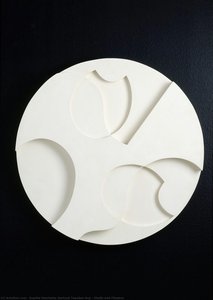
Created in 1938, Shells and Flowers serves as a profound testament to the radical evolution of Swiss modernism during the 1930s. Sophie Taeuber-Arp, a monumental figure born in Davos, moved beyond her early Dadaist provocations to embrace a sophisticated language of geometric abstraction. This work exemplifies the era's shift toward Constructivism, where the artist sought to find order and rhythm within the complexities of the universe.
The piece is a masterful exercise in minimalist geometric abstraction, utilizing a radial composition that emanates from a central point. Through the meticulous technique of paper cutting and intricate folding, Taeuber-Arp creates a series of concentric, cut-out circles that play with the concept of negative space. The stark, high-contrast palette—predominantly white against a deep, dark background—emphasizes the precision of the clean lines and the delicate, layered texture of the paper. By fusing organic, biomorphic inspirations with uncompromising mathematical symmetry, Shells and Flowers captures the 1930s spirit of exploring interconnectedness and the rhythmic cycles of nature through a purely abstract, contemplative lens.
Disagreeable Object - Alberto Giacometti
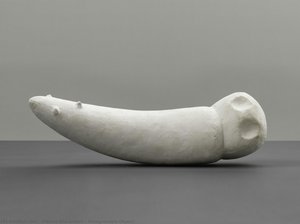 Disagreeable Object - Alberto Giacometti
Upon first encounter, the eye is drawn to the stark, enigmatic silhouette of Disagreeable Object, a work that commands attention through its unsettling simplicity. The sculpture presents an elongated, organic form characterized by smooth, continuous curves that flow without the interruption of sharp angles. Resting upon a muted, dark gray plane, the off-white, stone-like mass appears to emerge from a void, its surface subtly marked by the traces of its creation. This interplay of light and shadow across its rounded geometry creates a visual rhythm that is simultaneously calming and restless.
As a seminal work from 1931, this piece is a quintessential representative of Swiss art from the 1930s, capturing the era's profound shift toward Surrealism and early Modernism. Through this abstraction, Alberto Giacometti moves away from traditional representation to explore the tension between presence and absence. The work’s ambiguous, almost phallic shape challenges conventional notions of beauty, embodying the existential anxieties and the fascination with elemental materiality that defined the sculptural language of this transformative decade.
Armchair - Le Corbusier
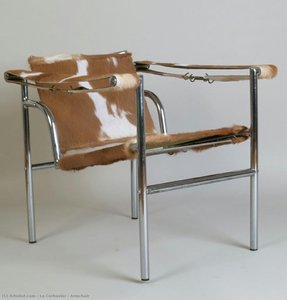 Armchair - Le Corbusier
Designed in 1932, the LC2 Armchair serves as a definitive expression of Swiss-French modernism, a movement that reshaped the visual language of the 1930s. This piece exemplifies the decade's shift toward functionalism, moving away from historical ornamentation toward a rigorous, architectural approach to everyday objects. The design is defined by a sophisticated interplay of industrial materials and geometric precision, reflecting the era's fascination with the machine age and structural clarity.
The palette is a study in textural and tonal contrast, pairing the cool, reflective silver of the chrome steel tubing with the warm, organic tones of cowhide leather upholstery. This juxtaposition of the industrial and the natural is central to the modernist ethos of the period. The construction relies on a framework of bent plywood and tubular steel, where straight lines and precise angles create a stable, sculptural silhouette. By distilling the chair into its essential components—structure, material, and form—Le Corbusier achieved a sense of minimalist elegance that remains a cornerstone of 1930s design theory.
Caught Hand - Alberto Giacometti
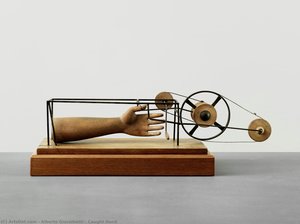 Caught Hand - Alberto Giacometti
Upon encountering Caught Hand, the viewer is immediately struck by the unsettling juxtaposition of organic anatomy and mechanical precision. The sculpture presents a hand, rendered with a delicate yet skeletal strength, appearing to grasp or be ensnared by clock faces. This surreal arrangement of wood and metal creates a profound visual metaphor, capturing a moment of existential tension where the human touch meets the rhythmic, cold ticking of eternity. The interplay between the tactile, textured wood and the rigid clock elements evokes a sense of vulnerability and the relentless march of time.
As a quintessential work from the 1930s, this piece exemplifies the radical shifts of the Surrealist movement that defined the era. Created by the Swiss sculptor Alberto Giacometti, the work reflects his early exploration of the subconscious and the irrational. By integrating temporal instruments directly into the anatomy of the hand, Giacometti bypasses rational thought to tap into the psychological depths of the human condition. This masterpiece stands as a testament to the era's fascination with the tension between biological reality and the abstract, inevitable progression of time.
Conclusion
The Swiss masters of the 1930s collectively redefined the boundaries of visual language, moving from the rhythmic abstractions of Paul Klee to the stark, existential silhouettes of Alberto Giacometti. Whether through the geometric precision of architectural modernism or the playful, patterned compositions of Sophie Taeuber-Arp, these works represent a decade of profound experimentation and structural clarity. Each piece serves as a vital link in the evolution of modernism, capturing a unique moment where Swiss precision met avant-garde intuition.
For those looking to integrate these historical movements into a contemporary setting, our full collection offers a gateway to these transformative eras. At Mus3ums.com, we allow you to bring the essence of these masterpieces into your own home through our museum-quality, hand-painted oil reproductions, meticulously crafted to preserve the texture and soul of the original works.