

Introduction
The dawn of the twentieth century in Germany marked a period of profound psychological and aesthetic upheaval, a time when the traditional boundaries of representation began to dissolve under the weight of rapid industrialization and shifting social structures. The artworks produced between 1900 and 1909 serve as a visual record of this tension, capturing a transition from the lingering elegance of late Symbolism to the raw, fractured energy of early Expressionism. It was a decade defined by a restless search for truth, where artists moved away from mere imitation of the natural world to explore the internal landscapes of the human soul.
During this era, German art became a battlefield of ideas. While some masters continued to refine the grand, dramatic traditions of portraiture and myth, a new generation of painters began to prioritize emotional intensity and color over anatomical precision. This period saw the emergence of movements that would eventually reshape the global perception of modern art, as creators sought to express the anxieties and spiritual hunger of a world on the brink of massive transformation. The brushwork became more urgent, the palettes more dissonant, and the subjects more introspective.
These works remain vital today because they represent the birth of the modern visual language. They challenge the viewer to look beyond the surface and confront the complexities of human existence, making them as relevant in a contemporary context as they were in the studios of Berlin and Munich a century ago. By examining these pieces, one gains insight into the very moment when art broke free from the constraints of the past to embrace the chaotic beauty of the modern age. The following selection highlights ten significant works that define this transformative decade, showcasing the diverse voices that shaped the German avant-garde.
Great Scene of Agony - Max Beckmann
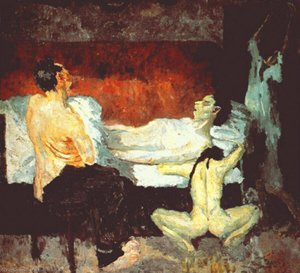 Great Scene of Agony - Max Beckmann
Painted in 1906, Great Scene of Agony serves as a profound testament to the psychological shifts occurring in German art during the first decade of the 1900s. Max Beckmann, a seminal figure in Expressionism, utilizes this work to move beyond mere representation, instead capturing the raw, visceral essence of the human condition. The composition features two nude male figures within a dimly lit, ambiguous interior; one figure reclines in a state of apparent exhaustion or vulnerability, while another leans over him in a gesture that oscillates between caregiving and profound intimacy.
Beckmann’s technique is defined by a heavy, tactile impasto that lends the canvas a rugged, gestural energy. He employs a somber, muted palette of rosy browns, deep reds, and dark greens, which heightens the work's melancholic and dramatic atmosphere. Rather than relying on traditional linear perspective, the artist uses overlapping organic forms and dramatic, unseen lighting to create a sense of claustrophobic depth. This stylistic approach—prioritizing emotional intensity and subjective experience over realistic accuracy—marks a definitive departure from academic traditions, signaling the arrival of a modern, introspective era in German painting.
Wounded Amazon - Franz von Stuck
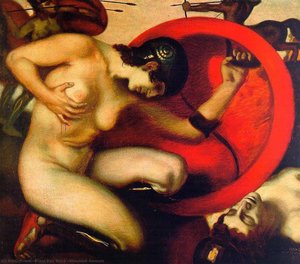 Wounded Amazon - Franz von Stuck
In 1904, Franz von Stuck produced Wounded Amazon, a quintessential example of German Symbolism from the early 1900s. This work captures the artist's fascination with mythic drama and the psychological depth of the female form. The composition centers on a nude Amazon in a state of profound vulnerability, kneeling amidst the chaos of a battlefield. Her body bears a visible wound, and her defensive posture—arms raised to shield her face—conveys an intense sense of distress and survival.
The painting is defined by its unsettling, dynamic tension. A large, vibrant red circle looms above the central figure, serving as an ominous, almost surreal focal point that contrasts sharply with the organic, flowing lines of the body. In the background, the struggle continues with the silhouettes of centaurs and other warriors, adding to the turbulent atmosphere. Stuck employs a heavy, impasto-like application of oil paint, using thick, expressive layers and deep shadows to create a tactile, dreamlike reality. This masterful use of light and texture ensures the piece remains a powerful testament to the dramatic aesthetic of the decade.
Portrait of the Artist's Wife with Hat - August Macke
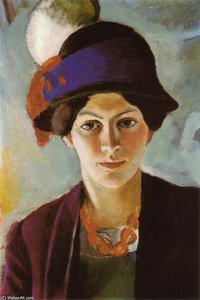 Portrait of the Artist's Wife with Hat - August Macke
Painted in 1909, Portrait of the Artist's Wife with Hat serves as a profound testament to the evolving aesthetic of German art during the first decade of the 20th century. As a key figure associated with the German Expressionist movement and the Der Blaue Reiter group, August Macke utilizes this work to bridge the gap between traditional portraiture and modern rhythmic form. This piece belongs to the 1900s group through its masterful capture of the era's transition toward luminous, emotive color palettes.
The composition centers on a woman radiating quiet confidence, her direct gaze creating an intimate connection with the viewer. Dressed in a striking purple jacket and adorned with elegant necklaces, she is framed by a soft, inviting light that suggests a moment of domestic tranquility. A subtle inclusion of a ball in the upper corner adds a layer of narrative intrigue, perhaps hinting at a social occasion. Through his expert application of oil paint, Macke achieves a balance of realistic detail and the vibrant, rhythmic essence that would define his later, more abstract landscapes. The work remains a captivating study of grace and light.
Portrait of a young woman with red hat - Paula Modersohn-Becker
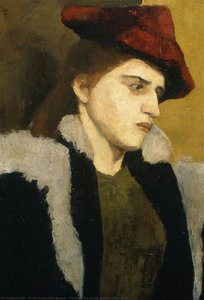 Portrait of a young woman with red hat - Paula Modersohn-Becker
Created in 1900, Portrait of a young woman with red hat stands as a profound testament to the evolving sensibilities of German art at the turn of the century. As a pioneer of German Expressionism, Paula Modersohn-Becker utilized this piece to move beyond mere likeness, focusing instead on the psychological depth of her subject. The composition is defined by a striking tension between the subject's intense, direct gaze and the bold, saturated red of her hat, which serves as a focal point against the more subdued background elements.
The work exemplifies the stylistic shifts occurring in Germany during the 1900s, acting as a vital bridge between the observational nature of Impressionism and the emotive, raw power of Expressionism. By emphasizing the inner life and emotional state of the sitter, Modersohn-Becker broke away from traditional portraiture. The presence of figures in the background adds a layer of spatial complexity, yet the viewer's attention remains anchored to the woman's captivating expression, marking a significant moment in the development of modern German portraiture.
Deer in the Reeds - Franz Marc
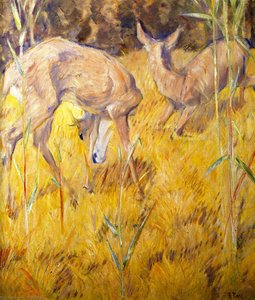 Deer in the Reeds - Franz Marc
Franz Marc's 1909 work, Deer in the Reeds, serves as a profound testament to the evolution of German Expressionism during the first decade of the 20th century. This oil on canvas captures a pivotal moment in Marc's transition from representational realism toward a more spiritual, symbolic abstraction. The composition centers on two deer amidst a dense thicket of tall grasses, utilizing organic lines and rounded forms to evoke a sense of tranquil contemplation.
The artist employs a rich, warm palette dominated by khaki, golden yellows, and deep greens, suggesting the soft, directional light of a late afternoon. Marc’s technical mastery is evident in the heavy impasto technique, where thick, tactile brushstrokes create a rhythmic texture in the reeds and the animals' fur. This emphasis on texture and color over precise anatomical detail reflects the broader movement's desire to express internal emotion rather than mere external reality. By simplifying shapes and prioritizing the harmony of the natural world, Marc creates a serene encounter that bridges the gap between the physical landscape and the spiritual essence of nature.
Small Horse Study I - Franz Marc
 Small Horse Study I - Franz Marc
In this 1905 work, Franz Marc provides a profound glimpse into the early stages of German Expressionism, a movement that sought to move beyond mere representation to uncover the spiritual essence of the natural world. Small Horse Study I captures two horses emerging from a somber, wooded thicket, where the animals serve as vessels for raw energy and purity rather than mere subjects of study.
The composition is defined by a dramatic interplay of light and shadow. One form sits prominently in the foreground, its muscularity articulated through heavy strokes of orange, ochre, and burnt sienna. Behind a tree trunk, a second shape remains partially obscured, creating an intimate, private atmosphere. The palette is grounded in deep blacks, charcoal grays, and forest greens, which contrast sharply with the vibrant, flickering warmth of the horses' flanks. Through vigorous, gestural brushwork and thick impasto textures, Marc avoids precise outlines, opting instead for organic shapes that convey physical weight and movement. This approach allows the artist to communicate deep emotion, using color and texture to reveal the pulse of life hidden within the shadows of the forest.
Marcella - Ernst Ludwig Kirchner
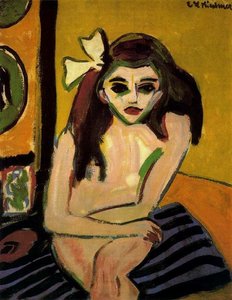 Marcella - Ernst Ludwig Kirchner
Created in 1909, Marcella serves as a profound testament to the shifting paradigms of German art during the first decade of the 20th century. In this oil on canvas, Ernst Ludwig Kirchner moves decisively away from traditional naturalism, embracing the raw, subjective language of Expressionism. The portrait of the young woman, Lina Franziska Fehrmann, is defined by a deliberate distortion of form and a flattened perspective that rejects classical spatial depth.
The composition is dominated by a vibrant, almost claustrophobic yellow plane that presses against the subject, heightening a sense of psychological tension. Kirchner utilizes
- Bold, angular lines
- Simplified, abstracted shapes
- A high-contrast palette of yellows, greens, and deep blacks
Japanisches Theater (Japanese Theatre) - Ernst Ludwig Kirchner
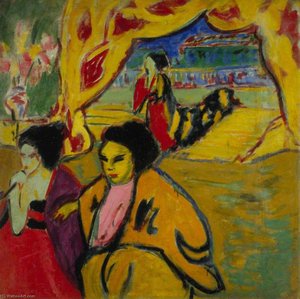 Japanisches Theater (Japanese Theatre) - Ernst Ludwig Kirchner
Upon first glance, the viewer is thrust into a vibrant, crowded stage setting defined by a sense of frantic, electric energy. The eye is immediately drawn to the striking interplay of intense reds, brilliant yellows, and deep, moody blues, which create a psychological tension far removed from traditional realism. A central female figure, accented by a pink scarf, appears caught in a moment of dramatic observation, while the presence of an umbrella and various performers in dynamic poses suggests a lively, perhaps unsettling, theatrical performance. The composition utilizes jagged, angular forms and a flattened perspective to heighten the sense of movement and immediacy.
As a seminal work from 1909, this piece is a quintessential example of German art from the 1900s, marking a pivotal shift toward German Expressionism. It captures the restless spirit of a decade defined by rapid societal upheaval and industrialization. By eschewing naturalistic color in favor of emotional intensity, Kirchner’s work exemplifies the era's movement to reveal the raw, subjective truths of the human psyche through bold, visible brushstrokes and a rejection of classical harmony.
Half-length portrait of an old farmer - Paula Modersohn-Becker
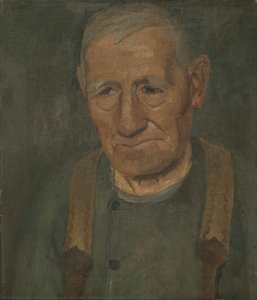 Half-length portrait of an old farmer - Paula Modersohn-Becker
Paula Modersohn-Becker's 1903 work, Half-length portrait of an old farmer, serves as a profound meditation on aging and the quiet dignity of rural existence. Created during the first decade of the 20th century, this piece exemplifies the shift toward the raw, emotive sensibilities that would define German art in the 1900s. Executed in tempera on canvas, the painting eschews the polished academicism of the previous century in favor of an intimate, unvarnished observation of the human condition.
The subject, an elderly man with white hair and glasses, is rendered with a striking sense of stillness. Modersohn-Becker utilizes a muted palette of earthy browns, ochres, and subtle blues to anchor the composition, creating a melancholic yet elegant atmosphere. Rather than offering a romanticized view of peasantry, she focuses on the essential character of the individual, using bold forms and a restrained color scheme to capture a sense of timelessness. This honest approach to portraiture marks her as a pioneering figure of early Expressionism, bridging the gap between traditional representation and the modern psychological depth characteristic of German masters from this era.
Prince Regent Luitpold of Bavaria (1821–1912) - Franz von Lenbach
 Prince Regent Luitpold of Bavaria (1821–1912) - Franz von Lenbach
The eye is immediately drawn to the face of Prince Regent Luitpold of Bavaria, emerging from a profound sea of shadow. The portrait is a masterclass in chiaroscuro, where light falls from above to catch the ridges of a weathered brow and the deep, etched lines of age. His beard, a thick and tactile landscape of white and grey, is rendered with heavy, textured impasto that suggests the frost on stone. This 1902 work exemplifies the German artistic output of the 1900s by capturing the solemnity and social gravity of the era through a lens of classical realism. As a prominent figure in Munich's cultural landscape, the Prince is depicted not merely as a ruler, but as a man shaped by history, his dignity emphasized by a restrained palette of espresso, deep browns, and muted grays.
- The sharp, angular lines of the collar provide a structural contrast to the organic curves of the face.
- Visible layering of pigments creates a sense of physical weight in the subject's attire.
- The tight, bust-shot composition forces an intimate encounter with the subject's somber presence.
Conclusion
The German art of the 1900s represents a profound era of transition, where the traditionalism of the late 19th century collided with the radical, fractured energy of modernism. From the expressive, psychological depth of the early Expressionists to the vibrant, rhythmic abstractions that sought to capture the essence of color and form, these works collectively redefined the visual language of Europe. Whether through the intense emotionality of a portrait or the structural boldness of a landscape, each piece contributed to a movement that challenged the boundaries of perception and paved the way for the avant-garde revolutions of the century to follow.
For those looking to bring this transformative period into their own space, Mus3ums.com offers a way to experience these masterpieces through our museum-quality, hand-painted oil reproductions. Each piece is meticulously crafted by skilled artists on 100% cotton canvas, ensuring the tactile depth and visible brushstrokes that define these historical movements. You can explore the breadth of this era by browsing our full collection and find a piece that resonates with your personal aesthetic.