

Introduction
The 19th century in Switzerland was a period of profound visual transformation, where the dramatic topography of the Alps met the shifting currents of European Romanticism and Symbolism. As the nation navigated its identity through the 1800s, its painters captured a unique intersection of the sublime and the intimate, moving from the meticulous precision of landscape studies to the deep, psychological explorations of the human condition. This era saw artists grappling with the tension between the awe-inspiring power of nature and the burgeoning complexities of modern life, creating a body of work that is as much about the spirit of the landscape as it is about the evolution of light and color.
From the sweeping, atmospheric vistas that defined the Romantic movement to the more structured, symbolic compositions of the late century, these artists were deeply connected to the cultural pulse of Europe. They did not merely document their surroundings; they interpreted them, often blending local Swiss traditions with the avant-garde movements emerging in Paris and beyond. This period produced a diverse spectrum of styles, ranging from the highly detailed naturalism of topographical views to the expressive, almost proto-modernist strokes that anticipated the coming century.
Today, these masters remain vital for their ability to evoke a sense of timelessness and emotional depth. Their works serve as a bridge between the classical traditions of the past and the expressive freedoms of the modern era, offering a profound look at how light, shadow, and terrain can be used to express the sublime. By examining the lives and legacies of these ten essential figures, we gain a deeper understanding of the visual language that shaped Swiss art and continues to resonate in the global art historical canon.
Arnold Böcklin
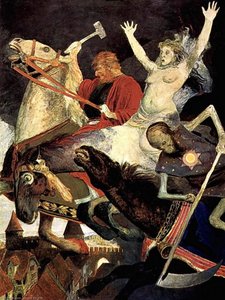 La Guerre - Arnold Böcklin
Born in Basel in 1827, Arnold Böcklin stands as a towering figure among 19th century Swiss painters, a master whose work bridged the gap between academic discipline and the profound mysteries of the human soul. After training at the Düsseldorf Academy, his vision was fundamentally transformed by the atmosphere of Italy, where he moved away from mere landscape painting toward a deeply allegorical and Symbolist style. His canvases are characterized by a tension between the tangible world and the spectral, often utilizing mythological figures to explore themes of mortality and the subconscious.
A visitor can recognize a Böcklin at a glance through his dramatic use of light and shadow, often favoring a palette of deep, somber hues punctuated by intense accents of red or gold. His brushwork is expressive, frequently employing thick impasto to create a sense of movement and emotional weight. This is vividly realized in his 1896 masterpiece, La Guerre, where he depicts a chaotic, layered struggle of human and supernatural figures. Through such works, Böcklin transformed the landscapes of his Swiss heritage and the classical echoes of Rome into haunting, dreamlike realms that remain central to the Symbolist movement.
Henry Fuseli
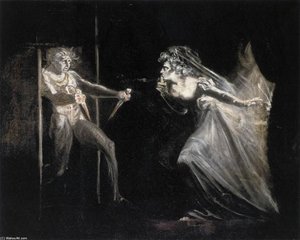 Lady Macbeth with the Daggers - Henry Fuseli
A visitor can immediately recognize the work of Henry Fuseli by its profound sense of psychological tension and the haunting, supernatural atmosphere that defines his Romantic style. His canvases often feature dramatic, almost theatrical compositions where light and shadow engage in a violent struggle. He possessed a unique ability to translate the internal turbulence of the human psyche into visual form, utilizing a gestural brushwork that often feels as fevered as a dream or a nightmare.
Born in Zürich, Switzerland, Fuseli’s artistic journey was shaped by a classical education and a brief, formative period serving as a pastor before he fully committed to the visual arts. His time in Italy, where he adopted the Italianized name Fuseli, allowed him to absorb the monumental power of Michelangelo, a fascination that would later define his approach to the human form. As a Swiss-born master who achieved immense prominence in the early 19th century, his work serves as a bridge between classical structure and the emotional intensity of the Romantic era.
In his representative work, Lady Macbeth with the Daggers, Fuseli demonstrates his mastery of chiaroscuro. The painting captures a descent into madness, using stark, accusatory light to carve the central figure from an impenetrable, somber gloom, perfectly embodying the sublime terror of Shakespearean drama.
Ferdinand Hodler
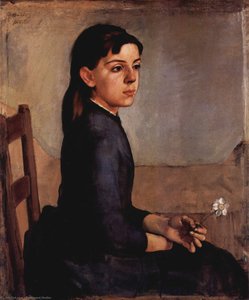 Portrait of Louise Delphine Duchosal - Ferdinand Hodler
A central figure among 19th century Swiss painters, Ferdinand Hodler (1853–1918) transformed the visual language of his era through a profound synthesis of technical precision and philosophical depth. Born in Bern, his early life was marked by the loss of his father and two brothers to tuberculosis, a personal tragedy that infused his work with a recurring meditation on mortality. After beginning his journey as a decorative painter, he moved to Geneva in 1871, where he transitioned from the meticulous realism of Swiss landscapes toward a more subjective, symbolic expression.
Hodler is most renowned for his theory of parallelism, a revolutionary approach that sought to capture the rhythmic, interconnected patterns found in nature and the human form. This method moved away from traditional perspective, instead using superimposed planes and rhythmic tonal variations to create a hypnotic sense of depth. His 1885 masterpiece, Portrait of Louise Delphine Duchosal, exemplifies this evolution. In this work, he utilizes a somber, muted palette to explore the human condition, using light and shadow to elevate a simple likeness into a profound Symbolist study. His innovative vision would eventually leave a lasting imprint on modern masters like Edvard Munch.
Félix Vallotton
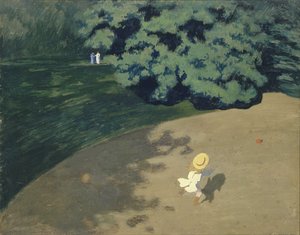 The Balloon - Félix Vallotton
Born in Lausanne in 1865, Félix Vallotton represents a vital link between Swiss origins and the radical avant-garde movements of the late 19th century. His journey began when he left the conservative, Protestant environment of his Swiss upbringing to pursue art in Paris, enrolling at the Académie Julian in 1882. Under the guidance of masters such as Jules Joseph Lefebvre and Gustave Boulanger, he developed a rigorous technical discipline that would later define his unique aesthetic.
Vallotton is most notably recognized for his association with the Nabis group, where he was often referred to as le Nabi étranger due to his Swiss roots. This outsider status contributed to a highly distinctive style characterized by flattened perspectives, muted color palettes, and a sense of clinical detachment. His representative work, The Balloon (1899), exemplifies this mastery. In this piece, he moves beyond mere Impressionism to capture a fleeting, nostalgic moment on a sun-drenched beach. Through a precise manipulation of light and shadow, he transforms a simple scene of a woman, a dog, and a child into a complex, evocative tableau that captures the essence of the fin de siècle.
Louis Buvelot
 Yarra flats - Louis Buvelot
Born in Morges, Switzerland, in 1814, Louis Buvelot represents a fascinating chapter of 19th-century Swiss art, characterized by a life of global movement. While many of his contemporaries remained within the European tradition, Buvelot’s journey took him from Switzerland to Brazil and eventually to Melbourne, Australia, in 1864. This migration allowed him to transplant his Swiss-trained sensibilities into a completely new hemisphere, ultimately earning him the title of the "father of Australian landscape painting."
His ability to merge European technical precision with the raw essence of the Australian bush left a profound mark on the Heidelberg School. In his evocative work Yarra flats (1871), Buvelot demonstrates a radical departure from traditional expansive vistas. Instead, he focuses on the intimate, atmospheric details of scrub and eucalyptus trees, capturing the subtle play of light and seasonal shifts through a masterful en plein air approach. This focus on temporal effects and the immediate environment allowed him to "begin the real painting of Australia," bridging the gap between his Swiss origins and the birth of Australian Impressionism.
Elizabeth Thompson
 The 28th Regiment at Quatre Bras - Elizabeth Thompson
Born in 1846, Elizabeth Thompson, later known as Lady Butler, remains a fascinating figure in the landscape of 19th-century painters from Switzerland. While her life and career were deeply intertwined with the British military, her Swiss origins place her within this specific European artistic lineage of the 1800s. Thompson was a specialist in the genre of historical military painting, driven by a desire to portray the pathos and heroism of combat rather than mere glory. This profound empathy is palpable in her representative work, The 28th Regiment at Quatre Bras.
In this 1875 masterpiece, she moves beyond simple battlefield sketches to achieve a visceral, gritty realism. By utilizing meticulous research and complex layering of oil glazes, she reconstructs the chaotic energy of the 1815 engagement with startling accuracy. The painting avoids romanticized tropes, instead focusing on the raw, somber reality of the soldiers' experience. Through her technical mastery, Thompson captures a frozen moment of valor, ensuring that the human element of historical conflict remains the central, moving focus of her canvas.
Karl Bodmer
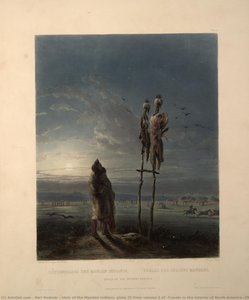 Idols of the Mandan Indians, plate 25 from volume 2 of `Travels in the Interior of North America' - Karl Bodmer
Born in Zurich in 1809, Karl Bodmer represents a unique intersection of Swiss precision and the sweeping grandeur of the Romantic era. His artistic foundation was laid under the guidance of his uncle, the engraver Johann Jakob Meier, whose influence instilled in him a meticulous command of draftsmanship. While his early career focused on the picturesque landscapes of the Rhine and Moselle valleys, his legacy was ultimately defined by a daring expedition to the American West alongside Prince Maximilian zu Wied-Neuwied.
Bodmer’s work is a vital part of the 19th century Swiss painters' tradition, as he transitioned from European topographical views to becoming a premier visual chronicler of the North American frontier. His approach blended the emotional depth of Romanticism with an almost scientific ethnographic accuracy. In his seminal work, Idols of the Mandan Indians (1844), Bodmer captures the profound spiritual essence of the Mandan people through a sophisticated aquatint technique. This method allowed him to achieve subtle tonal variations and a layered, atmospheric quality, immortalizing a complex culture and its sacred rituals with a level of detail that remains unparalleled in historical documentation.
Anton Graff
 Self-portrait of Anton Graff (1736-1813) - Anton Graff
Born in Winterthur, Switzerland, Anton Graff stands as a monumental figure whose career bridged the intellectual fervor of the Enlightenment and the emerging Neoclassical aesthetic of the 19th century. His journey from a humble student of Johann Ulrich Schellenberg to the prestigious position of court painter in Dresden illustrates a life defined by both technical mastery and social mobility. Graff’s ability to capture the psychological essence of the era's greatest minds—including Goethe and Schiller—cemented his reputation as a master of the intimate portrait.
His Self-portrait (1805) serves as a profound testament to this legacy. In this work, Graff moves away from the rigid formality of traditional court portraiture, opting instead for a naturalistic, eye-level perspective that invites the viewer into his private creative space. Through a sophisticated use of chiaroscuro, he highlights the textures of his cravat and the tools of his vocation, presenting himself not just as a craftsman, but as a dignified intellectual. As a Swiss-born artist whose influence and stylistic evolution shaped the visual language of the early 1800s, Graff remains a vital link in the lineage of 19th century Swiss painters."
Albert Anker
 Two Girls on the Stove Bench - Albert Anker
Albert Anker stands as a central figure among 19th century Swiss painters, having dedicated his life to capturing the soul of his homeland. Born in 1831 in Ins, Switzerland, Anker’s artistic journey was shaped by a rigorous academic foundation and a deep connection to Swiss traditions. After initial guidance in Neuchâtel, he pursued formal training under Louis Wallinger and later moved to Paris to study at the prestigious École nationale supérieure des Beaux-Arts under Charles Gleyre. This exposure to French Realism, combined with his early theological studies, allowed him to approach his subjects with both technical precision and a profound sense of human dignity.
His work is characterized by an extraordinary ability to elevate the mundane into the monumental, focusing on the quiet intimacy of rural life. A quintessential example of his mastery is “Two Girls on the Stove Bench” (1895). In this piece, Anker utilizes a sophisticated chiaroscuro effect, where the soft glow of the hearth contrasts against muted, dark tones to highlight the tranquil presence of the subjects. Through such realistic and warm portrayals, Anker secured his legacy as a master of Swiss genre painting.
Alexandre Calame
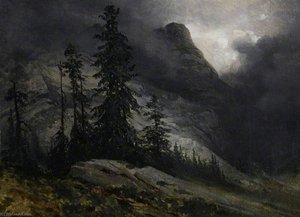 Storm at Handeck - Alexandre Calame
In his 1838 masterpiece, Storm at Handeck, Alexandre Calame captures the terrifying grandeur of the Bernese Alps, a work that epitomizes the Romantic fascination with the sublime. This painting serves as a profound encounter with nature's untamed power, where turbulent clouds and jagged massifs collide in a display of atmospheric drama. As a quintessential 19th century Swiss painter, Calame’s life and work were deeply rooted in the topography of his homeland, specifically the majestic landscapes of the Bernese Oberland.
Calame’s artistic journey, which saw him transition from a bank clerk to a celebrated figure of the Düsseldorf School, was defined by a meticulous devotion to the Alpine wilderness. Under the guidance of François Diday, he developed a sophisticated technique characterized by the use of layered glazes. This method allowed him to achieve a luminous, translucent quality in his palette, masterfully simulating the moisture-laden air and shifting light of mountain storms. His ability to blend expressive brushwork with precise atmospheric perspective allowed him to translate the immense scale of the Swiss peaks into emotive, tactile compositions that resonate with the raw energy of the natural world.
Conclusion
The 19th century was a transformative era for Swiss art, a period where the landscape shifted from the precise, romanticized views of the Alps to the profound psychological depths of Symbolism and the bold, rhythmic strokes of early Modernism. From the mythological dreamscapes of Arnold Böcklin and the dramatic, dark intensity of Henry Fuseli to the monumental, rhythmic compositions of Ferdinand Hodler, these artists collectively captured the soul of a nation and the evolving consciousness of Europe. Whether through the meticulous detail of Karl Bodmer's ethnographic studies or the intimate, domestic warmth found in the works of Albert Anker, this group of masters redefined how we perceive light, emotion, and the natural world.
At Mus3ums.com, we invite you to bring this rich heritage into your own living space. Our master artists specialize in creating museum-quality, hand-painted oil reproductions that honor the unique textures and brushwork of these Swiss masters. By choosing a custom commission or a fine art reproduction, you can transform your home or office with the timeless elegance of the 19th century. Explore our full collection and find the perfect masterpiece to live with you for generations.