

Introduction
The Spanish Baroque movement emerged from a profound intersection of intense religious fervor and the sophisticated courtly life of the Habsburg era. During the seventeenth century, the Iberian Peninsula became a crucible for a dramatic, theatrical style of painting that utilized tenebrism—the striking contrast between deep, enveloping shadows and piercing, singular light sources—to evoke profound emotion and spiritual ecstasy. This was an era where art served as a powerful tool for both the Catholic Counter-Reformation and the glorification of the Spanish monarchy, resulting in works that are as psychologically complex as they are visually arresting.
What unites these masters is a shared mastery of chiaroscuro and a commitment to a heightened sense of realism that transcends mere imitation. Whether capturing the quiet, ascetic devotion of a saint or the opulent, dignified presence of a royal portrait, these artists moved away from the idealized perfection of the Renaissance toward a more visceral, human experience. Their ability to manipulate light to direct the viewer's eye through complex diagonals and dramatic compositions created a sense of movement and tension that remains unparalleled in Western art history.
Today, the legacy of this period continues to resonate through its influence on modern cinematography and the psychological depth of contemporary portraiture. The works of these masters remain essential for understanding the evolution of light and shadow in the visual arts. In the following sections, we examine ten pivotal figures who defined this golden age, from the profound naturalism of Diego Velázquez to the intense, emotive brushwork of Jusepe de Ribera, tracing the lineage of a movement that transformed the canvas into a stage for the human soul.
Francisco de Zurbarán
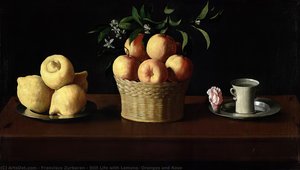 Still Life with Lemons, Oranges and Rose - Francisco de Zurbarán
Francisco de Zurbarán stands as a preeminent figure of the Spanish Baroque, a master whose work epitomizes the movement's profound use of tenebrism. His paintings are instantly recognizable by their intense, dramatic contrasts between deep, enveloping shadows and a singular, piercing light that carves subjects out of the darkness. This technique creates a sense of monumental stillness and spiritual weight, a hallmark of the Baroque era's theatricality.
Born in 1598 in Fuente de Cantos, Zurbarán’s technical precision was forged through an apprenticeship with Pedro Díaz de Villanueva in Seville. His ability to render the physical world with tactile realism allowed him to elevate both religious subjects and mundane objects into profound meditations. In his Still Life with Lemons, Oranges and Rose, this mastery is on full display. The composition captures a harmonious arrangement of fruit and delicate petals against a dark background, where the light dances across glossy citrus skins and velvety textures. Through precise brushwork and a keen eye for detail, Zurbarán transforms a simple tea setting into a serene, three-dimensional experience, embodying the quiet elegance and intense realism that defined the Golden Age of Spanish art.
Diego Velázquez
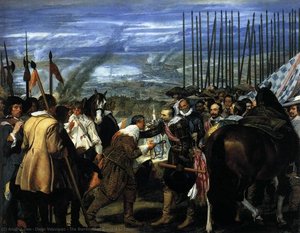 The Surrender of Breda (Las Lanzas) - Diego Velázquez
A titan of the Spanish Baroque, Diego Velázquez (1599–1660) redefined the boundaries of realism and courtly dignity. Born in Seville, his technical foundation was laid under the mentorship of Francisco Pacheco, a period of rigorous training that shaped his profound understanding of proportion and light. His ascent from the quiet, detailed observations of his early Seville years—seen in works like The Waterseller of Seville—to the epicenter of power in Madrid, marked a transformative era for Spanish art. By 1623, his talent had secured him a lifelong position within the royal service of King Philip IV, cementing his role as the preeminent chronicler of the Spanish crown.
Velázquez’s mastery of the Baroque movement is most evident in his ability to balance dramatic tension with psychological depth. In his monumental work, The Surrender of Breda (1634), he eschews mere historical documentation for a sophisticated exploration of honor and grace. Through an alla prima technique characterized by loose, vibrant brushwork and a muted, earthy palette, he captures the essence of form and texture without relying on excessive detail. His command of light and composition places him at the pinnacle of the Spanish Baroque, influencing generations of artists through his unparalleled ability to render the human condition with profound dignity.
Bartolomé Esteban Murillo
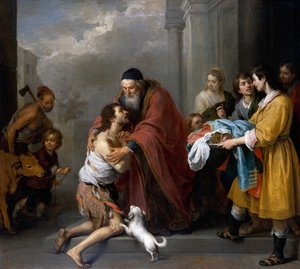 Return of the Prodigal Son - Bartolomé Esteban Murillo
Born in Seville in 1617, Bartolomé Esteban Murillo emerged from a challenging childhood to become one of the most beloved figures of the Spanish Baroque. After being orphaned at a young age, he found stability within the household of his sister and stepfather, eventually entering the workshop of his uncle and godfather, Juan del Castillo. This early training provided the technical foundation for a career that would define the softer, more emotive side of the Spanish Baroque movement.
While many of his contemporaries focused on the heavy, somber realism characteristic of the era, Murillo’s style underwent a profound evolution. He transitioned from the gravity of his early years toward a luminous, vaporous technique, utilizing delicate glazes to create a sense of divine radiance. His masterpiece, Return of the Prodigal Son (1670), exemplifies this mastery of light and shadow. In this poignant work, Murillo uses the dramatic tension of the Baroque to explore themes of redemption and paternal love, capturing the emotional depth of the biblical reunion through a sophisticated interplay of light that seems to emanate from within the canvas itself.
Juan de Valdés Leal
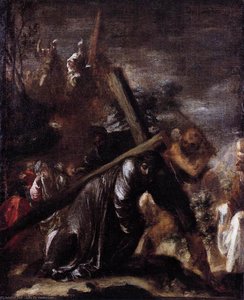 Carrying the Cross - Juan de Valdés Leal
A visitor encountering a work by Juan de Valdés Leal is immediately struck by a sense of profound, theatrical melancholy. His canvases reject the serene for the visceral, utilizing a dramatic chiaroscuro that plunges compositions into deep, espresso-toned shadows to highlight moments of intense spiritual or physical agony. As a quintessential figure of the Spanish Baroque, his style is defined by this preoccupation with the vanitas—the unsettling, monumental meditation on mortality and the fleeting nature of existence that characterized the era's religious fervor.
Born in Seville in 1622, Valdés Leal’s technical foundation was forged under the guidance of Antonio del Castillo in Córdoba before he returned to his birthplace to establish a prolific artistic household. His mastery of oil on canvas is perhaps most poignantly captured in his 1661 work, Carrying the Cross. In this piece, the artist employs masterful light and shadow to sculpt the suffering of Christ, using dynamic movement and muted, earthy tones to transform a biblical narrative into an immersive, emotional experience. His brushwork does not merely depict a scene; it evokes a palpable sense of pathos, ensuring his place as a master of the dramatic Baroque tradition.
Jusepe de Ribera
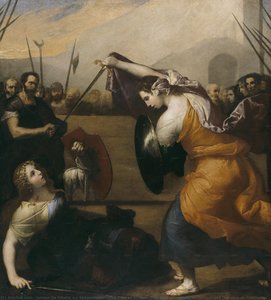 The Duel of Women (The Duel of Isabella de Carazzi and Diambra de Pettinella) - Jusepe de Ribera
Known throughout Italy as Lo Spagnoletto, Jusepe de Ribera stands as a titan of the Spanish Baroque movement. His work is instantly recognizable by its unflinching realism and a profound mastery of tenebrism. Unlike the more idealized compositions of his contemporaries, Ribera’s canvases are defined by a visceral, tactile quality, where thick impasto and dramatic chiaroscuro sculpt human forms out of deep, impenetrable shadows. His ability to capture the raw complexity of the human condition—from the grit of a martyr's skin to the tension of a battlefield—marks him as a central figure in the Spanish artistic tradition, bridging the gap between his Valencian origins and the vibrant Neapolitan school.
In his monumental 1636 work, The Duel of Women (The Duel of Isabella de Carazzi and Diambra de Pettinella), Ribera exemplifies the theatricality of the Baroque era. The composition is a masterclass in kinetic energy, utilizing sharp diagonals and a pyramidal structure to draw the viewer into a moment of intense conflict. Through a sophisticated interplay of light and shadow, he elevates a scene of historical rivalry into a profound study of power and resistance, ensuring his legacy as a master of dramatic intensity.
Antonio Del Castillo Y Saavedra
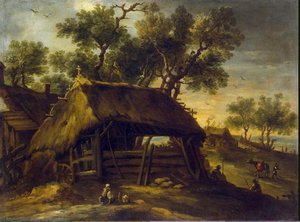 Landscape with Huts - Antonio Del Castillo Y Saavedra
A prominent figure of the Spanish Baroque, Antonio del Castillo y Saavedra (1616–1668) bridged the gap between religious devotion and the evocative power of the natural world. Born in Córdoba, his artistic lineage is deeply rooted in the masters of the Golden Age; he refined his technique under the guidance of his uncle, Juan del Castillo, and the legendary Francisco de Zurbarán. This training instilled in him a profound ability to manipulate light and shadow, a hallmark of the Baroque movement, which he utilized to imbue his compositions with intense emotional depth and a sense of theatrical presence.
His mastery is vividly realized in Landscape with Huts (1650), a work that transcends simple topographical recording. In this piece, Castillo employs a sophisticated chiaroscuro to capture the heavy, atmospheric quality of the Spanish countryside. The composition guides the eye through a series of rolling hills and modest, thatched-roofed dwellings, using a palette of deep, earthy tones to create a mood of quiet contemplation. Through his ability to balance dramatic lighting with a sensitive touch for texture, Castillo remains a vital voice in the history of Spanish Baroque painting.
Juan Carreño de Miranda
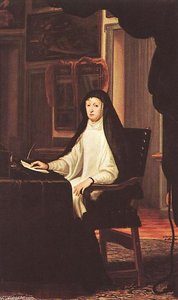 Queen Mariana de Austria as a Widow - Juan Carreño de Miranda
A hallmark of Juan Carreño de Miranda’s artistry is the ability to infuse royal portraiture with a profound sense of psychological depth and quietude. As a central figure in the Spanish Baroque movement, his work is characterized by a sophisticated mastery of light and a refined, elegant brushwork that echoes the influence of Diego Velázquez. Unlike the more aggressive chiaroscuro found in some of his contemporaries, Carreño de Miranda often employs a soft, directional light that models forms with grace, creating a sense of atmosphere that is both theatrical and deeply contemplative.
His technical command is perhaps most evident in Queen Mariana de Austria as a Widow. In this 1669 masterpiece, the artist moves beyond mere likeness to capture a state of spiritual resignation. The textures of the subject's habit and the delicate handling of light across the scene demonstrate the high aesthetic standards of the Spanish court. Born in Avilés in 1614 and trained in Madrid under masters like Pedro de las Cuevas, his journey from an apprentice to a significant court painter allowed him to define the visual language of the Spanish Golden Age through his ability to balance regal dignity with human vulnerability.
Claudio Coello
 Virgin and Child Adored by St Louis, King of France - Claudio Coello
Claudio Coello (1642–1693) stands as a pivotal figure in the Spanish Baroque, serving as a bridge between the grandiosity of the High Baroque and the emerging lightness of the Rococo. A master of courtly splendor, Coello’s style is defined by a sophisticated use of rich, vibrant color palettes and complex, theatrical compositions that demand the viewer's attention. His work is instantly recognizable through its ability to blend the dramatic chiaroscuro of the Spanish tradition with the luminous, painterly textures he absorbed from the royal collections of Titian and Rubens.
His technical brilliance is most profoundly realized in “Virgin and Child Adored by St Louis, King of France” (1668). In this monumental tableau, Coello demonstrates his capacity for visual storytelling, utilizing deep reds and golds to create an atmosphere of regal piety. The composition is characterized by:
- Luminous Depth: A masterful application of soft light that lends an ethereal quality to the central figures.
- Dynamic Grandeur: A complex arrangement of saints, angels, and royalty that creates a sense of divine movement.
- Textural Richness: A meticulous attention to detail in the drapery and skin tones, showcasing his academic training under Francisco Rizi.
Juan de Arellano
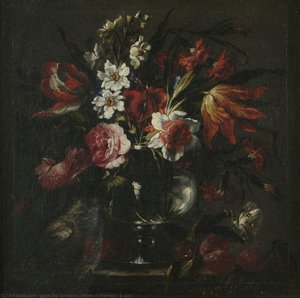 Vase of flowers, a pair - Juan de Arellano
While many of his contemporaries focused on the grand religious narratives and intense martyrdoms characteristic of the Spanish Baroque, Juan de Arellano (1614–1676) carved a unique niche by mastering the silent, elegant language of botanical splendor. Born in Santorcaz, near Madrid, Arellano’s work represents a sophisticated intersection of Spanish sensibility and the lush, ornamental traditions of the Flemish and Italian schools. He emerged as a specialist in floral still lifes, a choice that allowed him to explore the ephemeral grace of nature with unparalleled precision.
His technical mastery is defined by a profound use of chiaroscuro, where luminous highlights dance across petals to emerge from velvety, deep shadows. This dramatic interplay of light and dark is perfectly exemplified in his representative work, Vase of Flowers, a Pair. In this composition, Arellano achieves a level of botanical accuracy that borders on the scientific, yet he imbues every rose, tulip, and lily with a poetic, theatrical soul. By absorbing the meticulous detail of Flemish masters and the light-drenched compositions of Italian painters, Arellano became a cornerstone of seventeenth-century still life, transforming simple bouquets into opulent, staged spectacles of life and light.
Alonso Cano
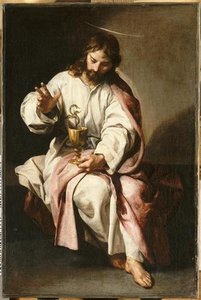 Saint Jean Evangeliste et la coupe empoisonnée - Alonso Cano
A true polymath of the Spanish Golden Age, Alonso Cano (1601–1667) stands as a singular figure whose mastery spanned painting, sculpture, and architecture. Born in Granada, his artistic foundation was built upon the structural principles of architecture inherited from his father, Miguel Cano. His evolution into a premier figure of the Spanish Baroque was solidified through his studies under Francisco Pacheco, the esteemed mentor of Velázquez, which infused his canvases with a profound sense of spiritual luminosity and dramatic tension.
Cano’s work is defined by an extraordinary ability to capture the divine within the human form, blending the anatomical grace of his sculptural training under Juan Martínez Montañés with a painterly sensitivity to light. His representative masterpiece, Saint Jean Evangeliste et la Coupe Empoisonnée, exemplifies the theatricality of the Baroque era. In this striking tableau, Cano utilizes dramatic lighting and intense emotion to depict the young Saint John in a moment of profound moral and spiritual peril. Through his ability to evoke deep religious devotion and navigate the complexities of human vulnerability, Cano remains a vital pillar of the Spanish Baroque movement.
Conclusion
The Spanish Baroque was a period of profound emotional intensity, defined by the dramatic interplay of light and shadow that transformed canvas into a theatrical stage. From the profound spiritualism of Zurbarán and the masterful psychological depth of Velázquez to the tender, humanistic grace of Murillo, these artists collectively shaped a visual language of unparalleled gravity and movement. Whether through the stark chiaroscuro of Ribera or the intricate compositions of Coello and Arellano, this movement captured the very essence of the human soul and the divine, leaving a legacy that continues to resonate through the halls of history.
For those seeking to bring this era of dramatic grandeur into a contemporary setting, our full collection offers a curated selection of these masters. At Mus3ums.com, we honor this heritage through meticulous, museum-quality hand-painted oil reproductions. Each piece is crafted by expert artists on 100% cotton canvas, ensuring that the tactile depth, visible brushstrokes, and rich tonal ranges of the original Spanish masters are preserved for your home or professional space.