The Brutality of the Mannerist Vision
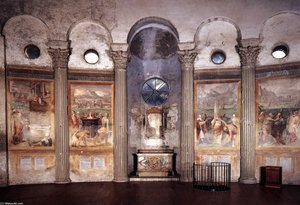
To look at the work of Niccolò Circignani is to confront the visceral reality of late-Renaissance and Mannerist tension. He was not interested in mere decoration; he focused on the heavy, often gruesome weight of religious narrative. His name, often eclipsed by his nickname Il Pomarancio, carries the mark of a painter who understood how to use elongated proportions and complex compositions to drive home a point. In the church of San Stefano Rotondo in Rome, his presence is felt through over thirty graphic scenes of martyrdom. These are not polite religious images. They depict every gruesome method of execution with an insistence on cruel detail that famously unsettled even casual observers like Charles Dickens. He used the human form as a vehicle for shock.
His technical approach relied on a sophisticated use of light and a mastery of medium, ranging from frescoes to sanguine drawings. In his hands, the bodies of saints were not just symbols but subjects of intense physical struggle. This was a calculated aesthetic choice. By emphasizing the mechanics of torture—the stretching upon the rack or the searing heat of the stake—he forced the viewer into a direct, uncomfortable engagement with the subject matter.
A Career Forged in Rome and Umbria
Circignani’s trajectory was defined by his movement between the major artistic hubs of Italy. Born in Pomarance, he brought a specific regional identity to the larger stages of Rome, Orvieto, and Città di Castello. His early training under Daniele da Volterra and later Santi di Tito provided him with the structural foundations of the Florentine and Roman Mannerist styles. This education allowed him to navigate high-stakes commissions with ease.
His professional life was marked by significant partnerships and heavy responsibilities:
- In 1564, he worked on Old Testament frescoes for the Vatican Belvedere.
- He entered a partnership with Hendrick van den Broeck in Perugia during the mid-1560s.
- His work extended to major altarpieces in Orvieto (1570), Umbertide (1572), and Città di Castello (1573–1577).
- He decorated the Sala della Meridiana in the Torre dei Venti within the Vatican around 1580.
The artist did not work in isolation. His career was intertwined with other significant figures of the period, including Giovanni de' Vecchi and Antonio Tempesta. This network of collaborators helped him maintain a presence in the most important religious and civic spaces of the late 16th century.
Evolution Toward Monumentality
As his career progressed, Circignani’s style underwent a visible shift. The frantic, often jagged energy of his early Mannerist period began to settle into something more unified. By the time he was working in Rome during the 1580s, particularly on the frescoes for the Jesuit churches like Il Gesù, his compositions moved toward a more monumental type of structure. This transition reflected the broader stylistic evolution occurring in post-Tridentine Italy, where the need for clarity and impact began to reshape religious art.
Despite this move toward a more stable composition, the intensity of his subject matter remained. Whether he was painting the Annunciation in Città di Castello or the Ascension in Cascia, the core of his work stayed rooted in a powerful, often heavy-handed delivery of sacred truth. He left behind a legacy that is less about grace and more about the undeniable, physical presence of the divine and the mortal struggle.
Spørgsmål og svar
Hvilke andre navne er Niccolò Circignani kendt under?
Niccolò Circignani er også kendt som Niccolo Circignani.
Hvor kommer Niccolò Circignani fra?
Niccolò Circignani blev født i Italy.
Hvilken by og hvilket land er Niccolò Circignani født i?
Niccolò Circignani blev født i Pomarance, i Italy.