


Introduction
The 20th century marked a transformative era for Australian art, as creators moved beyond colonial traditions to forge a visual language uniquely suited to their vast, often harsh, and luminous landscapes. This period saw a profound shift from mere topographical documentation toward deep psychological expression and the exploration of modernism. Bound by a shared sense of place and a desire to define a national identity, these artists grappled with the tension between European influences and the raw, elemental light of the Southern Hemisphere.
As the century progressed, the movement evolved from the impressionistic studies of the early decades into more radical forms, including cubist abstractions, social realism, and expressive figurative works. This evolution reflected a changing society, capturing everything from the quiet intimacy of domestic life to the gritty realities of urban expansion. The works of this era remain vital today because they represent the foundational dialogue of a modern nation, offering a window into how a distinct culture began to see itself through color, light, and form.
To understand this artistic evolution, one must look to the masters who defined the movement. The following selection explores ten pivotal figures—from the pioneers of modernism to the expressive masters of the mid-century—whose legacies continue to shape the aesthetic landscape of the continent.
William Dobell
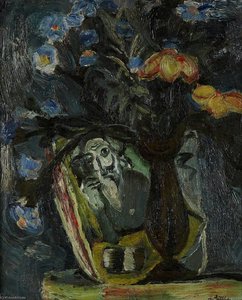 Still Life with Chagall Print - William Dobell
In the evocative Still Life with Chagall Print, created in 1933, we encounter a profound sense of melancholy and introspection. The composition, characterized by a palette of deep blues and yellows, juxtaposes vibrant floral arrangements with the weary, cloaked figure of an elderly man. This work exemplifies the artist's transition toward an Expressionistic style, where loose brushstrokes and a heavy impasto technique prioritize emotional resonance over strict realism.
As a defining figure of 20th century Australian painters, William Dobell's legacy is deeply intertwined with the evolution of modernism. His journey was shaped by significant European influences, including his studies under André Lhote in Paris and the imaginative color palettes of Paul Klee. These experiences allowed him to move beyond the rigid structures of Cubism toward a more expressive, tactile approach to his subjects. Whether capturing the essence of landscapes or the quiet drama of a still life, his work remains a testament to the transformative power of light and texture in mid-century art.
Frank Hinder
 Tram kaleidoscope - Frank Hinder
A true pioneer of the Australian modernist movement, Frank Hinder (1906–1992) redefined the visual language of his nation during the 20th century. His artistic journey, which began at the Julian Ashton Art School in Sydney, eventually led him to become a founding member of the Contemporary Art Society. Hinder’s versatility was perhaps most strikingly demonstrated during World War II, when he applied his keen sense of form and pattern to create essential camouflage designs for the war effort. This ability to manipulate shape and perception would become a hallmark of his later explorations in sculpture and painting.
His 1948 work, Tram Kaleidoscope, stands as a vibrant testament to this era of transformation. In this piece, Hinder captures the rhythmic, fractured energy of urban transit, turning a mundane commute into a swirling dance of geometry and light. By deconstructing the figures and the mechanical environment into a kaleidoscopic pattern, he moved beyond mere representation toward a sophisticated abstraction. This work exemplifies why Hinder remains a central figure among 20th century Australian painters: he successfully bridged the gap between traditional training and the radical, structural innovations of international modernism.
Charles Jones
 Tulip Couleur Cardinal - Charles Jones
In the delicate study Tulip Couleur Cardinal, created around 1910, we encounter the observant eye of Charles Jones. This work captures a botanical moment through a focused lens, where a deep, cardinal hue is held within the petals of the subject. The composition relies on strong tonal contrasts, using light to carve the rounded forms of the flowers out of a dark, shadowed background, creating a sense of dramatic, reflective depth.
Born in Burwood, Australia, in 1878, Jones’s contribution to the 20th century Australian art scene was unique. While he trained at the Julian Ashton Art School in Sydney and the Slade School of Fine Art in London, he ultimately transitioned from an aspiring professional artist to a pivotal patron and businessman. His influence on the Australian landscape was profound; he established the David Jones Art Gallery in 1944, a vital institution that championed local talent, including William Dobell. His commitment to the arts was further solidified through his publication, Art in Australia. Through his patronage and his own refined aesthetic sensibility, Jones helped foster the growth of the Australian artistic community during a transformative century.
Christine Lamson Dean
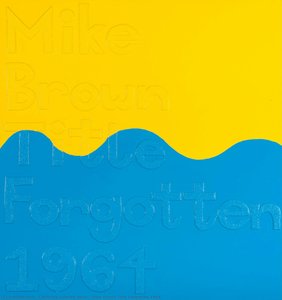 Mike Brown Title Forgotten 1964 - Christine Lamson Dean
A significant figure in the evolution of contemporary Australian abstraction, Christine Lamson Dean represents the sophisticated continuation of 20th-century modernist traditions. Born in Sydney in 1963, her artistic foundation was built through a Bachelor of Arts at the University of Sydney and a diploma from Sydney Teachers College. Her practice is deeply rooted in the legacy of late modernism, drawing intellectual and stylistic inspiration from the works of Margo Lewers, Lyndon Dadswell, and Frank and Margel Hinder.
Dean’s work is distinguished by a unique, poetic synthesis of text and abstraction. Rather than using language as a mere label, she integrates it as a structural and political element within her compositions. This is masterfully demonstrated in her representative work, Mike Brown Title Forgotten 1964. In this piece, a resonant blue field serves as a stage for bold yellow lettering, creating a graphic tension that bridges the gap between linguistic meaning and visual mystery. By merging the legible with the enigmatic, Dean explores the layers of memory and nomenclature, cementing her place as a vital voice in the lineage of Australian painters who redefined the boundaries of modernism.
Grace Cossington Smith
 Four panels for a screen: loquat tree, gum and wattle trees, waterfall, picnic in a gully - Grace Cossington Smith
A central figure in the evolution of Australian modernism, Grace Cossington Smith (1892–1984) redefined the nation's visual language through her vibrant, rhythmic approach to light and color. Her inclusion in the canon of 20th century Australian painters is cemented by her role as a pioneer of Post-Impressionism, a movement she helped introduce to the local scene with works like The Sock Knitter (1915). After studying under Antonio Dattilo Rubbo and being influenced by European modernist theories during her travels to England, she developed a highly distinctive technique characterized by mosaic-like, square brushstrokes and unblended, luminous colors.
Her ability to translate sensory experiences into structured, rhythmic compositions is masterfully displayed in her 1929 work, "Four panels for a screen: loquat tree, gum and wattle trees, waterfall, picnic in a gully." This expansive piece demonstrates her capacity to blend domestic intimacy with the wild Australian landscape, using light to guide the viewer through a botanical dreamscape. From the sun-drenched textures of her still lifes, such as Fruit in the Window, to the architectural light of The Lacquer Room, Smith’s legacy remains a testament to the transformative power of color in 20th century art.
Frederick McCubbin
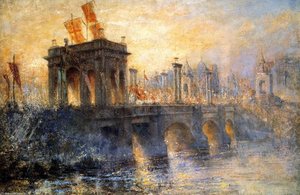 Princess Bridge - Frederick McCubbin
A cornerstone of the nation's visual identity, Frederick McCubbin remains a defining figure for 20th century Australian painters due to his profound influence on the Heidelberg School. His work bridged the transition from late 19th-century traditions into the early 20th century, establishing a uniquely local aesthetic that moved away from rigid European academicism toward a raw, authentic portrayal of the Australian spirit. By embracing plein air techniques, McCubbin captured the shifting light and rugged textures of the bush, helping to define the landscape of a developing nation.
In his 1908 masterpiece, Princess Bridge, this mastery of light and atmosphere is vividly realized. The scene captures a landmark of Melbourne bathed in the soft, golden glow of a late afternoon, evoking a sense of quiet contemplation and nostalgia. Through meticulous detail and a sophisticated use of tonal depth, McCubbin transforms a structural landmark into a poetic symbol of connection between urban life and the surrounding environment. His ability to infuse everyday scenes with such emotional resonance is what secures his legacy among the most significant artists of the Australian era.
John Brack
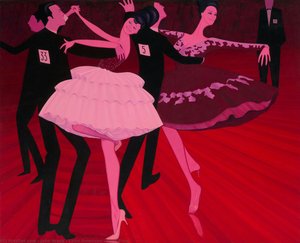 Latin American Grand Final - John Brack
In his 1969 work Latin American Grand Final, John Brack captures the intense, ritualistic tension of the ballroom. The painting depicts a central dancer mid-kick, her movement framed by sharp spotlights and draped costumes. Through heavy tonal gradations and a striking contrast between light and shadow, Brack transforms a high-stakes competition into a structured, almost psychological study of human performance and the masks worn during public spectacle.
A pivotal figure in 20th century Australian painting, Brack was born in Melbourne in 1920 and became a prominent member of the Antipodeans group. His work is defined by a sharp, succinct realism that moved away from the serene landscapes of earlier eras to focus on the idiosyncrasies of modern urban life. While contemporaries like Arthur Streeton sought the natural beauty of the landscape, Brack turned his gaze toward the social structures and daily rhythms of the city.
His mastery of contemporary realism is evident in his ability to document the energy of the era with precision. Whether capturing the bustling atmosphere of Collins St., 5 pm or the regulated elegance of a dance championship, Brack’s legacy lies in his profound ability to translate the essence of mid-century Australian life onto the canvas.
John Longstaff
 Mr Maurice Moscovitch - John Longstaff
A central figure in the evolution of Australian portraiture, John Longstaff (1861–1941) bridged the gap between traditional academicism and the shifting sensibilities of the early 20th century. His career, which spanned the transition into the modern era, is defined by a profound ability to capture the psychological weight of his subjects. Having studied at the Melbourne National Gallery School and later refined his technique in the ateliers of Paris, Longstaff brought a sophisticated European sensibility back to his homeland. This international exposure allowed him to master the interplay of light and shadow, a skill that would define his legacy as a five-time winner of the prestigious Archibald Prize.
In his 1925 work, Mr Maurice Moscovitch, we see the culmination of this mastery. This oil portrait of the Russian-born actor serves as a profound study in presence, utilizing a dramatic chiaroscuro to pull the sitter from a dark, indistinct void. The brushwork is purposeful and tactile, particularly in the impasto highlights that give the skin a lifelike texture. By capturing the contemplative gravity of the actor, Longstaff demonstrated why he remains a cornerstone of 20th century Australian painters, blending the dignity of Edwardian portraiture with a modern, painterly intensity.
Henry Lamb
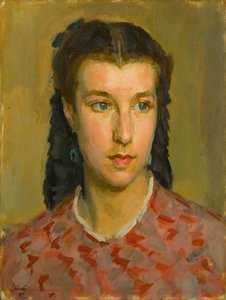 Manon - Henry Lamb
Born in Adelaide, Australia, in 1883, Henry Lamb represents a vital link between the Southern Hemisphere and the European avant-garde. His inclusion in this group of 20th century Australian painters is defined by his birth in the colony and his subsequent evolution into a master of the modern era. Though his creative journey took him from the intellectual circles of Manchester to the prestigious Chelsea School of Art under Augustus John, his Australian origins provided the foundational identity for a career that would bridge continents.
Lamb’s artistic temperament was marked by a decisive pivot from medicine to the fine arts, a transition that allowed him to capture the psychological essence of his subjects. This is profoundly realized in his 1946 portrait, Manon. In this work, Lamb moves beyond mere likeness to evoke the melancholic spirit of the Belle Époque. Through a meticulous layering of thin oil glazes, he achieves a luminous, almost internal glow, particularly in the rendering of the subject's hair. The painting demonstrates his ability to blend Post-Impressionist sensibilities with a refined, expressive line work, creating a sense of vulnerability and timelessness that defines his contribution to 20th-century art.
Rupert Bunny
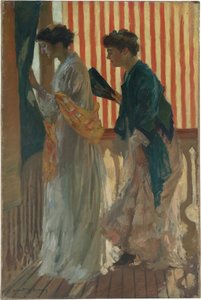 Who comes? - Rupert Bunny
Rupert Bunny represents a sophisticated bridge between Australian origins and the height of Parisian fin-de-siècle aestheticism. Born in St Kilda, Victoria, in 1864, his career flourished during the early 20th century, a period where his presence in the French art scene solidified his status as a premier expatriate talent. His inclusion in this group of 20th century Australian painters is defined by his ability to translate a classical, academic foundation—honed under masters like Laurens—into a luminous, symbolic language that captivated the European avant-garde.
A viewer recognizes a Bunny masterpiece through his sumptuous colorism and a profound sense of tranquil leisure. He frequently composed idyllic scenes featuring female figures in states of dreaming or repose, often set against the shimmering translucence of water. In his representative work, Who comes?, this mastery of light is palpable. Painted around 1908, the piece utilizes a striking interplay of light and shadow, where sunlight filters through striped blinds to illuminate flounced drapery, creating a sense of luxurious, quiet domesticity. His brushwork and palette evoke a romantic, dreamlike atmosphere that remains a hallmark of his enduring legacy.
Conclusion
The 20th century was a transformative era for Australian art, a period where the landscape and the human condition were reimagined through diverse lenses. From the expressive, often controversial portraiture of William Dobell to the vibrant, rhythmic compositions of Grace Cossington Smith, these artists collectively moved beyond mere representation to capture the unique light and spirit of their continent. Whether through the social realism of John Brack or the structural explorations of Frank Hinder, this group of painters redefined the visual language of a nation, blending international modernism with a deeply local sensibility.
For those looking to bring this rich heritage into their own living spaces, Mus3ums.com offers a way to honor these masters. We specialize in museum-quality, hand-painted oil reproductions that capture the authentic texture and soul of these iconic works. You can explore our full collection to find the perfect piece and invite the legacy of these great Australian painters into your home through our bespoke, artist-crafted canvases.


