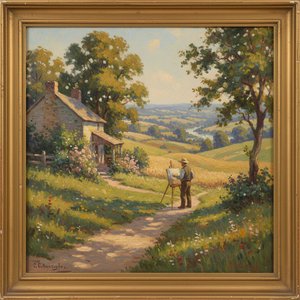
A Life in Color and Shadow
The life of John Henry Witt was one of quiet persistence, moving through the American landscape with the steady hand of a craftsman. Born in 1840, his early years were shaped by the formative training he received in Cincinnati, where he studied under Joseph Oriel Eaton at the age of eighteen. This period of instruction provided the technical foundation for a career that would eventually span from the riverbanks of the Midwest to the bustling studios of New York City. His path was not always a straight line toward acclaim; there were years of practical labor, including a stint as a photographer's tinter, a role that required a keen eye for light and subtle tonal shifts.
By the time he settled in Columbus, Ohio, in 1862, Witt had begun to find his footing. His early efforts were marked by a focus on Biblical themes, such as his first significant work, Rebecca at the Well. This period of his life was characterized by a search for subject matter that could sustain a professional practice, moving from religious narratives toward the more secular demands of portraiture and landscape.
The Breadth of a Working Artist
Witt’s output was diverse, reflecting the varied needs of his patrons and the shifting interests of the mid-to-late nineteenth century. He was a painter of many modes, capable of shifting his focus from the intimate details of a still life to the expansive reach of a landscape. His technical versatility allowed him to navigate different markets, from the private commissions of individuals to the formal requirements of state institutions.
- Portraiture, including thirteen gubernatorial portraits commissioned for the Ohio House.
- Landscape painting, capturing the natural world in various settings.
- Genre scenes, depicting everyday human activity.
- Still-life compositions, focusing on the arrangement of objects.
- Religious subjects, particularly in his early career.
His reputation grew through steady, reliable work. In 1865, he received an award at the Ohio State Fair for his oil painting, a recognition that signaled his rising standing among his peers. He was also a man of instruction, passing his knowledge to students such as Silas Martin and James Henry Moser, ensuring that his technical approach survived through his pupils.
The New York Years and Finality
The latter part of Witt's life was centered in New York City, a move he made around 1877 or 1878. In this urban environment, he became a regular contributor to the Academy Annuals, exhibiting his work at the National Academy of Design until 1899. This period represented the culmination of his professional life, a time when he was a recognized presence in the American art scene, even if he remained somewhat of a private figure to his contemporaries. He died in New York City in 1901, leaving behind a body of work that captured the evolving spirit of a developing nation.
Ερωτήσεις και Απαντήσεις
Από πού προέρχεται ο/η John Henry Witt;
Ο/Η John Henry Witt γεννήθηκε στην/στη Ireland.
Με τι άλλα ονόματα είναι γνωστός/η ο/η John Henry Witt;
Ο/Η John Henry Witt είναι γνωστός/η επίσης ως John Witt, John Henry Harrison Witt, John Harrison Witt, Witt.
Πού και πότε γεννήθηκε ο/η John Henry Witt;
Ο/Η John Henry Witt γεννήθηκε στην/στη Dublin το 1840.