The Life and Training of Niels Møller Lund
Niels Møller Lund enters the scene in 1863. Born in Faaborg-Midtfyn Municipality, Denmark, his early years are shaped by a movement away from his Scandinavian roots toward the industrial pulse of the United Kingdom. He grows up in Newcastle-upon-Tyne, a setting that provides the foundational landscape for his later focus on the North-East of England.
The trajectory of his training takes him from the English coast to the heart of the European art scene. He travels to Paris to study at the Académie Julian. Here, the discipline of formal training meets the shifting currents of late 19th-century aesthetics. This period of study provides the technical grounding for a career spent capturing the atmosphere of British life and the specific light of the English landscape.
Artistic Style and Technique
Lund operates at the intersection of Impressionism and Romanticism. He moves away from rigid, precise representation to prioritize the emotional resonance of a scene. His focus remains fixed on the fleeting qualities of light and atmosphere, attempting to pin down a specific moment before the weather shifts. This approach is particularly evident in his depictions of the English landscape, where he captures the shifting moods of the North-East and the urban sprawl of London.
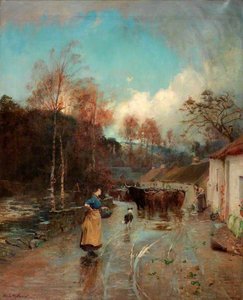
The physical application of paint is deliberate and textured. He employs loose brushstrokes that allow the surface of the canvas to feel active, rather than static. Subtle tonal variations create depth, allowing light to appear as if it is moving through mist or reflecting off damp surfaces. In works like After Rain, the technique emphasizes the heavy, moisture-laden air of a rainy day, using color to suggest temperature and humidity rather than just outlining shapes.
His method relies on the interplay between shadow and illumination to define form. Instead of sharp outlines, he uses the weight of color to establish the silhouette of a subject against the sky. This technique allows for a sense of movement within his landscapes, capturing the transient nature of the natural world through a controlled, expressive hand.
Notable Works and Subjects
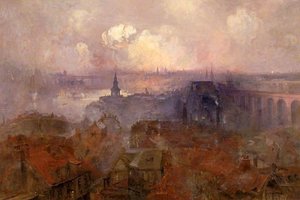
The landscape of the British North-East and the urban sprawl of London provide the primary settings for his most significant compositions. In 1892, he produced After Rain, a work that captures the specific atmosphere of a damp, post-precipitation environment. His interest in the industrial and urban character of the North-East is evident in his depictions of Newcastle upon Tyne, specifically in Newcastle upon Tyne from Gateshead and Newcastle upon Tyne from the East. These works focus on the structural presence of the city as viewed from across the water.
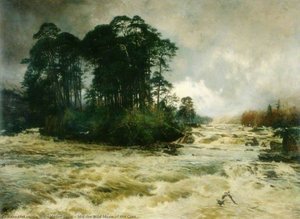
A shift toward more dramatic, historical, or monumental subjects appears in his varied output. He rendered Attack on the Japanese Battery at Shimonoseki, September 1864, a scene of military engagement. His most recognized work, The Heart of the Empire, captures the urban density of London. This painting focuses on the architectural and social weight of the city, specifically the area around Threadneedle Street. His earlier work, Mid the Wild Music of the Glen, was created about 1888 and presents a serene, natural scene featuring a man on horseback amidst lush vegetation and rocks.
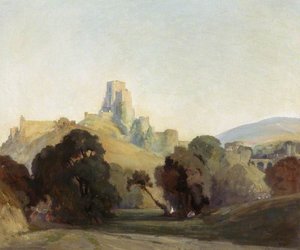
The silhouette of Corfe Castle in Dorset becomes a recurring focal point in his later career. He focused heavily on this location, producing a series of paintings that emphasize the castle's imposing presence against the sky. One such work, Corfe Castle, Dorset, dates to about 1909. These studies often utilize stormy skies to heighten the sense of scale and isolation within the landscape.
- Attack on the Japanese Battery at Shimonoseki, September 1864
- Mid the Wild Music of the Glen, about 1888
- After Rain, 1892
- The Heart of the Empire, 1904
- Corfe Castle, Dorset, about 1909
Where to See His Works Today
His presence in public collections remains anchored in the landscapes and urban scenes of the United Kingdom. In London, the Guildhall Art Gallery holds "The Heart of the Empire," a work that once provided the visual basis for other interpretations of Threadneedle Street. This piece remains a central part of the city's artistic record.
The North of England preserves a significant portion of his output. The Laing Art Gallery in Newcastle upon Tyne houses several of his paintings, including views of the Tyne from both Gateshead and the East. His connection to this region is deep, with his brushstrokes still visible in the halls of the Laing. Meanwhile, the National Museum of the Royal Navy in Portsmouth maintains a record of his more historical subjects, holding a painting of the attack on the Japanese Battery at Shimonoseki.
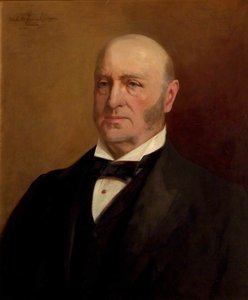
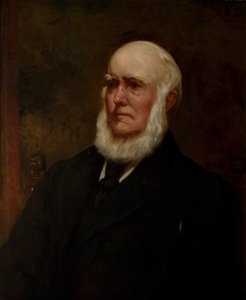
Further west, the Derry City Council in Londonderry maintains two of his works within its collection. These pieces, alongside the portraits of Joseph Cook and John Cooke, represent the breadth of his engagement with individual subjects and the social fabric of the era.
Ερωτήσεις και Απαντήσεις
Πού και πότε γεννήθηκε ο/η Niels Møller Lund;
Ο/Η Niels Møller Lund γεννήθηκε στην/στη Faaborg-Midtfyn Municipality το 1863.
Σε ποια ιστορική περίοδο δραστηριοποιήθηκε ο/η Niels Møller Lund;
Ο/Η Niels Møller Lund δραστηριοποιήθηκε κατά την περίοδο του/της 19th Century. Η συγκεκριμένη εποχή τοποθετεί τη δραστηριότητα του/της καλλιτέχνη/στη στην ιστορία.
Με τι άλλα ονόματα είναι γνωστός/η ο/η Niels Møller Lund;
Ο/Η Niels Møller Lund είναι γνωστός/η επίσης ως Niels Moller Lund, Niels Moeller Lund.